Copper has a reputation as the metal with a PhD in economics: its price is said to anticipate global growth. In 2026 it went one way while the metals investors buy for safety went the other.
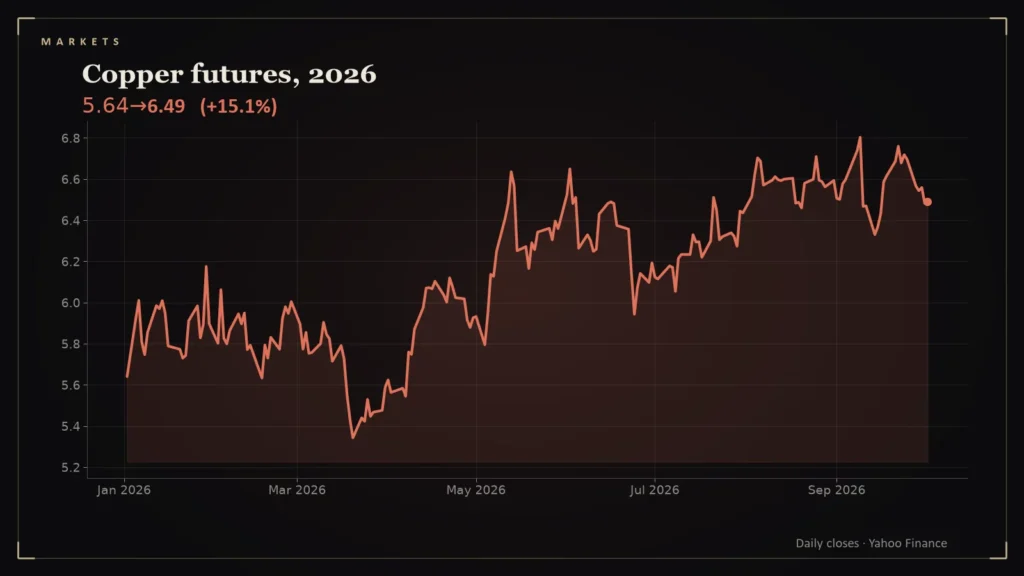
- Copper futures were $5.63 at the end of 2025, hit a 2026 low of $5.34 on March 20, a high of $6.80 on September 9, and ended near $6.49 on October 2, up about 15 percent for the year [1].
- Over the same period gold was down about 3.8 percent and silver about 13 percent for the year [2][3].
- Copper is an industrial metal; gold is a monetary one, so the divergence says markets are pricing growth and infrastructure demand differently from fear [1][2].
- AI data centers and grid builds are a commonly cited source of copper demand, but the price data alone do not prove it.
The path
Yahoo Finance data show copper futures ending 2025 at $5.63 per pound, falling to $5.34 on March 20, climbing to a 2026 high of $6.80 on September 9, and closing near $6.49 on October 2, a gain of about 15 percent for the year [1]. That is a trend that began just before the broader stock-market low on March 30.
The contrast with gold and silver
Gold peaked at $5,318.40 on January 29 and is about 3.8 percent lower for the year; silver is about 13 percent lower after a 47 percent drop from its high [2][3]. When copper rises and gold falls together, markets are generally saying that growth and building matter more than fear does, or that rising real yields are a bigger drag on non-yielding monetary metals than on industrial ones.
The demand story
Analysts often point to electrification, grid expansion and data-center construction as structural sources of copper demand, and the 2026 capital-spending guidance of up to $205 billion at Alphabet and $190 billion at Microsoft is consistent with that story [4]. Supply matters too, since mines take years to open. The price series cannot tell us which factor dominated, only that the market paid more.
How the year unfolded
The close at the peak was $6.80 a pound on 9/09, and the October 2 close of $6.49 was 4.6 percent below it [1]. Copper closed at or above $6.50 on 40 of the 190 sessions in 2026 through October 2 [1] (my calculation). The copper-to-gold ratio, copper dollars per pound times 1,000 divided by the gold price, went from 1.30 on the first session to 1.56 on October 2, as copper rose and gold fell [1][2].
Demand explanations deserve caution. Digital-infrastructure spending is one source of copper demand, and the capital-spending guidance of the biggest technology companies, described in the July reports, is large [4]. China’s sharply reduced crude imports in the second quarter are a reminder that the same country’s demand moves many commodity markets [5]. But the price series cannot tell us how much of copper’s move came from data centers, grids, supply disruptions or speculation.
What could change it
- China: the largest buyer of copper has also been cutting energy imports [5].
- Rates: a 10-year yield above 5 percent weighs on construction and capital spending.
- Tariffs: trade measures can distort copper flows regionally.
Copper’s strength is a quieter signal than gold’s weakness, but it points the same direction: in 2026, markets rewarded the things that get built over the things that get hoarded. This is analysis, not investment advice.
Questions readers ask
How has copper performed in 2026?
Up about 15 percent for the year through October 2, with a high of $6.80 on September 9 and a low of $5.34 on March 20 [1].
Why does copper matter as an economic signal?
It is an industrial metal used in construction, wiring and electronics, so its price is often read as a signal of growth demand.
References
- Copper Futures (HG=F) Historical Prices — Yahoo Finance — https://finance.yahoo.com/quote/HG%3DF/history/
- Gold Futures (GC=F) Historical Prices — Yahoo Finance — https://finance.yahoo.com/quote/GC%3DF/history/
- Silver Futures (SI=F) Historical Prices — Yahoo Finance — https://finance.yahoo.com/quote/SI%3DF/history/
- AI investment worries spread after Alphabet capex hike; Amazon, Microsoft, Meta also face scrutiny — Digital Today — https://www.digitaltoday.co.kr/en/view/86477/ai-investment-worries-spread-after-alphabet-capex-hike-amazon-microsoft-meta-also-face-scrutiny
- China's crude oil imports fell in the second quarter — U.S. Energy Information Administration — https://www.eia.gov/TODAYinENERGY/detail.php?id=67905