The market’s relationship with AI spending has had two moods. In 2024 and 2025, announcing more was good news. In 2026 it became a stress test, and the reaction swung on the day.
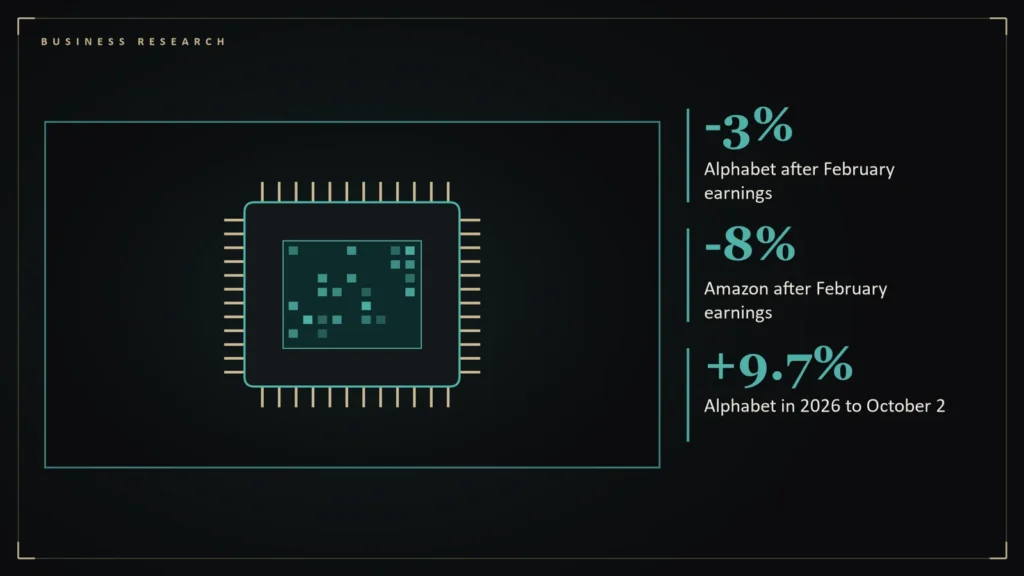
- After February 2026 earnings, Alphabet fell about 3 percent and Amazon more than 8 percent; JPMorgan warned of “meaningful free cash flow burn” at Amazon [1].
- After Alphabet’s July 24 capex increase, its shares fell 7 percent, and Amazon, Meta and Microsoft also declined [2].
- By October 2, Alphabet was up about 9.7 percent for 2026, Amazon about 9.0 percent, Meta about 10.3 percent and Microsoft about 7.0 percent [3].
- The pattern: short-term punishment for capex surprises, longer-term focus on whether growth arrives.
February: the first flinch
After fourth-quarter earnings in February, CMC Markets reported, both Alphabet and Amazon sold off despite strong fundamentals. Alphabet fell about 3 percent, while Amazon dropped more than 8 percent after its call; downgrade and price-target cuts followed, with JPMorgan warning of “meaningful free cash flow burn,” though analysts acknowledged the spending was “strategically justified given strong customer demand” [1].
July: the second wave
After Alphabet raised its 2026 capex range to as high as $205 billion on July 24, its shares fell 7 percent, and Amazon, Meta and Microsoft shares also declined. The analysis noted that markets had treated AI infrastructure investment as a growth signal and had begun weighing the cash drain against uncertain returns [2].
The longer view
Price history through October 2 shows the sell-offs did not define the year. Alphabet was up about 9.7 percent for 2026, Amazon about 9.0 percent, Meta about 10.3 percent and Microsoft about 7.0 percent [3]. Amazon’s low for the year, $198.79, came on February 13, right after that earnings reaction, and it traded as high as $284.02 on August 3 [3].
July 24 in the price data
The closing prices show the cluster of declines on July 24: Alphabet +0.6 percent, Amazon -0.7 percent, Meta -1.8 percent and Microsoft +0.0 percent on the day (my calculation from daily closes) [3]. The analyst Mark Mahaney of Evercore ISI was quoted saying that Alphabet’s higher capital spending increases the likelihood that Amazon and Microsoft will make similar decisions, which is the logic that dragged the others down with it [2].
The February reaction had the same structure. Alphabet fell about 3 percent and Amazon more than 8 percent after their results, and chip suppliers Qualcomm and Arm each lost more than 9 percent on the day of Alphabet’s report, evidence that the market treated the capital-spending guidance as news for the whole chain [1]. Amazon’s 2025 capital spending was about $131 billion against a consensus of $146.6 billion before the new guidance, a reminder that expectations had been moving as well [1]. Both episodes ended in recoveries: by October 2 all four stocks were up for the year [3].
What the pattern says
Markets react to guidance in hours and to results in quarters. A capex increase is a cost the market sees at once and a benefit it has to wait to measure. Investors who sold on the day lost out when cloud growth stayed strong, which suggests the reaction function was about the speed of the spending, not about its direction. The next test comes when the spending stops accelerating, or when the revenue stops. This is analysis, not investment advice.
Questions readers ask
How did Amazon stock react to its February 2026 earnings?
It fell more than 8 percent after the call as investors reacted to a large capex increase, per CMC Markets [1].
How have Big Tech stocks done in 2026 overall?
Through October 2, Alphabet was up about 9.7 percent, Amazon 9.0, Meta 10.3 and Microsoft 7.0 [3].
References
- Magnificent 7 Earnings, Part 2: Massive AI Capex — CMC Markets — https://www.cmcmarkets.com/en/optox/magnificent-7-earnings-part-2-massive-ai-capex
- AI investment worries spread after Alphabet capex hike; Amazon, Microsoft, Meta also face scrutiny — Digital Today — https://www.digitaltoday.co.kr/en/view/86477/ai-investment-worries-spread-after-alphabet-capex-hike-amazon-microsoft-meta-also-face-scrutiny
- Yahoo Finance historical prices for AMZN, GOOGL, META and MSFT — https://finance.yahoo.com/quote/AMZN/history/