The U.S. has a law for stablecoins and not yet a law for everything else in crypto. The bill that would finish the job is stuck at the last hurdle, and the reasons are specific.
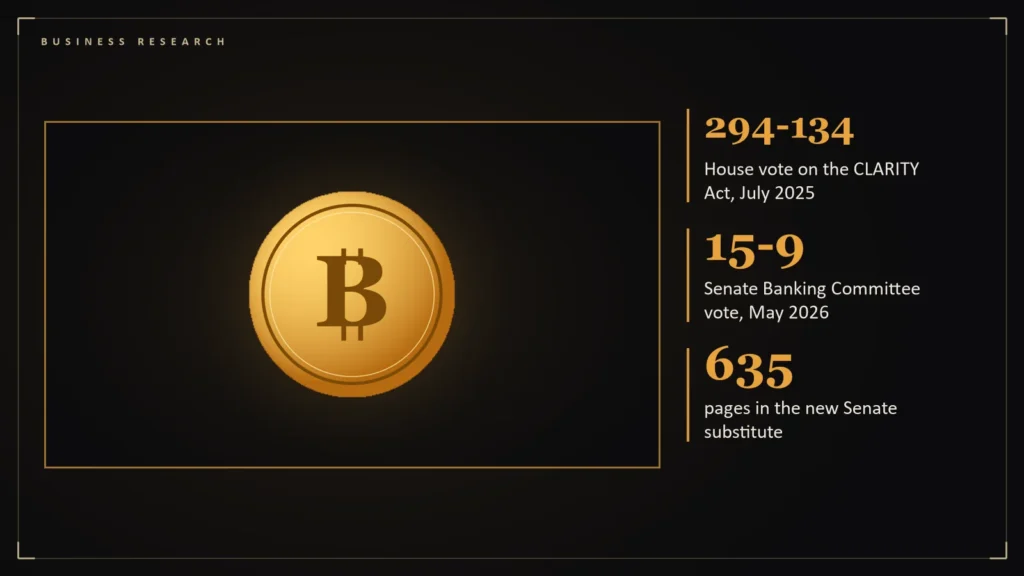
- The CLARITY Act passed the House 294-134 on July 17, 2025 and the Senate Banking Committee 15-9 on May 14, 2026, but has not been signed into law [1].
- On August 8, 2026 the Senate filed a cloture motion on the motion to proceed, falling short of Majority Leader Thune’s pledge of a vote before the August recess [1].
- On September 13, Senate Republicans released a new 635-page substitute amendment, restarting text negotiations [1].
- Passage needs 60 votes; Republicans need at least seven Democratic crossovers, and committee support suggests only two are committed [1].
The timeline
The Digital Asset Market Clarity Act passed the House 294-134 on July 17, 2025, and cleared the Senate Banking Committee 15-9 on May 14, 2026. As of September 27, it had not been signed into law and remained at the Senate floor stage [1].
Senate Majority Leader John Thune promised on August 3 a floor vote before the August recess. On August 8 the Senate filed a cloture motion on the motion to proceed, a procedural step that limits debate but is not a final vote, so the promise fell short [1]. On September 13 Senate Republicans released an entirely new 635-page substitute amendment, effectively restarting text negotiations rather than voting on existing language [1].
The vote count
Passage requires 60 votes. Republicans alone cannot reach that, so at least seven Democrats must cross over. The committee vote suggests only two are committed so far [1].
The three blocking disputes
- Ethics. Democrats demand permanent conflict-of-interest rules. A July 22 draft offered a temporary ban, sunsetting January 20, 2029, on federal officials issuing digital assets, and it applied only going forward [1].
- DeFi developer liability. The bill shields non-custodial developers, which the industry supports and some Democrats see as an illicit-finance loophole [1].
- Stablecoin yield. Banks want exchange rewards banned and crypto platforms oppose that; the September substitute added a “regulatory circuit breaker” without resolving the disagreement [1].
The three disputes and the calendar
The tech-insider analysis breaks down the blockers. First, ethics: Senate Democrats including Gillibrand, Alsobrooks and Gallego demanded enforceable conflict-of-interest language, an ethics amendment from Van Hollen failed 11 to 13 in committee in May, and a July 22 draft bars federal officials from issuing digital assets in exchange for consideration but sunsets on January 20, 2029 and has no retroactive penalties [1]. Second, developer liability for decentralized finance: Section 604 incorporates the Blockchain Regulatory Certainty Act, and the Lummis-Grassley amendment keeps criminal liability for knowingly facilitating illicit transactions, though Democrats see a possible illicit-finance loophole [1]. Third, stablecoin yield: banks want the GENIUS Act’s interest ban extended to exchange rewards, and the September 13 substitute added a regulatory circuit breaker without settling the core issue [1].
Regulators have not waited. On March 17, 2026 the SEC and CFTC jointly classified 16 assets as digital commodities, including XRP, Ethereum, Solana and Bitcoin Cash [1]. The calendar was the hard constraint: the Senate’s state work period began August 10, and if the bill missed that window it would likely reset to the next Congress, with mid-2027 the earliest realistic enactment and most operational provisions unlikely to take effect before late 2027 [1]. Galaxy Research put 2026 passage at 50-50 in July, and as of September 27 there was no presidential signature [1]. The House version still has to be reconciled with the Senate text, which includes a separate Agriculture Committee version [1].
What it means
Until a market-structure law passes, the SEC and CFTC divide authority through rules and enforcement, not statute. For companies, that means regulatory uncertainty. For observers, the useful metric is the number of Democratic yes votes, not the number of press statements. This is analysis, not investment advice.
Questions readers ask
What is the CLARITY Act?
The Digital Asset Market Clarity Act, a bill to set rules for crypto market structure; it passed the House and Senate Banking Committee but not the full Senate [1].
How many votes does it need in the Senate?
Sixty, which requires at least seven Democratic crossovers; committee support suggests only two are committed [1].
References
- The CLARITY Act in 2026: Where US Crypto Market Structure Actually Stands — Tech Insider — https://tech-insider.org/clarity-act-2026-status/