Central banks usually move on their own schedules. On September 16, the two most important ones moved on the same day, and in the same direction.
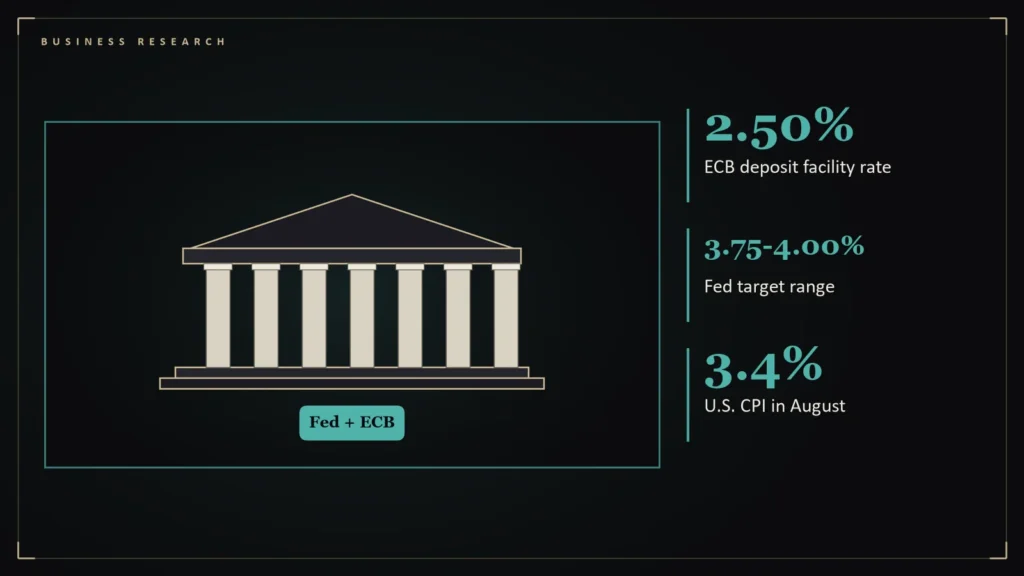
- On September 16, 2026 the Fed raised its target range by 25 basis points to 3.75 to 4.00 percent [1].
- The ECB’s rate table shows a deposit facility rate of 2.50 percent, main refinancing 2.65 percent and marginal lending 2.90 percent effective September 16, up from 2.25, 2.40 and 2.65 percent in June [2].
- Both banks cited persistent inflation; U.S. CPI was 3.4 percent in August, with energy up 16.3 percent [1][3].
- Both economies import energy exposed to the Strait of Hormuz disruption, but the U.S. is also an energy producer.
The Fed
The Federal Open Market Committee voted 12-0 to raise the target range for the federal funds rate by 25 basis points to 3.75 to 4.00 percent, saying inflation remains elevated [1].
The ECB
The European Central Bank’s official rate table shows its three key rates changed effective September 16: the deposit facility rate is now 2.50 percent, main refinancing operations 2.65 percent and the marginal lending facility 2.90 percent, up from 2.25, 2.40 and 2.65 percent set on June 17 [2]. Market coverage reported a 25-basis-point increase to all three.
Why at the same time
The shared cause is energy. The war with Iran and the near-closure of the Strait of Hormuz drove oil above $100, and inflation followed on both sides of the Atlantic [3][4]. Neither bank said it was coordinating with the other, and central banks are formally independent, but their problems are the same: a supply shock that threatens to become embedded in expectations.
The differences
- Starting point: the Fed’s range is 1.25 to 1.5 points above the ECB’s deposit rate.
- Exposure: Europe is a net energy importer; the United States also produces oil, which makes its terms of trade less exposed.
- Currency: the dollar index rose from 96.2 in January to about 102 in October, partly reflecting the relative strength of the U.S. economy and U.S. rates [5].
The ECB’s path through 2025 and 2026
The ECB’s table shows a longer story than one day. In 2025 it cut its deposit facility rate step by step, from 3.00 to 2.75 percent on February 5, to 2.50 on March 12, 2.25 on April 23 and 2.00 on June 11, with the main refinancing and marginal lending rates moving in parallel [2]. In 2026 it reversed course: on June 17 it raised the deposit rate to 2.25 percent, with main refinancing at 2.40 and marginal lending at 2.65, and on September 16 it raised again to 2.50, 2.65 and 2.90 percent [2]. September was therefore the second increase of the year for the ECB, whereas the Fed’s was its first move after a long hold.
That difference is a reminder not to read the two decisions as a single policy. The ECB’s deposit rate of 2.50 percent sits 1.25 to 1.5 points below the Fed’s range of 3.75 to 4.00 percent [1][2]. Both banks cited persistent inflation, and both economies feel the oil shock, though the United States is also a producer [3][4]. The dollar index was strong over the period, as covered elsewhere in this series, but the data cannot say how much of that reflects the rate gap [5].
What to watch
Whether either bank signals more. The Fed’s statement did not [1], and the next meetings are October 27-28 for the Fed and later in the autumn for the ECB. A pair of simultaneous hikes is a signal of how seriously policymakers take energy-driven inflation; it is not yet a cycle. This is analysis, not investment advice.
Questions readers ask
Did the ECB raise rates in September 2026?
Yes: its deposit facility rate rose to 2.50 percent effective September 16, per the ECB’s rate table [2].
Why did both central banks raise rates?
Both cited persistent inflation driven largely by energy prices after the war disrupted the Strait of Hormuz [1][3][4].
References
- Federal Reserve Press Release, September 16, 2026 — Federal Reserve Board — https://federalreserve.gov/newsevents/pressreleases/monetary20260916a.htm
- ECB Key Interest Rates — European Central Bank — https://www.ecb.europa.eu/stats/monetary/rates/html/index.en.html
- Consumer Price Index — August 2026 — U.S. Bureau of Labor Statistics — https://www.bls.gov/news.release/cpi.nr0.htm
- Brent climbs past $100 as US-Iran clashes in Strait of Hormuz reignite global energy fears — Business Today — https://www.businesstoday.in/world/story/brent-climbs-past-100-as-us-iran-clashes-in-strait-of-hormuz-reignite-global-energy-fears-554426-2026-09-10
- U.S. Dollar Index (DX-Y.NYB) Historical Prices — Yahoo Finance — https://finance.yahoo.com/quote/DX-Y.NYB/history/