The First Image of a Black Hole: An Earth-Sized Telescope of Eight
On April 10, 2019 the Event Horizon Telescope showed the shadow of the M87 black hole, 55 million light-years away and 6.5 billion times the Sun's mass.
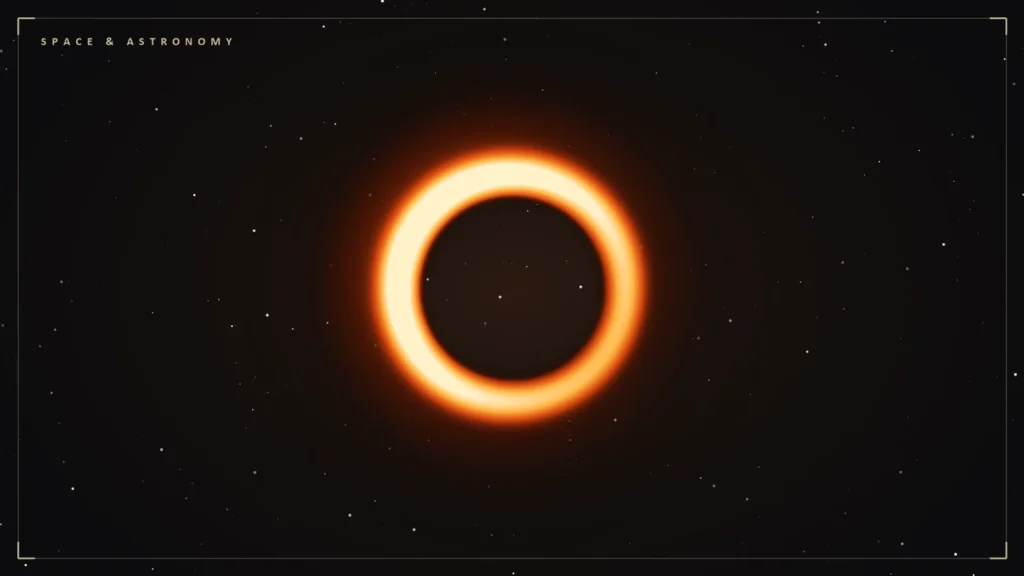
You cannot photograph a black hole the way you photograph a cat. It gives off no light of its own. What astronomers did instead was photograph the glow that surrounds it, like drawing a bowling ball by the ring of light it bends.
- The Event Horizon Telescope announced the first image of a black hole on April 10, 2019 [1].
- The black hole in galaxy M87 is 55 million light-years from Earth and has a mass 6.5 billion times that of the Sun [1].
- Eight radio observatories were linked with very long baseline interferometry to form a single Earth-sized virtual telescope [1].
- A second image, of Sagittarius A* at the center of our galaxy (4 million solar masses), followed on May 12, 2022 [1].
The result
The National Science Foundation reports that on April 10, 2019 the Event Horizon Telescope collaboration announced its image of the black hole in the galaxy Messier 87. The black hole is 55 million light-years away and has a mass 6.5 billion times that of the Sun [1]. The picture shows emission from hot gas swirling around it under the influence of strong gravity near its event horizon: a bright, ring-like structure around a dark central region called a shadow [1].
A telescope the size of a planet
No single dish could do this. The collaboration linked eight radio observatories using very long baseline interferometry, which creates a single Earth-sized virtual telescope [1]. Ultra-precise atomic clocks timestamp the data at each site so that signals can be combined later [1]. Think of eight microphones across a continent combining into one very wide ear.
A second portrait
On May 12, 2022, the same collaboration announced the first direct visual evidence of Sagittarius A*, the black hole at the center of our own galaxy, with a mass of about 4 million Suns. That image was extracted from 2017 observations [1].
What the picture shows and does not
NASA’s description stresses what a black hole is: a dense, compact object whose gravitational pull is so strong that, within a certain distance, nothing can escape, not even light; such objects are thought to result from the collapse of very massive stars [1][2]. The black hole in M87 is outlined by emission from hot gas swirling around it under the influence of strong gravity near its event horizon, and a separate image from the European Southern Observatory’s Very Large Telescope shows a jet produced by the black hole near the center of the galaxy [2].
The EHT image is therefore not a photograph of the hole but of its surroundings. The collaboration’s later image of Sagittarius A* was drawn from the same 2017 observations, which shows how much computation lies between the radio data and the final picture [1]. Ultra-precise atomic clocks timestamp the data at each telescope so that signals recorded thousands of miles apart can be combined later into one Earth-sized view [1].
What the image is and is not
- It is a reconstruction. The data are radio measurements converted to an image by computation.
- It shows a shadow. The dark disc is where light cannot escape; the ring is the surrounding gas.
- Colours are chosen. The orange tint represents radio intensity, not visible light.
Questions readers ask
When was the first black hole image released?
On April 10, 2019, showing the black hole in galaxy M87, according to the National Science Foundation [1].
How does the Event Horizon Telescope work?
It links eight radio observatories using very long baseline interferometry to act as one Earth-sized telescope, with atomic clocks synchronising the data [1].
References
- Event Horizon Telescope, National Science Foundation — https://www.nsf.gov/news/media-toolkits/event-horizon-telescope
- First Image of a Black Hole, NASA Science — https://science.nasa.gov/resource/first-image-of-a-black-hole/