A “quarter-point hike” sounds tiny. It is, per household, and the arithmetic shows exactly how tiny and where it is not.
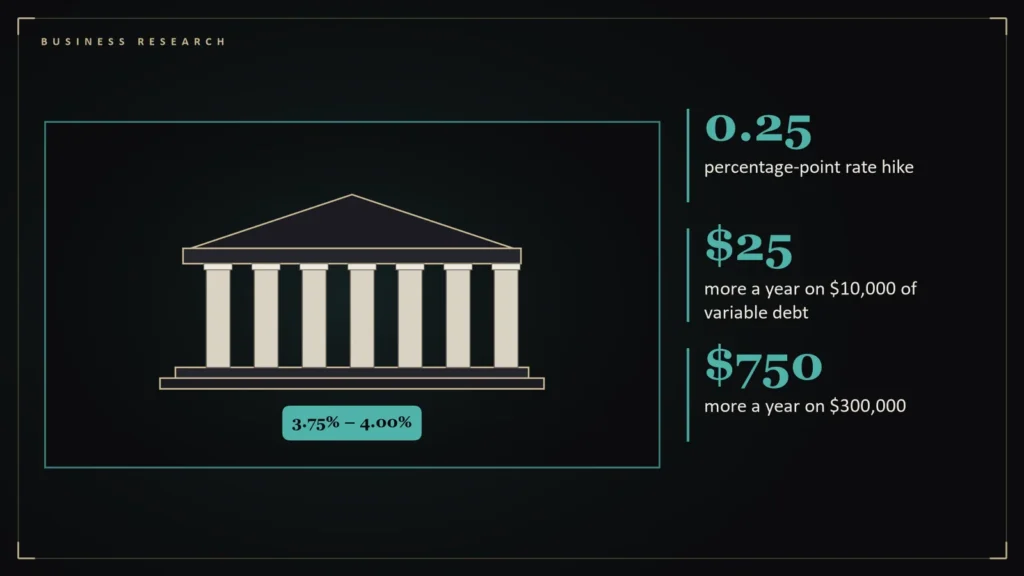
- On September 16, 2026 the FOMC raised its target range by 0.25 percentage points to 3.75 to 4.00 percent [1].
- A quarter point on $10,000 of variable-rate debt is $25 a year; on $300,000 it is $750 a year (simple arithmetic).
- The same move adds $25 a year to the interest on $10,000 in a variable-rate savings account, if the bank passes it on in full.
- Long-term rates, such as the 10-year Treasury at 5.28 percent on October 2, are set by markets, not directly by the Fed [2].
The decision
The Federal Open Market Committee voted 12-0 on September 16, 2026 to raise the target range for the federal funds rate by 25 basis points, to 3.75 to 4.00 percent, saying inflation remains elevated [1]. A basis point is one hundredth of a percentage point, so 25 basis points is 0.25 percentage points.
The multiplication
Interest per year equals balance times rate. A 0.25 percent change on a balance of $10,000 is $25 a year. On a $300,000 variable-rate mortgage it is $750 a year, or about $62.50 a month. On $5,000 of credit card debt at a variable rate it is $12.50 a year. These are the first-order effects for balances that reset with the Fed’s policy rate, whether on credit cards, home equity lines or adjustable-rate loans.
Savers get the mirror image
A variable-rate savings or money market account that passes the full increase to customers pays $25 more a year on $10,000. Many banks pass through only part of a rate rise and do it slowly, so compare your account’s advertised rate before and after.
What the Fed does not control
Fixed-rate mortgages and corporate bonds follow long-term yields, which markets set. The 10-year Treasury yield was 3.96 percent on February 27 and 5.28 percent on October 2, a rise of about 1.3 points that is much larger than the Fed’s single quarter-point move [2]. For a new fixed-rate borrower, expectations about inflation mattered more than the hike itself.
The quarter-point table
The same multiplication works for any balance. A quarter point is 0.25 percent a year, or about one-twelfth of that each month (simple interest, ignoring compounding):
| Balance | Extra per year | Extra per month |
|---|---|---|
| $1,000 | $2.50 | $0.21 |
| $5,000 | $12.50 | $1.04 |
| $10,000 | $25.00 | $2.08 |
| $25,000 | $62.50 | $5.21 |
| $100,000 | $250.00 | $20.83 |
| $300,000 | $750.00 | $62.50 |
| $500,000 | $1,250.00 | $104.17 |
For a household, the effect depends on which side of the table it sits on and whether its rates are linked to the policy rate at all. A fixed-rate mortgage, a car loan or a fixed-rate certificate of deposit does not change when the Fed moves; a credit card, a home equity line or a savings account usually does, with a lag that varies by lender [1]. The next scheduled meetings are listed on the Fed’s calendar [3]. Long-term yields, such as the 10-year at 5.28 percent on October 2, respond to many forces besides one meeting, as discussed above [2].
The takeaway
- One hike is a small direct cost; a series of hikes compounds.
- Check which of your balances are variable and which fixed.
- The next FOMC meetings are October 27-28 and December 8-9 [3].
This is arithmetic, not personal financial advice.
Questions readers ask
How much does a quarter-point rate hike cost a borrower?
Balance times 0.25 percent per year: $25 a year on $10,000 and $750 a year on $300,000 of variable-rate debt.
When is the next Fed meeting?
October 27-28, 2026, followed by December 8-9 [3].
References
- Federal Reserve Press Release, September 16, 2026 — Federal Reserve Board — https://federalreserve.gov/newsevents/pressreleases/monetary20260916a.htm
- CBOE 10-Year Treasury Yield (^TNX) Historical Data — Yahoo Finance — https://finance.yahoo.com/quote/%5ETNX/history/
- FOMC Calendars — Federal Reserve Board — https://www.federalreserve.gov/monetarypolicy/fomccalendars.htm