Concrete and Cracked Pottery: What Brutalism and Wabi-Sabi Share
Banham defined Brutalism as honesty to materials; Leonard Koren's wabi-sabi is the beauty of the incomplete and impermanent. Same instinct, two cultures.
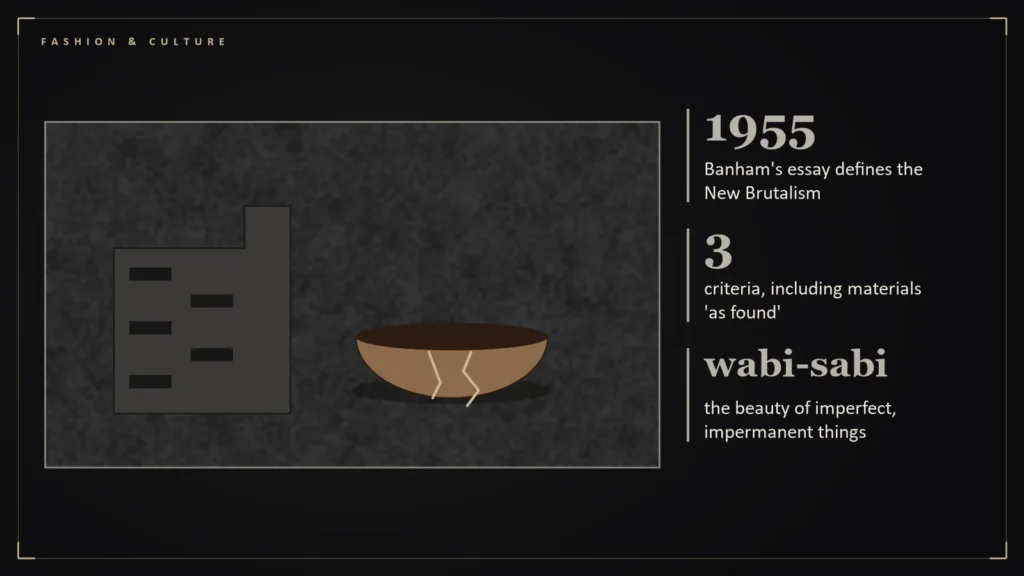
Put a poured-concrete stairwell next to a hand-thrown tea bowl with a crooked lip, and an architect and a potter would probably agree on one thing: neither is pretending to be something else. That shared honesty is why two styles from opposite sides of the world keep turning up in the same wardrobes.
- Reyner Banham’s December 1955 essay defined the New Brutalism by three criteria, including valuing materials for their inherent qualities “as found” [1].
- Leonard Koren’s book describes wabi-sabi as “the beauty of incomplete, imperfect, impermanent things” [2].
- Both styles reject disguise: the structure, the weave, the seam is left visible.
- In fashion that translates into raw finishes, visible weaves and irregular volumes treated as deliberate choices [3].
Brutalism: show the structure
Critic Reyner Banham gave Brutalism its definition in a December 1955 essay in The Architectural Review, naming three criteria: “1, Formal legibility of plan; 2, clear exhibition of structure, and 3, valuation of materials for their inherent qualities ‘as found’” [1]. The movement was a reaction against the diluted modernism of the postwar years, and its core idea was truth to materials: concrete, brick and steel expressed as what they are, not dressed up as something finer [1].
Wabi-sabi: love what time does
Leonard Koren’s 1994 book on the subject describes wabi-sabi as “the beauty of incomplete, imperfect, impermanent things” [2]. IED, the Istituto Europeo di Design, adds the practical vocabulary for fashion: irregular volumes, raw finishes and non-uniform details as intentional choices, natural untreated materials like linen, hemp and raw cotton, and fabrics with visible weaves [3].
A short history of the argument
Reyner Banham, the critic who gave Brutalism its best-known definition, was born in Norwich in 1922, joined The Architectural Review in 1952 and later taught at the Bartlett, University College London and the University of California; he died in London in 1988 [1]. His book The New Brutalism: Ethic or Aesthetic? followed the 1955 essay in 1966, and his other works include Theory and Design in the First Machine Age and Megastructures [1]. The Metroland blog credits buildings by Yorke, Rosenberg & Mardall, Denys Lasdun, Owen Luder and Lyons, Israel & Ellis, and John Voelcker’s Arkley house, to the movement’s wider family [1].
The style fell from favor in the 1970s as tastes shifted toward smaller designs and the oil crisis changed priorities, and its early 21st-century reappreciation has made it culturally prominent in media and merchandise [1]. That swing, from scorned to collectible, is a useful companion to wabi-sabi’s idea that worn, honest surfaces age into something people value. Both movements ask the viewer to look again at what is usually hidden.
Where they meet
The two traditions disagree on temperament. Brutalism is heavy, assertive and confident about permanence. Wabi-sabi is quiet, modest and at ease with decay. But they agree on method. Both ask the maker not to hide the seam, the pour line, the hammer mark or the frayed edge, because the evidence of making is the beauty.
On clothing, that agreement is visible as a short list: a seam turned to the outside, a hem left raw, a weave you can see, a color that fades well instead of fading badly. Pair a heavy, structured silhouette with a soft, uneven fabric and you have both philosophies in one outfit: a bunker wrapped in linen.
Questions readers ask
What are the three principles of Brutalism?
Reyner Banham listed formal legibility of plan, clear exhibition of structure, and valuation of materials for their inherent qualities ‘as found’ [1].
What does wabi-sabi mean?
Leonard Koren’s book describes it as the beauty of incomplete, imperfect, impermanent things [2].
References
- The Old New Brutalism — Modernism in Metro-Land — https://www.modernism-in-metroland.co.uk/blog/the-old-new-brutalism
- Wabi-Sabi for Artists, Designers, Poets & Philosophers — Leonard Koren (1994), summarized by Poets & Writers — https://www.pw.org/best-books/wabisabi_for_artists_designers_poets_philosophers
- Wabi-Sabi in Fashion: The Beauty of Imperfection — IED — https://www.ied.edu/news/wabi-sabi-fashion-beauty-imperfection