Big numbers lose meaning without a yardstick. Here is the 2026 AI spending plan of the four biggest cloud spenders, added up and put next to something familiar.
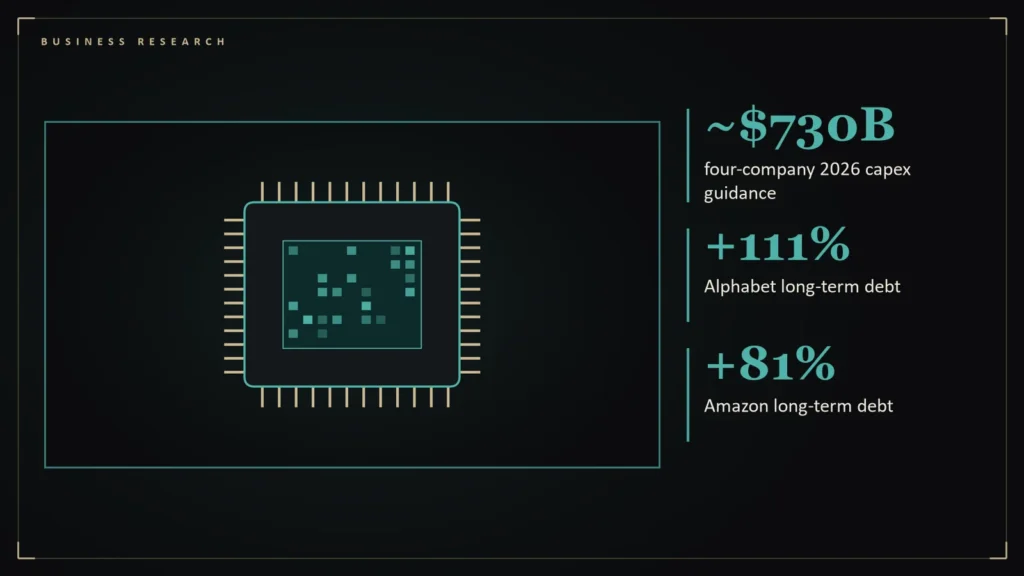
- Summing the guidance figures reported in July gives roughly $724 to $740 billion: Alphabet up to $205 billion, Microsoft $190 billion, Amazon about $200 billion and Meta $138.9 to $145 billion [1].
- A separate tally put the combined four-company figure near $725 billion [2].
- Alphabet and Amazon both reported negative free cash flow for the first time, with long-term debt up 111 percent and 81 percent [1].
- For scale, U.S. retail and food services sales were $773.9 billion in a single month, August [3].
The sum
After second-quarter earnings, guidance for 2026 capital spending, as summarized by Digital Today, was: Alphabet up to $205 billion; Microsoft $190 billion; Amazon about $200 billion; and Meta between $138.9 and $145 billion [1]. Adding the top of each range gives about $740 billion; adding Alphabet’s top with the bottom of Meta’s gives about $724 billion. Another analysis put the combined figure at roughly $725 billion [2]. The definitions differ slightly by company (Microsoft includes finance leases), so the sum is an approximation.
The yardstick
U.S. retail and food services sales, covering everything Americans buy in stores, restaurants and online, were $773.9 billion in August alone [3]. In other words, four companies plan to invest in a year about as much as American consumers spend in a month.
How it is financed
Not entirely from cash. Alphabet’s long-term debt rose 111 percent to $98 billion, Amazon’s rose 81 percent to $119 billion, and both reported negative free cash flow for the first time [1]. The spending is happening because cloud revenue is growing fast: Google Cloud grew 82 percent in the second quarter [1].
What it supports
- Chip makers such as Nvidia, whose shares are up about 25 percent for 2026 [4].
- Utilities and power equipment, as data centers drive demand for electricity.
- Construction and materials, including copper, which is up about 15 percent [5].
Where the sources differ
Not every report gives the same company figures. The Crypto Briefing summary of the July earnings lists Microsoft at about $175 billion, Amazon at $220 billion after an upward revision and Meta at $130 billion to $145 billion, and a combined total of about $725 billion for the four companies, with an outlook of $950 billion to $1.2 trillion in 2027 [2]. The figures used elsewhere in this article, with Alphabet up to $205 billion, Microsoft $190 billion and Amazon about $200 billion, come from a different report [1]. The totals land in the same neighborhood, but the split between companies is not settled, which is why the article gives a range.
Markets treated the four differently in late July. Microsoft rose about 9 percent after hours on July 29 and Amazon about 5 percent, while Meta fell 10 percent despite strong earnings on concerns about monetization; Microsoft’s Azure grew 43 percent in that report and its AI business reached a $37 billion annual run rate, up 123 percent, with AWS growing more than 28 percent [2]. For scale, even the lower guidance figures are close to the $773.9 billion of retail and food-services sales Americans recorded in a single month [3]. That comparison is for scale only: capital spending is multi-year and global, while retail sales are one month in one country.
The risk in the arithmetic
A plan this large depends on revenue growing to match. If it does, the investment looks prescient; if it does not, the debt and the depreciation remain. That is why investors have begun reading free cash flow and not just growth. This is analysis, not investment advice.
Questions readers ask
How much will Big Tech spend on AI in 2026?
About $725 to $740 billion across Alphabet, Microsoft, Amazon and Meta, by guidance as reported in July [1][2].
How is that spending financed?
Partly with debt: Alphabet’s long-term debt rose 111 percent to $98 billion and Amazon’s 81 percent to $119 billion [1].
References
- AI investment worries spread after Alphabet capex hike; Amazon, Microsoft, Meta also face scrutiny — Digital Today — https://www.digitaltoday.co.kr/en/view/86477/ai-investment-worries-spread-after-alphabet-capex-hike-amazon-microsoft-meta-also-face-scrutiny
- Amazon, Meta, Microsoft stocks surge after strong AI earnings as hyperscaler capex nears $725B — Crypto Briefing — https://cryptobriefing.com/amazon-meta-microsoft-ai-earnings-surge/
- Advance Monthly Retail Trade Report — U.S. Census Bureau — https://www.census.gov/retail/sales.html
- NVIDIA (NVDA) Historical Prices — Yahoo Finance — https://finance.yahoo.com/quote/NVDA/history/
- Copper Futures (HG=F) Historical Prices — Yahoo Finance — https://finance.yahoo.com/quote/HG%3DF/history/