Kind of Blue (1959): Five Sketches, Seven Players and Modal Jazz
Miles Davis brought seven musicians and five sketches to the studio in 1959. Kind of Blue put modal jazz on the map and entered the National Registry in 2002.
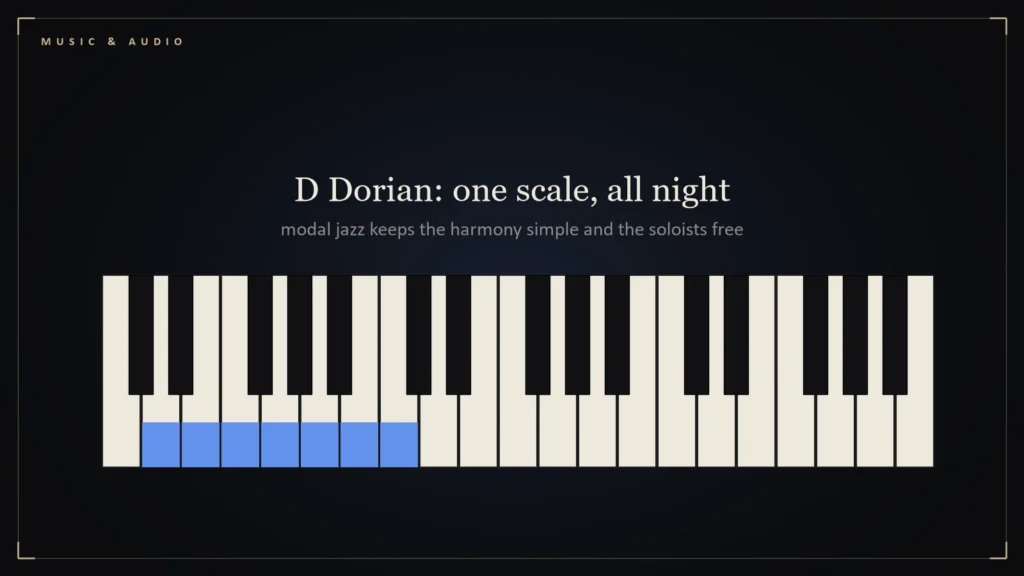
Most great albums are built like cathedrals, slowly and with plans. Kind of Blue was built like a sketch pad: a few outlines, a handful of masters and the nerve to leave space.
- In 1959 seven musicians recorded five simple compositional sketches for Miles Davis’s Kind of Blue [1].
- Davis experimented with ‘modal’ jazz, keeping the background simple while soloists played over one or two modes, or scales, instead of busy chord changes [1].
- NPR describes it as the best-selling jazz album of all time [1].
- The album was added to the Library of Congress’s National Recording Registry in 2002 [2].
Five sketches
According to NPR, in 1959 seven now-legendary musicians in the prime of their careers went into the studio to record five simple compositional sketches [1]. Sketches, not finished scores, left room for the album to sound spontaneous, as if the band were thinking aloud.
What “modal” means
In most jazz of the time, soloists improvised over fast-changing chords. Davis kept the background simple and let the soloists play over one or two modes, meaning scales, rather than a busy chord progression [1]. Imagine painting on a plain white wall instead of a crowded wallpaper: every line shows. That is why the album is often recommended to listeners new to jazz.
The reputation
NPR calls it a “universally acknowledged masterpiece” and the best-selling jazz album of all time [1]. Those are the broadcaster’s characterisations, and sales claims depend on how they are counted. The Library of Congress added the album to the National Recording Registry in 2002, and noted that John Coltrane, who played on it, appears on three Registry selections [2].
The sessions in more detail
NPR names the seven players: John Coltrane on tenor, Julian “Cannonball” Adderley on alto, pianists Bill Evans and Wynton Kelly, bassist Paul Chambers, drummer Jimmy Cobb and Davis on trumpet [1]. The band came to the studio on March 2, 1959 and were given outlines; Davis wanted to capture spontaneity, on the first take if possible, and the first tune recorded, “Freddie Freeloader,” features Kelly’s swinging piano [1]. The second, “So What,” opens with Chambers stating the melody over unorthodox chords from Evans, serving as a kind of fanfare [1].
The ideas had been building. A year earlier, Davis handed Evans a piece of paper with the symbols for G minor and A augmented and told him to see what he could do, which led to the chord cycle behind “Blue in Green” [1]. Evans also introduced Davis to the modal writing of classical composers such as Béla Bartók and Maurice Ravel, and Davis drew on modal qualities in the blues [1]. The second day of recording came seven weeks later, without Kelly, and the first tune recorded then was essentially a series of Flamenco- and North African-derived scales [1].
Why the recording matters to listeners
Because the music is so spacious, it rewards good playback. The room sound and the decay of each note are part of the experience. That is one reason lossless formats matter to people who care about hearing a performance as it was made. Read what lossless audio means.
- Players: seven musicians.
- Material: five sketches.
- Idea: modal improvisation.
Questions readers ask
What is modal jazz?
A style in which soloists improvise over one or two modes, or scales, instead of a fast-changing chord progression, as on Kind of Blue [1].
When was Kind of Blue added to the National Recording Registry?
In 2002, according to the Library of Congress [2].
References
- Miles Davis: 'Kind of Blue', NPR — https://www.npr.org/2011/01/04/10862796/miles-davis-kind-of-blue
- 'Kind of Blue', Miles Davis (1959), National Recording Registry, Library of Congress — https://www.loc.gov/static/programs/national-recording-preservation-board/documents/KindOfBlue.pdf