Two organizations measure monthly retail sales, and they often disagree. Understanding why is a good lesson in what a statistic actually counts.
- The CNBC/NRF Retail Monitor uses anonymized credit and debit card purchase data from Affinity Solutions, avoiding the monthly revisions typical of survey-based Census figures [1].
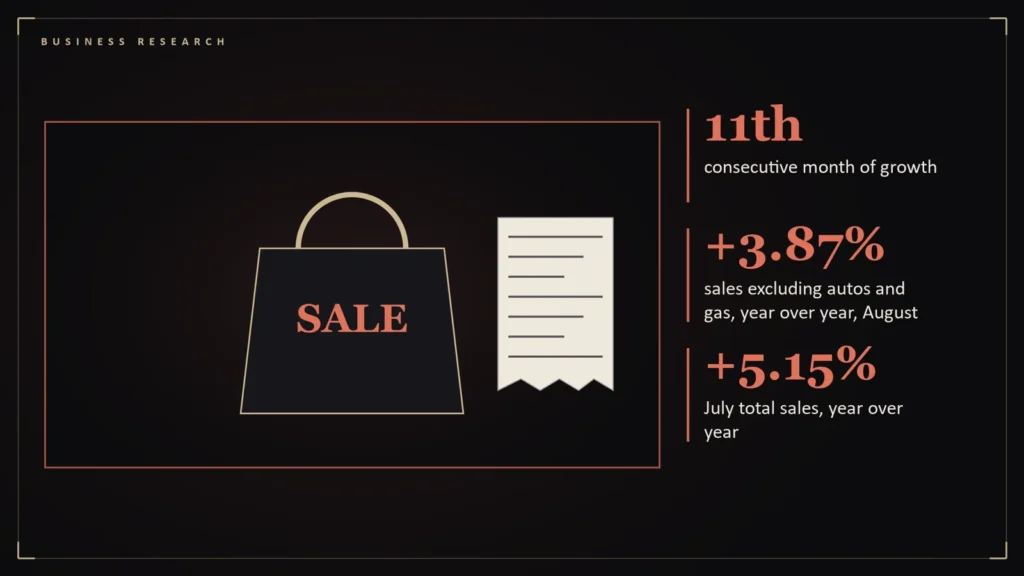
- August total sales excluding autos and gas rose 0.22 percent from July and 3.87 percent year over year; core sales (also excluding restaurants) rose 0.17 percent and 3.47 percent [1].
- The report showed the 11th consecutive month of growth, and July’s total was +0.32 percent month over month and +5.15 percent year over year [1].
- The Monitor changed its methodology in September to weight card data to Census totals, so August and July figures are not directly comparable [1].
Two different instruments
The Census Bureau’s Advance Monthly Retail Trade Report is based on a survey of retailers and covers all retail and food services including autos and gas. In August it showed sales up 1.2 percent from July and 6.0 percent from a year earlier [2]. The CNBC/NRF Retail Monitor works differently: it analyzes anonymized credit and debit card purchases from Affinity Solutions, which avoids the monthly revisions typical of survey data [1].
What the Monitor said for August
The Monitor reported total retail sales excluding auto dealers and gas stations up 0.22 percent from July and 3.87 percent year over year on a seasonally adjusted basis. Core retail sales, which also exclude restaurants, were up 0.17 percent on the month and 3.47 percent on the year. It was the 11th consecutive month of growth; July had been up 0.32 percent and 5.15 percent [1]. NRF President Matthew Shay said households remained “budget-conscious,” helped by low unemployment and steady wage growth [1].
Why the numbers differ
- Scope: the Monitor excludes autos and gas, where prices are volatile; Census includes them.
- Data source: cards versus a retailer survey.
- Timing and revisions: card data rarely changes after release; Census data is revised, as when July was changed to a 0.5 percent decline [2].
How comparable are the series?
The release spells out the method. The Retail Monitor uses actual, anonymized credit and debit card purchase data compiled by Affinity Solutions, and it reports month-over-month and year-over-year changes on a seasonally adjusted basis, which is a change from earlier practice [1]. Core retail sales exclude restaurants in addition to auto dealers and gas stations, so core is narrower than total [1]. Because it relies on transactions, NRF says the Monitor does not need to be revised monthly or annually, unlike Census surveys [1].
The method changed with this release. The Monitor now weights the card data to reflect the makeup of U.S. consumers and projects it to match Census Bureau retail sales totals, and NRF warns that changes calculated on the updated basis are not directly comparable with previously published Monitor figures [1]. Enhanced sector details and dollar levels were to arrive in the full report launching in October [1]. For a reader, the rule is to compare a Monitor figure with other Monitor figures from the same method and to treat the Census series as a different instrument, as already described.
A methodology note
In September the Monitor shifted to a new method that weights card data to align with Census totals and seasonally adjusts year-over-year comparisons, so August figures cannot be compared directly with July’s [1]. That is a reminder to read the footnotes when a series changes how it is built.
Neither series is “right.” Together they bracket the picture: the Census says nominal sales are up 6 percent including fuel, and the Monitor says everyday retail is up roughly 3.5 to 4 percent. This is analysis, not investment advice.
Questions readers ask
What is the CNBC/NRF Retail Monitor?
A monthly measure of retail sales built from anonymized credit and debit card data from Affinity Solutions [1].
How does it differ from Census retail sales?
It uses card data rather than a retailer survey and excludes autos and gas stations in its headline measures [1][2].
References
- CNBC/NRF Retail Monitor Shows 11th Month of Sales Growth in August — National Retail Federation — https://nrf.com/media-center/press-releases/cnbc-nrf-retail-monitor-shows-11th-month-of-sales-growth-in-august
- Advance Monthly Retail Trade Report — U.S. Census Bureau — https://www.census.gov/retail/sales.html