The most useful habit in economic reading is to ask whether a number is nominal or real. Retail sales are nominal: they count dollars spent, not goods bought. When prices rise, dollars rise even if shopping carts do not.
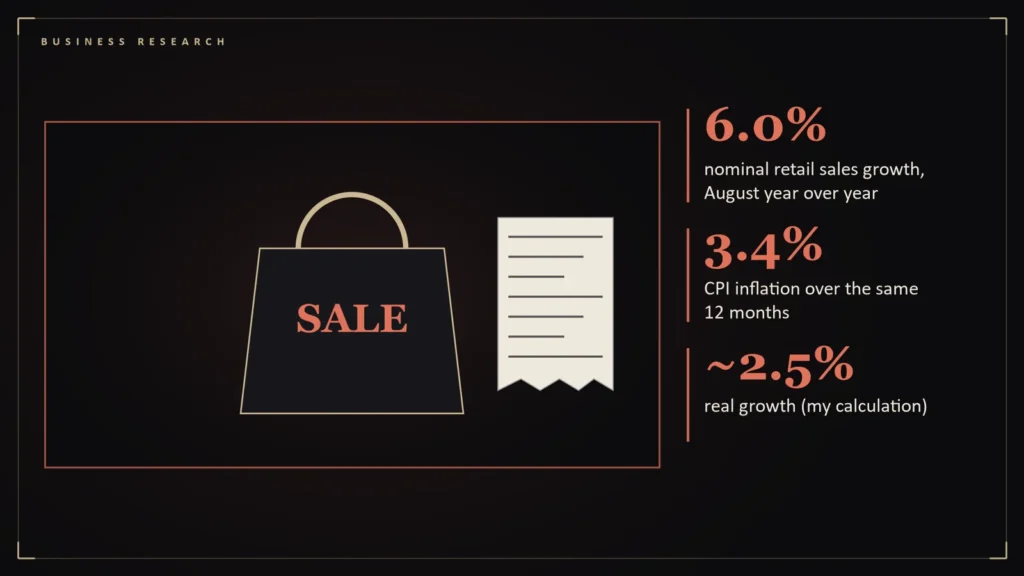
- Retail and food services sales were up 6.0 percent year over year in August 2026 [1].
- CPI inflation was 3.4 percent over the same 12 months, which puts real retail growth near 2.5 percent (my calculation) [2].
- Gas stations are part of retail sales, and gasoline was up 27.4 percent from a year earlier, inflating the total [2].
- The CNBC/NRF Retail Monitor, which excludes autos and gas, showed total sales up 3.87 percent year over year in August [3].
The simple adjustment
Census data show August retail and food services sales up 6.0 percent from a year earlier [1]. Consumer prices were up 3.4 percent over the same period [2]. Dividing one by the other gives a rough real growth rate: 1.060 divided by 1.034 is about 1.025, or roughly 2.5 percent. This is a simplification, since the CPI covers a different basket than retail sales, but it is the right order of magnitude.
Why the gap is larger than usual
Two parts of retail sales respond sharply to fuel prices. Gas stations record dollars at the pump, and gasoline prices rose 27.4 percent in 12 months [2]. And stores that sell a lot of goods affected by shipping and energy costs pass some of those costs on. The CNBC/NRF Retail Monitor strips out autos and gas stations and shows a much smaller number: total sales excluding them were up 3.87 percent in August, and 3.47 percent excluding restaurants too [3]. Against 3.4 percent core-and-headline inflation, those figures imply little real growth in everyday retail [2][3].
Three ways to read a spending number
- Check the deflator. Subtract inflation to get a real rate.
- Check what is included. Fuel and autos swing the total.
- Check the base. A holiday or an event, like Prime Day, shifts the month.
Three ways to deflate the same number
The choice of deflator changes the answer. Using headline CPI of 3.4 percent, the exact calculation, (1.060 divided by 1.034) minus 1, gives 2.51 percent real growth [1][2]. Using core CPI of 2.4 percent, which excludes food and energy, it gives 3.52 percent, and comparing the Retail Monitor’s 3.87 percent, which excludes autos and gas, with headline CPI gives 0.45 percent [2][3] (my arithmetic). The first two measure a broader basket of retail goods against the price index that tracks consumers, and the third narrows the retail measure to exclude gas.
The range, from about 0.5 to about 3.5 percent real growth, is the honest answer to how fast Americans were really buying more, and it is wide because sales include gasoline, whose prices rose 27.4 percent while the Monitor excludes it [2][3]. A single number such as 6 percent invites a single story; the range suggests a modest real gain concentrated in the categories without big price rises. That is also why economists look at the labor market, as the later pay-and-prices article does [4].
What it means
The consumer is spending more dollars but is probably buying about 2.5 percent more stuff, and in categories outside gas and cars, less than that. That is consistent with other signals: sentiment near a record low and wages growing 3.0 percent, slightly below inflation [2][4]. A consumer in that spot is not collapsing, but is not roaring either. This is analysis, not investment advice.
Questions readers ask
What does nominal mean in economic data?
It means measured in current dollars without adjusting for inflation; real figures subtract inflation.
What is real retail sales growth in 2026?
Roughly 2.5 percent in August, from 6.0 percent nominal growth and 3.4 percent CPI inflation (a rough calculation) [1][2].
References
- Advance Monthly Retail Trade Report — U.S. Census Bureau — https://www.census.gov/retail/sales.html
- Consumer Price Index — August 2026 — U.S. Bureau of Labor Statistics — https://www.bls.gov/news.release/cpi.nr0.htm
- CNBC/NRF Retail Monitor Shows 11th Month of Sales Growth in August — National Retail Federation — https://nrf.com/media-center/press-releases/cnbc-nrf-retail-monitor-shows-11th-month-of-sales-growth-in-august
- The Employment Situation — September 2026 — U.S. Bureau of Labor Statistics — https://www.bls.gov/news.release/empsit.nr0.htm