Headlines about the job market are mostly about two numbers: how many jobs were added and what the unemployment rate is. A third number, the participation rate, explains why those two can seem to disagree.
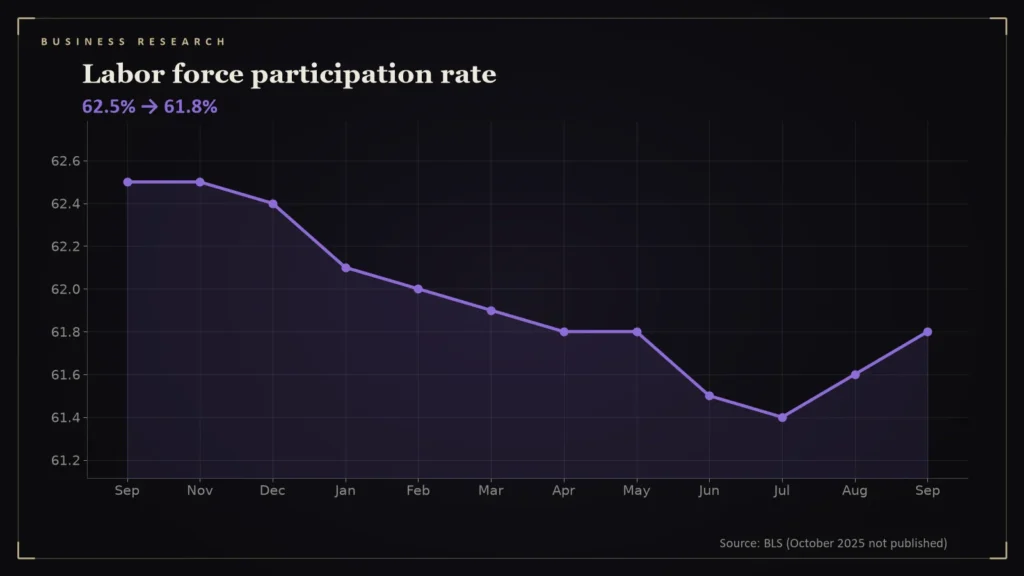
- The labor force participation rate was 62.5 percent in September 2025, fell to 61.4 percent in July 2026, and recovered to 61.8 percent in September [1][2].
- The employment-population ratio was 59.2 percent in September [2].
- A falling participation rate lets the unemployment rate stay low even when hiring is weak.
- The Fed’s statement said job gains “have kept pace with the workforce” [3].
What it measures
The labor force participation rate is the share of the working-age population that is either employed or looking for work. It falls when people retire, stop looking, or never enter. The unemployment rate counts only people looking for work, so someone who stops looking disappears from the numerator and the denominator.
The 2026 path
Bureau of Labor Statistics data show participation at 62.5 percent in September 2025, 62.4 percent in December, and then falling month by month: 62.1 percent in January 2026, 61.9 in March, 61.8 in April and May, 61.5 in June, and 61.4 in July. It then recovered to 61.6 in August and 61.8 percent in September [1][2]. The September employment-population ratio, the share of all adults who have jobs, was 59.2 percent [2].
Why it matters
A decline of 1.1 points in participation, applied to a large working-age population, removes millions of people from the labor force. With fewer people looking, the unemployment rate can hold near 4.2 percent even if payroll growth is only a few tens of thousands a month. That is consistent with the Federal Reserve’s September description that job gains have kept pace with the workforce and the unemployment rate has changed little [3].
What could be behind it
The data do not identify the cause. Common explanations include population aging and lower immigration; BLS figures show the pattern but not why. Each explanation has different consequences: aging is slow and structural, while a drop in labor supply from other sources could reverse.
The monthly path, and the other measures
The published months of the participation rate in the BLS series I used:
| Month | Participation rate |
|---|---|
| Sep 2025 | 62.5% |
| Nov 2025 | 62.5% |
| Dec 2025 | 62.4% |
| Jan 2026 | 62.1% |
| Feb 2026 | 62.0% |
| Mar 2026 | 61.9% |
| Apr 2026 | 61.8% |
| May 2026 | 61.8% |
| Jun 2026 | 61.5% |
| Jul 2026 | 61.4% |
| Aug 2026 | 61.6% |
| Sep 2026 | 61.8% |
Two other household-survey measures round out the picture. The employment-population ratio was 59.2 percent in September, little changed since January, and 5.8 million people outside the labor force said they wanted a job, with 1.5 million marginally attached to the labor force, down 236,000 [2]. A participation rate that falls because people retire is different from one that falls because discouraged workers stop looking, and the numbers on their own cannot say which is behind a given month, which is why the report lists those groups separately [2].
How to use it
- When payrolls are weak and unemployment is low, check participation first.
- A rising participation rate with flat unemployment signals a healthier labor market than the reverse.
- Compare against the same month a year earlier, since the series has a seasonal rhythm.
This is analysis, not investment advice.
Questions readers ask
What is the labor force participation rate?
The share of the working-age population that is employed or looking for work.
What was participation in September 2026?
61.8 percent, down from 62.5 percent in September 2025 [1][2].
References
- BLS Public Data API: Labor Force Participation Rate, series LNS11300000 — https://api.bls.gov/publicAPI/v1/timeseries/data/LNS11300000
- The Employment Situation — September 2026 — U.S. Bureau of Labor Statistics — https://www.bls.gov/news.release/empsit.nr0.htm
- Federal Reserve Press Release, September 16, 2026 — Federal Reserve Board — https://federalreserve.gov/newsevents/pressreleases/monetary20260916a.htm