A consumer economy is a simple machine: jobs create paychecks and paychecks fund spending. The 2026 version has all three parts moving at different speeds, and the pace of the middle one, real wages, decides whether it keeps working.
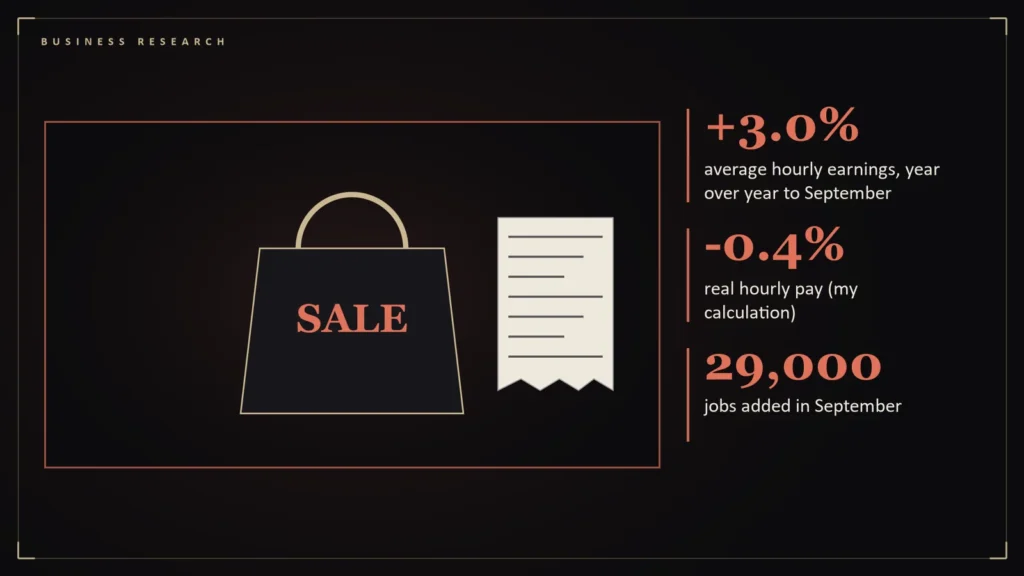
- Average hourly earnings rose 3.0 percent over the 12 months to September, to $37.81 [1].
- CPI rose 3.4 percent over the 12 months to August, so real hourly pay is down about 0.4 percent (my calculation) [1][2].
- Payrolls grew 29,000 in September and average about 68,000 a month for 2026, with unemployment at 4.2 percent [1][3].
- Retail sales were up 6.0 percent from a year earlier in August, about 2.5 percent in real terms [4].
Part one: jobs
Payrolls rose by 29,000 in September, and the unemployment rate was 4.2 percent [1]. The revised data show monthly payroll growth averaging roughly 68,000 for 2026 [3]. That is slow, but it is positive, and unemployment is low.
Part two: pay versus prices
Average hourly earnings were $37.81 in September, up 3.0 percent from a year earlier [1]. CPI inflation was 3.4 percent through August [2]. Divide the two and real hourly pay is down roughly 0.4 percent, a small decline, but a decline after several years of modest real gains. When wages lag prices, households have to spend a larger share of income on necessities.
Part three: spending
Despite that, retail and food services sales were up 6.0 percent from a year earlier in August, roughly 2.5 percent after adjusting for inflation [4][2]. Spending is outrunning real pay. Households can do that for a while by drawing down savings, borrowing, or trading down to cheaper products, but not indefinitely.
Real pay, month by month
The two series can be lined up for each month of 2026 where both exist. The table compares the year-over-year change in average hourly earnings with the year-over-year change in the CPI (not seasonally adjusted), and the gap is real pay growth in percentage points (my arithmetic from the BLS series) [1][2][3]:
| Month | Earnings | CPI | Gap |
|---|---|---|---|
| Jan | 3.7% | 2.4% | +1.3 |
| Feb | 3.7% | 2.4% | +1.3 |
| Mar | 3.4% | 3.3% | +0.2 |
| Apr | 3.6% | 3.8% | -0.2 |
| May | 3.3% | 4.2% | -0.9 |
| Jun | 3.4% | 3.5% | -0.1 |
| Jul | 3.2% | 3.4% | -0.2 |
| Aug | 3.1% | 3.4% | -0.3 |
The table shows why the hinge language fits. Real pay growth was positive early in the year and turned negative as energy-driven inflation climbed, which is the same arc described in the wages-versus-prices analysis. Spending can continue for a while on savings, credit and the rising value of assets for some households, so a squeeze in real pay is not an instant cut in retail sales. It does mean the support for spending has to come from somewhere other than paychecks, and that is the question to watch in coming reports [4].
The hinge
- If real wages turn positive, because inflation eases or pay accelerates, spending is on a firm footing.
- If real wages stay negative while hiring slows, the gap between spending and income has to close, usually by spending slowing.
- The Fed’s September rate hike aims at the inflation side of that equation [5].
That is why the monthly jobs report and the CPI release are the two most important releases for retailers. One tells you how many paychecks, the other what they buy. This is analysis, not investment advice.
Questions readers ask
Are real wages rising or falling in 2026?
Slightly falling: hourly earnings were up 3.0 percent while CPI was up 3.4 percent, about −0.4 percent in real terms (a rough calculation) [1][2].
Why do real wages matter for retail?
Spending is funded by income; if prices outrun pay, households must save less, borrow more, or cut back [1][2][4].
References
- The Employment Situation — September 2026 — U.S. Bureau of Labor Statistics — https://www.bls.gov/news.release/empsit.nr0.htm
- Consumer Price Index — August 2026 — U.S. Bureau of Labor Statistics — https://www.bls.gov/news.release/cpi.nr0.htm
- BLS Public Data API: Current Employment Statistics, series CES0000000001 — https://api.bls.gov/publicAPI/v1/timeseries/data/CES0000000001
- Advance Monthly Retail Trade Report — U.S. Census Bureau — https://www.census.gov/retail/sales.html
- Federal Reserve Press Release, September 16, 2026 — Federal Reserve Board — https://federalreserve.gov/newsevents/pressreleases/monetary20260916a.htm