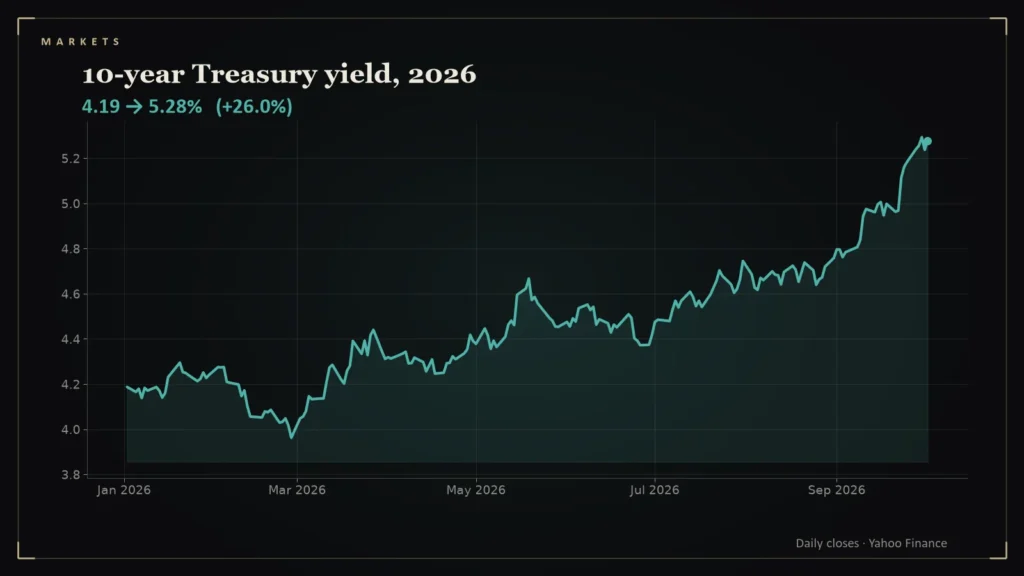
A 5 percent yield sounds generous until you remember that prices are rising. The number that matters to investors is the real rate, what is left after inflation.
- The 10-year Treasury yield was 5.28 percent on October 2, 2026 [1], and CPI inflation was 3.4 percent over 12 months through August [2].
- The approximate real yield is the difference, about 1.9 percentage points (my calculation).
- At the start of 2026 the 10-year yield was 4.16 percent against CPI inflation near 2.4 percent, a real yield of roughly 1.8 points [1][2].
- Real rates matter for gold, growth stocks and anyone borrowing or saving for the long term.
The formula
The real interest rate is approximately the nominal rate minus inflation. On October 2, 2026, the 10-year Treasury yielded 5.28 percent [1]. Consumer prices were up 3.4 percent from a year earlier in August [2]. The difference is about 1.9 percentage points. The exact calculation divides (1 plus nominal) by (1 plus inflation), which gives a very similar figure.
A comparison with January
At the end of 2025 the 10-year yield was 4.16 percent [1], and inflation in January 2026 was about 2.4 percent (calculated from BLS index data) [3]. That is a real yield of about 1.8 points. So the real yield is only slightly higher now than at the start of the year; the headline yield rose mainly because inflation rose.
Why real rates matter
- Gold and Bitcoin pay nothing, so a higher real yield makes them relatively less attractive; gold fell from $5,318 to about $4,176 over the year [4].
- Growth stocks are valued on distant earnings, which are discounted at a rate that includes the real yield.
- Savers and borrowers care what a rate buys after prices rise.
An important caveat
The real yield here uses trailing inflation. Investors care about expected future inflation, which can differ. The Treasury sells inflation-protected securities (TIPS) whose yields give a market-based measure of real rates; those figures are not used here.
The real yield month by month
The simple real-yield calculation can be repeated for each month using the 10-year yield at month-end and that month’s twelve-month CPI inflation (my arithmetic from daily closes and BLS index values) [1][3]:
| Month | 10-year yield | CPI, 12-month | Approx. real yield (points) |
|---|---|---|---|
| Jan | 4.24% | 2.4% | +1.9 |
| Feb | 3.96% | 2.4% | +1.5 |
| Mar | 4.31% | 3.3% | +1.1 |
| Apr | 4.39% | 3.8% | +0.6 |
| May | 4.45% | 4.2% | +0.2 |
| Jun | 4.42% | 3.5% | +0.9 |
| Jul | 4.74% | 3.4% | +1.4 |
| Aug | 4.76% | 3.4% | +1.4 |
The table shows that the real yield did not rise in a straight line: it swung as inflation rose in the spring and fell back, and as the nominal yield climbed in the second half. For gold, which pays no interest, the real yield is the usual comparison, and the metal’s drop from its January peak came as real yields were rising [4]. It is a relationship worth watching, not an iron law.
What it implies
A positive real yield of nearly 2 percent on the safest long-term asset in the world is a meaningful alternative to risk. It is part of why some of the 2026 market moves, especially in gold and crypto, have been so sensitive to rates. This is analysis, not investment advice.
Questions readers ask
What is a real interest rate?
The nominal rate minus inflation; it shows the return after prices rise.
What is the real 10-year yield now?
About 1.9 points: a 5.28 percent yield minus 3.4 percent CPI inflation, by a simple calculation [1][2].
References
- CBOE 10-Year Treasury Yield (^TNX) Historical Data — Yahoo Finance — https://finance.yahoo.com/quote/%5ETNX/history/
- Consumer Price Index — August 2026 — U.S. Bureau of Labor Statistics — https://www.bls.gov/news.release/cpi.nr0.htm
- BLS Public Data API: Consumer Price Index, series CUUR0000SA0 — https://api.bls.gov/publicAPI/v1/timeseries/data/CUUR0000SA0
- Gold Futures (GC=F) Historical Prices — Yahoo Finance — https://finance.yahoo.com/quote/GC%3DF/history/