When a supply route closes, prices rise, and the world’s biggest oil buyer has a choice: pay up or buy less. In 2026, China chose to buy less, and that choice changed the shape of the oil shock.
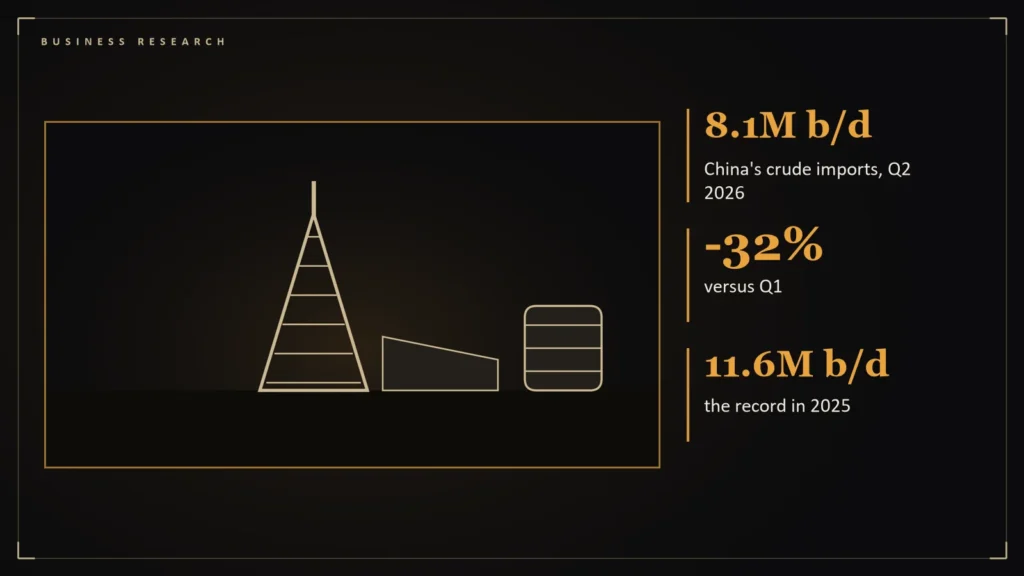
- China imported 8.1 million barrels per day of crude in Q2 2026, 32 percent less than Q1; May and June fell below 8.0 million b/d for the first time since 2016 [1].
- The biggest drops came from Iraq (910,000 b/d), Russia (640,000) and the UAE (600,000) [1].
- China’s 2025 imports had been a record 11.6 million b/d, when prices were lowest [1].
- The EIA notes China’s lower imports reduced global demand, softening the price effect of the disrupted supply [1].
The numbers
According to the U.S. Energy Information Administration, China imported 8.1 million barrels per day of crude oil in the second quarter of 2026, 32 percent less than in the first quarter. Imports fell below 8.0 million b/d in both May and June, the first time since 2016 [1]. That compares with an annual record of 11.6 million b/d in 2025, a year when prices were at their lowest [1].
Where the oil stopped coming from
The largest declines in waterborne imports between the first and second quarters were from Iraq, down 910,000 b/d, Russia, China’s top supplier, down 640,000, and the United Arab Emirates, down 600,000 [1]. With traffic through the Strait of Hormuz severely constrained, Gulf producers with little capacity to bypass it could not ship.
Living off stocks
China’s refineries did not cut as much as its imports. Crude processing fell by 2.2 million b/d compared with 3.9 million b/d for imports, which implies China drew down inventories it had built up during the cheap-oil year [1]. That is a buffer, and buffers run out.
The effect on prices
The EIA’s conclusion is that China’s lower imports reduced global demand and softened the upward price effects from the disrupted supply [1]. Brent still reached $118.35 on March 31 [2], but it eased back to about $72 by the end of June before rising again [2]. Without Chinese demand destruction, the spike could have been worse.
Where the oil went: stocks, not refineries
The EIA’s arithmetic shows how China absorbed the shock. Its refineries processed 2.2 million barrels a day less crude in the second quarter than in the first, yet imports fell by 3.9 million barrels a day; the difference came from drawing down inventories [1]. The EIA estimates that global inventory draws hit a record 5.1 million barrels a day in the second quarter, and says they would have been larger had global demand not declined [1].
The comparison year matters too. China imported a record 11.6 million barrels a day in 2025 while expanding its strategic oil stocks when crude prices were lowest, and averaged 12.0 million barrels a day in the second half of that year [1]. The second-quarter decline came from tanker cargoes rather than pipelines: waterborne imports from Iraq (down 910,000 barrels a day), Russia, China’s top source (down 640,000), and the United Arab Emirates (down 600,000) fell, while pipeline imports from Russia held steady [1]. A country that has built stocks in cheap years can ride out a supply disruption for a while, which is exactly what the data show, but not indefinitely.
What to watch
- Whether China’s imports return to normal once voyages from the Middle East resume; it takes 20 to 25 days for a tanker to arrive.
- How fast inventories rebuild, which would add to demand.
- Brent’s climb back above $100 in September, which suggests the cushion has thinned [3].
This is analysis, not investment advice.
Questions readers ask
How much did China's crude imports fall in Q2 2026?
To 8.1 million barrels per day, 32 percent below Q1, per the EIA [1].
How did lower Chinese imports affect oil prices?
They reduced global demand and softened the price effect of the supply disruption [1].
References
- China's crude oil imports fell in the second quarter — U.S. Energy Information Administration, Today in Energy — https://www.eia.gov/TODAYinENERGY/detail.php?id=67905
- Brent Crude Oil (BZ=F) Historical Prices — Yahoo Finance — https://finance.yahoo.com/quote/BZ%3DF/history/
- Brent climbs past $100 as US-Iran clashes in Strait of Hormuz reignite global energy fears — Business Today — https://www.businesstoday.in/world/story/brent-climbs-past-100-as-us-iran-clashes-in-strait-of-hormuz-reignite-global-energy-fears-554426-2026-09-10