The Word Behind the Style: Where “Brutalism” Really Comes From
It is not about brutality. Brutalism comes from béton brut, raw concrete, and was named by Alison Smithson and defined by Reyner Banham in 1955.
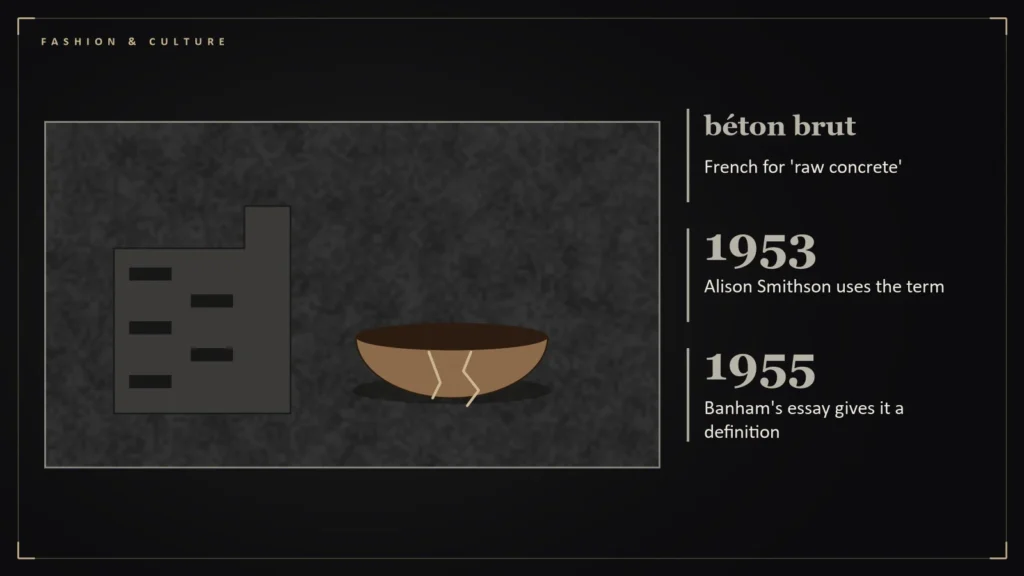
The most common mistake about Brutalism is the obvious one: that it means “brutal.” The word is French, and what it describes is not violence but honesty. A wall of raw concrete, still showing the grain of the wooden forms it was poured into, is not hostile. It is simply unvarnished.
- Brutalism most plausibly comes from the French béton brut, “raw concrete” [1].
- Alison Smithson used the term in 1953 in Architectural Design to describe a Soho house project [1].
- Reyner Banham’s December 1955 essay “The New Brutalism” gave it a formal definition in The Architectural Review [1].
- A playful alternative origin links it to Peter Smithson’s nickname “Brutus” [1].
Two origin stories
The tidy explanation is that Brutalism descends from béton brut, French for raw concrete [1]. The charming alternative is that it merges the nickname “Brutus,” used for the architect Peter Smithson, with the name of his wife and partner Alison [1]. Historians are happy to hold both stories at once, which is typical of architecture’s relationship with its own myths.
1953: the word appears
Alison Smithson used the word in print in 1953, in Architectural Design, describing a project for a house in Soho [1]. It was a working term inside a small group of architects, not yet a movement.
1955: the manifesto
The word became a movement when critic Reyner Banham published “The New Brutalism” in The Architectural Review in December 1955. He reduced it to three tests: formal legibility of plan, clear exhibition of structure, and valuation of materials for their inherent qualities “as found” [1]. It was a deliberate reaction against the diluted modernism of the immediate postwar period [1].
What the 1955 definition actually said
Banham’s essay in The Architectural Review listed three marks of the New Brutalism: formal legibility of plan, clear exhibition of structure and valuation of materials for their inherent qualities “as found” [1]. The underlying idea was “truth to materials”: concrete, brick or steel is not disguised, and the raw material becomes part of the building’s appearance rather than something to hide [1]. The Metroland article stresses that the label began as a specific philosophy, not a catch-all name for any postwar concrete building [1].
The two origin stories sit side by side in that article. The straightforward one is the French béton brut, raw concrete; the fanciful one is an amalgam of Peter Smithson’s nickname “Brutus” and his wife Alison’s name [1]. Alison Smithson used the word in Architectural Design two years before Banham’s essay, describing a project for a house in Soho [1]. The clothing parallel is easy to draw: a seam, a weave or a raw hem left visible is the garment version of an exposed beam.
Why the name matters for clothing
Read that definition again with a garment in mind and it starts to sound like a design brief. Legible plan: the pattern of the piece is visible in the cut. Exhibited structure: seams, hems and fastenings are shown, not hidden. Materials as found: the cloth is allowed to look like cloth. That is why “brutalist” fashion is rarely about being harsh and almost always about being plain-spoken.
Questions readers ask
Where does the word Brutalism come from?
Most commonly from the French béton brut, meaning raw concrete; a playful alternative links it to Peter Smithson’s nickname ‘Brutus’ [1].
Who defined Brutalism?
Critic Reyner Banham defined it in his December 1955 essay ‘The New Brutalism’ in The Architectural Review [1].
References
- The Old New Brutalism — Modernism in Metro-Land — https://www.modernism-in-metroland.co.uk/blog/the-old-new-brutalism