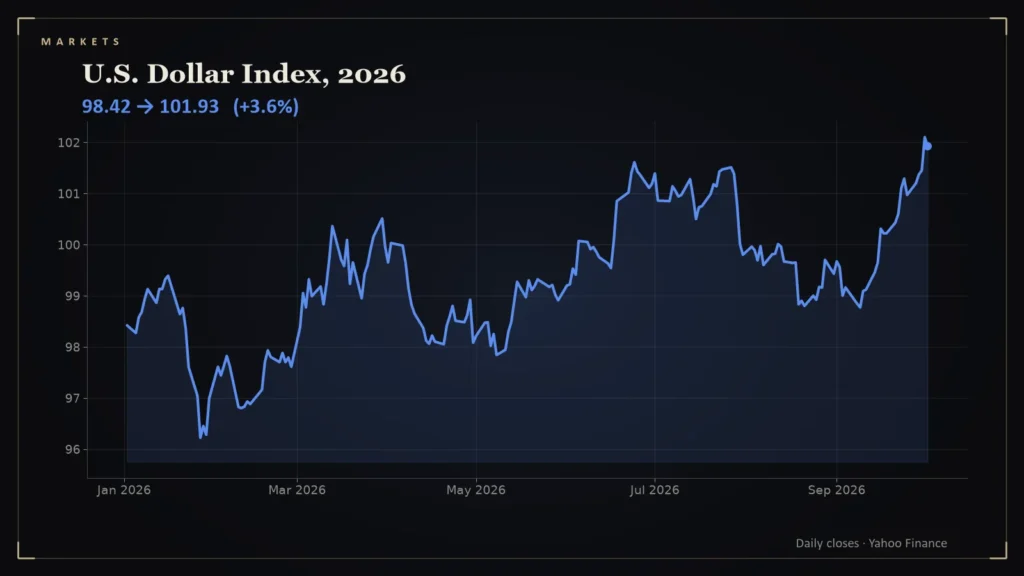
When traders talk about “the dollar,” they usually mean the DXY, an index of the dollar against a basket of major currencies. In 2026 it has moved in a direction that fits the year’s big stories, though the line between a fit and an explanation deserves care.
- The U.S. dollar index (DXY) traded as low as 96.22 on January 27, 2026 and as high as 102.10 on October 1; it ended near 101.87, up about 3.7 percent for the year [1].
- Brent crude rose roughly 68.5 percent in 2026, from a January 7 low near $60 to a March 31 high of $118.35 [2].
- The Fed raised its target range to 3.75 to 4.00 percent on September 16, 2026 [3].
- Correlation is not cause: the data show the dollar and oil rising together but cannot say which drove which.
The move
Yahoo Finance’s price history shows the DXY at 96.22 on January 27, 2026, its low for the year, and at 102.10 on October 1, the high. It ended the latest session around 101.87, about 3.7 percent higher for 2026 [1]. That is a steady climb, not a spike.
What lined up with it
Oil. Brent crude fell to about $60 on January 7, jumped to a 2026 high of $118.35 on March 31, and was around $102.56 on October 4, up some 68.5 percent for the year [2]. A war that disrupts the Strait of Hormuz hurts energy importers in Europe and Asia more than it hurts the United States, an energy producer, which is one common reason the dollar benefits from oil shocks.
And the Fed. The central bank raised its target range 25 basis points to 3.75 to 4.00 percent on September 16, with a unanimous vote and a statement describing inflation as elevated [3]. Higher U.S. rates tend to attract capital to dollar assets.
What we cannot conclude
The price series prove co-movement, not causation. The dollar could be rising because of oil, because of the Fed, because of foreign central banks (the ECB also raised rates on September 16, taking its deposit facility rate to 2.50 percent from 2.25 percent [4]), or because investors are looking for safety. Analysts often assign one cause after the fact; the data support several.
How tightly did they move together?
On a daily basis, not very tightly. The correlation of daily changes between the dollar index and Brent from January to October 2 was 0.25 [1][2] (my calculation), which says that on a typical day one did not predict the other. At month-end, both rose in 3 of the 9 months in the series [1][2]. The year-long story of a higher dollar and higher oil is therefore a statement about the whole period, not a claim that the two moved in lockstep.
Policy rates add a second thread. The Fed’s target range ended the period at 3.75 to 4.00 percent after the September 16 hike, and the ECB’s deposit facility rate was 2.50 percent [3][4]. A dollar index measures the U.S. currency against a basket dominated by the euro, so the gap between the two central banks’ rates is a plausible influence but not a proven one. The honest summary is that the dollar rose 3.6 percent over the span while several things changed at once.
The practical reading
A stronger dollar makes imports cheaper for Americans and exports pricier for others, and it weighs on U.S. multinational earnings measured in dollars. If you hold foreign assets or sell abroad, the move from 96 to 102 is worth a line in your risk notes. If you do not, it is mostly a barometer: the dollar rose in a year when the world became a more anxious place.
Questions readers ask
How much has the dollar index risen in 2026?
It rose from a low of 96.22 on January 27 to a high of 102.10 on October 1, about 3.7 percent for the year as of the latest close [1].
Why might the dollar rise when oil spikes?
The U.S. is an energy producer while many other economies import energy, and higher U.S. interest rates attract capital, but the data alone do not prove either cause [2][3].
References
- U.S. Dollar Index (DX-Y.NYB) Historical Prices — Yahoo Finance — https://finance.yahoo.com/quote/DX-Y.NYB/history/
- Brent Crude Oil (BZ=F) Historical Prices — Yahoo Finance — https://finance.yahoo.com/quote/BZ%3DF/history/
- Federal Reserve Press Release, September 16, 2026 — Federal Reserve Board — https://federalreserve.gov/newsevents/pressreleases/monetary20260916a.htm
- ECB Key Interest Rates — European Central Bank — https://www.ecb.europa.eu/stats/monetary/rates/html/index.en.html