In March 2025, a presidential order made bitcoin a reserve asset of the United States. Eighteen months later, the reserve is a set of coins the government already had, held under rules nobody outside the Treasury can fully see.
- President Trump signed the order establishing the Strategic Bitcoin Reserve on March 6, 2025; it designated existing government holdings as a reserve and did not authorize new purchases [1].
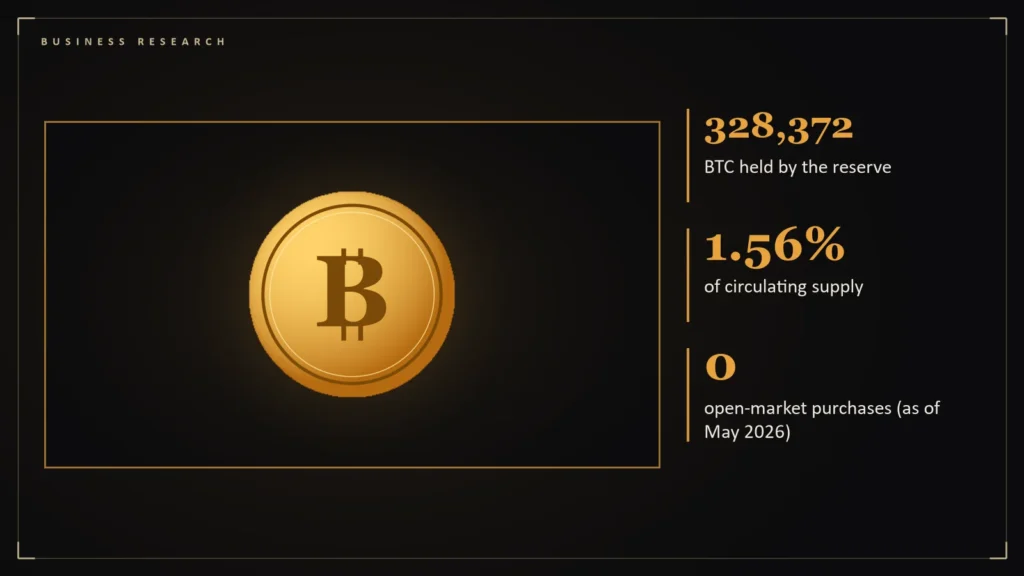
- The reserve holds about 328,372 BTC, roughly 1.56 percent of circulating supply, mostly seized in forfeitures such as Silk Road and the Bitfinex hack [1].
- As of the source’s May 2026 report, no open-market purchases had been made and the BITCOIN Act (rebranded ARMA) had not advanced through Congress [1].
- No quarterly proof-of-reserves attestations have been published, and Treasury has not disclosed custody arrangements [1].
What the order did
President Trump signed the order establishing a Strategic Bitcoin Reserve on March 6, 2025. It designated the government’s existing bitcoin as a strategic reserve and told agencies to inventory their crypto assets within 30 days, but it did not authorize buying more [1].
What is in it
According to a BlockEden status report from May 2026, the reserve holds approximately 328,372 BTC, about 1.56 percent of the circulating supply, worth roughly $25 billion at the time. The entire position consists of coins seized in federal forfeitures, mostly from Silk Road (about 100,000 BTC) and the Bitfinex hack (about 95,000 BTC) [1]. No open-market purchases have been made [1].
The legislative gap
Senator Cynthia Lummis introduced the BITCOIN Act in March 2025, now called the American Reserves Modernization Act (ARMA), which would require Treasury to acquire 200,000 BTC a year for five years to reach one million, funded through budget-neutral mechanisms such as revaluing gold certificates. The report says it has not advanced through Congress [1]. An official, Patrick Witt of the Presidential Council for Digital Assets, had hinted at an announcement on budget-neutral acquisition at the Bitcoin 2026 conference [1].
Transparency
The report also notes that no quarterly cryptographic proof-of-reserves attestations have been published and that Treasury has not disclosed custodial arrangements or governance policies [1]. For comparison, BlackRock’s IBIT ETF holds roughly 786,300 BTC and Coinbase custodies about 973,000 BTC across client accounts [1].
Where the coins came from, and what is planned
BlockEden’s report details the holdings. The reserve was worth about $25 billion at the time of the report. Silk Road seizures account for more than 100,000 BTC, including 69,370 BTC taken in 2020 and 50,000 BTC in late 2022, and Treasury sold 9,861 Silk Road coins for $216 million in March 2023; the Bitfinex hack recovered about 95,000 BTC of the roughly 120,000 stolen in 2016 [1]. The order also created a separate U.S. Digital Asset Stockpile for non-bitcoin tokens held through forfeiture [1].
Purchases are the open question. The order told Treasury and Commerce to identify “budget-neutral strategies” for acquiring more bitcoin without taxpayer money [1]. The proposed ARMA bill would target 1 million BTC over five years, 200,000 a year, or about 548 BTC a day, at a cost of roughly $64 billion at an average price of $64,000, with funding ideas such as revaluing gold certificates, Federal Reserve remittances of $6 billion a year and the Exchange Stabilization Fund [1]. For context, BlackRock’s iShares Bitcoin Trust held about 786,300 BTC and Coinbase custodied about 973,000 BTC across client accounts [1]. No policy has been published on rebalancing, governance, lending or staking, or custody arrangements [1].
Why it matters
- The reserve is a symbolic declaration more than a market actor: it does not buy.
- Its size, 1.56 percent of supply, makes it a large holder that has promised not to sell.
- Without legislation or a funding mechanism, it will not grow.
The gap between the announcement and the operation is the story. The reserve exists; the program does not yet. This is analysis, not investment advice.
Questions readers ask
How much bitcoin does the U.S. government hold in the reserve?
About 328,372 BTC, mostly seized coins, according to a May 2026 status report [1].
Has the U.S. bought bitcoin for the reserve?
As of that report, no open-market purchases had been made [1].
References
- The US Strategic Bitcoin Reserve at 90 Days — BlockEden — https://blockeden.xyz/blog/2026/05/03/us-strategic-bitcoin-reserve-90-day-status-report/