Retailers talk about a “stress test” when they want to know whether shoppers will keep spending when something squeezes them. 2026 has applied a very specific squeeze: the price of filling a gas tank.
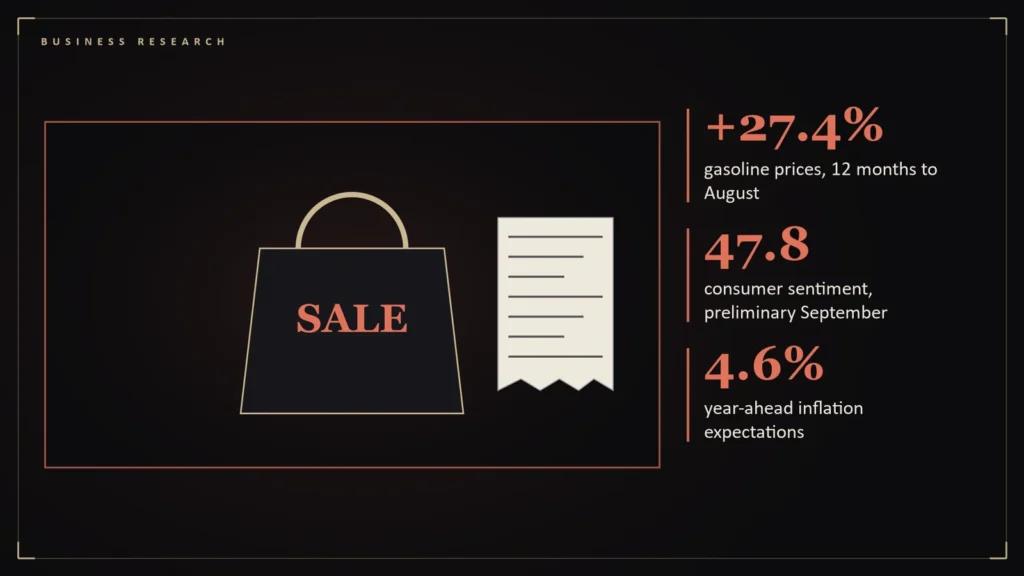
- Gasoline prices rose 27.4 percent over 12 months through August, and the overall CPI rose 3.4 percent [1].
- University of Michigan consumer sentiment fell to 47.8 in preliminary September data, 16 percent below February’s level before the Iran conflict [2].
- Year-ahead inflation expectations rose to 4.6 percent from 4.0 percent in August [2].
- Even so, retail and food services sales were up 6.0 percent year over year in August, to $773.9 billion [3].
The squeeze
The Bureau of Labor Statistics reported that gasoline prices rose 3.9 percent in August and were up 27.4 percent over the previous 12 months, while overall CPI inflation was 3.4 percent [1]. Gas is the most visible price in the economy, the one drivers see on a sign every day, and it shapes how people feel about inflation more than its weight in the index would suggest.
The mood
The University of Michigan’s consumer sentiment index fell to 47.8 in preliminary September data from 51.7 in August, its second straight decline and 16 percent below February’s level, before the conflict began. Year-ahead inflation expectations jumped to 4.6 percent from 4.0 percent [2]. Director Joanne Hsu noted that the expectations number “substantially exceeds the 3.4 percent seen in February” [2]. The final September reading was reported at 48.1, a historically low level [4].
The spending
And yet the Census Bureau reports retail and food services sales of $773.9 billion in August, up 1.2 percent from July and up 6.0 percent from a year earlier [3]. The two data series disagree, which is the central puzzle of the 2026 consumer.
What the sentiment survey adds
The University of Michigan survey breaks sentiment into two parts. The Current Economic Conditions Index was 50.9, down from 51.9 in August and 60.4 in September 2025, while the Index of Consumer Expectations was 45.8, down from 51.5 in August and 51.7 a year earlier [2]. Overall sentiment was 13 percent lower than a year ago [2]. Long-run inflation expectations rose to 3.4 percent from 3.3 percent, where they had stayed for three months [2].
Survey director Joanne Hsu said the current year-ahead reading substantially exceeds the 3.4 percent seen in February before the Iran conflict began, along with all 2024 readings [2]. Both Democrats and Republicans reported sizable sentiment declines, with consumers expecting more financial pressure on personal finances and business conditions, and the report names fuel prices, trade tensions and the Iran conflict as contributing factors [2]. The pattern is the one described above: a gloomy mood alongside spending that nominal prices help to prop up.
Reconciling the two
- Nominal versus real. With prices up 3.4 percent, a 6.0 percent sales gain is roughly 2.5 percent in real terms.
- Gas stations. Higher fuel prices inflate sales at gas stations without any increase in goods bought.
- Behavior versus sentiment. Surveys capture how people feel; sales capture what they do. They often diverge.
The stress test is still running. For now, households are paying the bill, and the mood shows what it is costing them. This is analysis, not investment advice.
Questions readers ask
How much have gasoline prices risen?
27.4 percent over the 12 months through August 2026 [1].
Why are retail sales rising if consumers are gloomy?
Sales are nominal and include higher fuel prices; sentiment surveys measure feelings, which often diverge from spending [1][2][3].
References
- Consumer Price Index — August 2026 — U.S. Bureau of Labor Statistics — https://www.bls.gov/news.release/cpi.nr0.htm
- U.S. consumer sentiment slips in September, inflation expectations rise — The Star (Reuters) — https://www.thestar.com.my/news/world/2026/09/12/us-consumer-sentiment-slips-in-september-inflation-expectations-rise
- Advance Monthly Retail Trade Report — U.S. Census Bureau — https://www.census.gov/retail/sales.html
- Consumer sentiment falls again in September — Advisor Perspectives — https://www.advisorperspectives.com/dshort/updates/2026/09/25/consumer-sentiment-falls-again-in-september