Every trading day, financial sites publish a list of “market cap movers,” the stocks that gained or lost the most value. They look like a scoreboard. Without a few ground rules, they are easy to misread.
- Market capitalization equals share price multiplied by shares outstanding, so a stock’s market-value change tracks its price change when share count is steady.
- A big dollar move in a mega-cap can be a small percentage move, and the reverse is true for small companies.
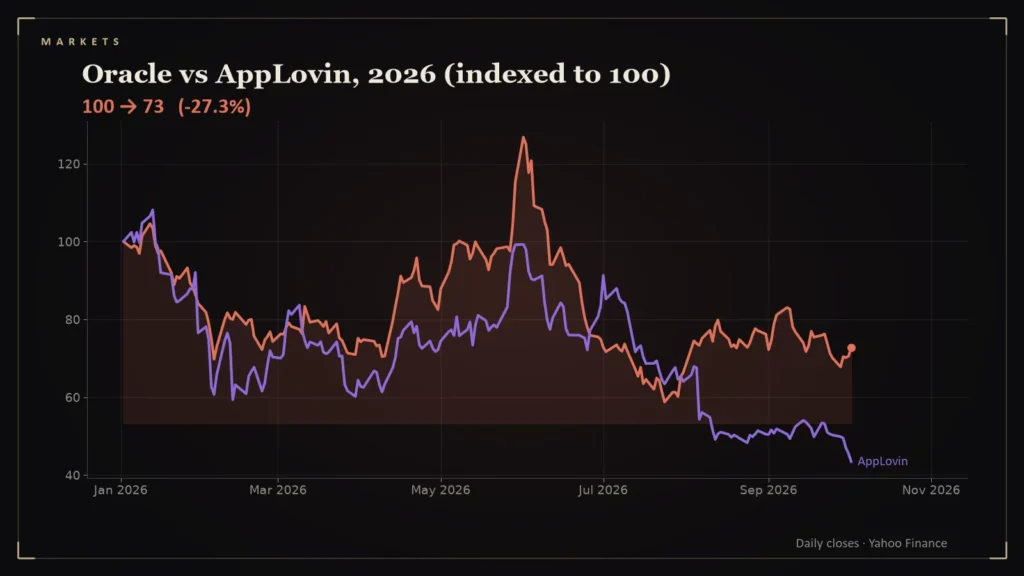
- Oracle fell about 54 percent from June 1 to July 24, 2026; AppLovin is down about 60 percent for the year [1][2].
- Lists of top movers rarely say why a stock moved; read the news behind it.
What market cap is
Market capitalization is the share price multiplied by the number of shares outstanding. It is the market’s running estimate of what the company is worth. When the share count is stable, a stock’s change in market cap moves in step with its price. A $1 move in a $10 stock is a 10 percent event; the same $1 move in a $500 stock is two-tenths of one percent.
Dollars versus percentages
A list ranked by dollars is dominated by the giants, because a small percentage of a trillion-dollar company is more money than a large percentage of a small one. A list ranked by percentages is dominated by the small and volatile. They answer different questions: where did the most wealth shift, and which stocks moved the most relative to their size.
Two 2026 examples
Oracle fell from $248.15 on June 1 to $114.99 on July 24, about 54 percent in under two months, then recovered some ground [1]. AppLovin closed 2025 at $673.82 and ended up at $268.22 on October 2, about 60 percent lower [2]. Both would appear on a movers list on their worst days, but the lists would not have told you why. For Oracle the reason lay in record spending, negative free cash flow and concentration in a single customer [3]; for AppLovin in short reports and a reported but unconfirmed probe [4].
A dollar is not a percent
A concrete comparison shows why lists mislead. A one-dollar move is 0.19 percent for Microsoft at $517.53, 0.37 percent for AppLovin at $268.22 and 0.70 percent for Oracle at $142.30 (October 2 closes) [1][2] (my arithmetic). A list ranked by dollar change would put the high-priced stock on top for the same percentage move, which is why a list of the biggest dollar movers is usually a list of the most expensive stocks.
The two examples carry stories that a list will not. Oracle’s fall followed its OpenAI-linked surge, its large capital spending and heavy debt, as the Channelchek analysis lays out [3]; AppLovin’s slide followed short reports and a reported regulatory inquiry, with the allegations lacking primary evidence in the report discussed by MarketBeat [4]. The habit this article recommends, asking what the move was, how large it was in percent, what the company said and what the source of the claim is, fits both cases.
A four-question habit
- Is the list ranked by dollars or by percent?
- Did the move happen on news or on no news at all?
- Is it one day, or the end of a long slide?
- What changed in the business or the story, not just the price?
A movers list is a headline generator, not an analysis. Use it to find out what to read next. This is analysis, not investment advice.
Questions readers ask
What is market capitalization?
Share price multiplied by shares outstanding; it is the market’s estimate of a company’s total equity value.
Why do market cap movers lists favor large companies?
When ranked by dollar change, a small percentage move in a very large company outweighs a big percentage move in a small one.
References
- Oracle (ORCL) Historical Prices — Yahoo Finance — https://finance.yahoo.com/quote/ORCL/history/
- AppLovin (APP) Historical Prices — Yahoo Finance — https://finance.yahoo.com/quote/APP/history/
- Why Oracle Stock Has Lost Half Its Value in Six Weeks — Channelchek — https://dashboard.channelchek.com/why-oracle-stock-has-lost-half-its-value-in-six-weeks/
- AppLovin Faces Money Laundering Claims. Here's What's Missing — MarketBeat — https://www.marketbeat.com/articles/applovin-faces-money-laundering-claimsheres-whats-missing/