After 88 Years, Gallup Stops Counting: What the End of the Approval Rating Changes
On February 13, 2026 Gallup said it will stop publishing presidential approval ratings, ending a series that began under FDR. What replaces it, and what is lost.
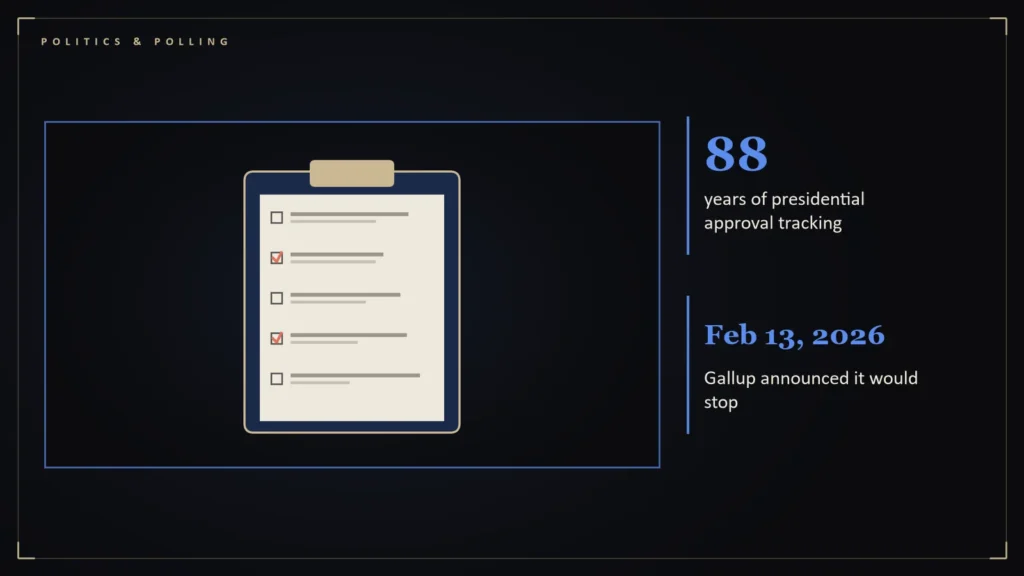
The presidential approval rating is one of the longest-running measurements in American public life, and on February 13, 2026, the organization that started it said it was done.
- Gallup announced on February 13, 2026 that it would end its presidential approval and favorability tracking after 88 years, a series dating to Franklin D. Roosevelt’s era [1].
- It said it will no longer publish assessments of individual political figures, and will focus on issues and conditions that shape people’s lives [1].
- Gallup will continue to poll public opinion on prominent issues and the nation’s mood [1].
- Other pollsters and aggregators still publish approval measures, but none has Gallup’s unbroken history.
What Gallup announced
Gallup said it would end its presidential approval and favorability tracking after 88 years. The practice dates to the late 1930s and the Franklin D. Roosevelt era, making it the longest-running continuous effort to track opinion of the president [1]. The company attributed the change to a shift toward research on “issues and conditions that shape people’s lives,” adding that it will no longer publish assessments of individual political figures [1].
What continues
Gallup says it will still poll Americans on prominent issues and the national mood [1]. Its June 2026 survey on the Iran conflict, for example, which found 34 percent approving of the military action, is an issue measurement of that kind [2]. So the data stream continues; one specific series has stopped.
What is lost
The value of a long series is comparability. One agency, with a consistent question and method, asked about presidents from different eras, gave historians a single yardstick. A set of other pollsters, each with different wording, sampling and timing, cannot reproduce that. Averages of multiple polls do a good job at tracking the present; they are a weaker instrument for comparing across decades.
What Gallup will still measure
The announcement says the effort dates to Franklin D. Roosevelt’s tenure in the late 1930s, and that Gallup is shifting its research toward the issues and conditions that shape people’s lives [1]. The company will continue to poll public opinion on prominent issues and on the nation’s mood [1]. That leaves a great deal of the Gallup record intact, including the kind of issue polling that produced its June 2026 finding that 34 percent approved of the military action in Iran, below levels seen for the Gulf War and the war in Afghanistan [2].
That same poll illustrates what issue measurement can do. It tracked how support for earlier operations changed over time, such as Libya in 2011, where approval fell from 47 percent to 39 percent, and Haiti in 1994, where it fell from 54 percent to 36 percent, and it found support strongest among older Americans and men [2]. An earlier Indeed poll in March 2026 showed 40 percent approval among registered voters [2]. These are time series about a policy, and they remain possible without a personal approval rating. What disappears is the single, continuous benchmark that let anyone compare presidents across nine decades; no other pollster can offer that unbroken history, which is the sense in which the change is a loss for historians.
What to do as a reader
- Use averages, not single polls, for the current moment.
- Note the question wording: “approve of the job” is not the same as “favorable view.”
- Treat comparisons with past presidents as approximate when they cross pollsters.
The measurement did not become less necessary. It just lost its most famous publisher.
Questions readers ask
Why did Gallup stop publishing presidential approval?
Gallup said it is shifting toward research on issues and conditions that shape people’s lives and will no longer publish assessments of individual political figures [1].
When did Gallup announce the change?
February 13, 2026 [1].
References
- After 88 years, Gallup will stop measuring presidential approval ratings — WNEM — https://www.wnem.com/2026/02/13/after-88-years-gallup-will-stop-measuring-presidential-approval-ratings
- Poll reveals how public support for Iran war compares to other U.S. conflicts — Fox 5 NY, reporting Gallup — https://www.fox5ny.com/news/poll-reveals-how-public-support-iran-war-compares-other-us-conflicts