Hip-Hop’s First Party: 1520 Sedgwick Avenue, August 11, 1973
Hip-hop is commonly dated to an August 11, 1973 party at 1520 Sedgwick Avenue in the Bronx, where DJ Kool Herc looped the breaks on two turntables.
Genres rarely have a birthday. Hip-hop is an exception, or at least a famous almost-exception: a single night, a single room, a single idea about how to treat a record.
- Hip-hop’s birth is commonly dated to August 11, 1973, at a party in the community room of 1520 Sedgwick Avenue in the Bronx [1].
- It was a ‘Back-to-School Jam’ thrown by Cindy Campbell and her brother Clive, who DJed as Kool Herc [1].
- Kool Herc was 18 and was among the first DJs to isolate and repeat the break, the most danceable part of a record [1].
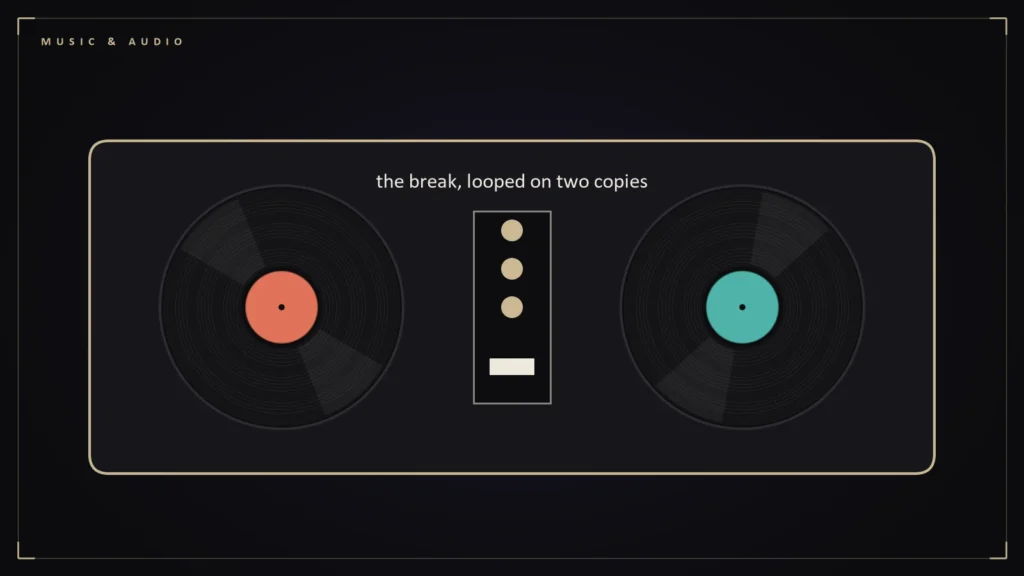
- He extended the break by playing two copies of the same record on two turntables [1].
The party
NPR reports that on August 11, 1973, a modest party for fellow teenagers was held in a small community room at 1520 Sedgwick Avenue in the Bronx. That event is now commonly celebrated as the birth of hip-hop [1]. The party was a “Back-to-School Jam” organised by Cindy Campbell and her brother Clive, an aspiring disc jockey who went by DJ Kool Herc. It lasted into the early morning [1].
The idea: loop the break
Kool Herc, who was 18, noticed that dancers loved one short part of a record, the break, where the melody dropped away and the drums took over. He isolated and repeated those breaks to keep the floor moving [1]. The method used two copies of the same record on two turntables, so that he could hand the break from one to the other and stretch a few seconds into minutes [1]. Picture a surfer who finds the best wave and learns how to ride it forever.
Why a technical trick became a genre
Looping the break turned the DJ from a selector of songs into a player of an instrument. It created a space for rhythmic speech over the beat and for dancers to build their own style around it. NPR’s anniversary coverage places this party at the start of that chain [1].
The door fee, the closet and the rest of the night
NPR’s account adds the details. Cindy Campbell threw the party to raise money for new clothes for the school year, with admission of 25 cents for girls and 50 cents for boys [1]. Jerry Leader, who grew up in the building, says Herc set up in a closet with his music while everyone jammed in the community room, a room that is relatively unchanged today, with low ceilings and a small kitchen and no plaque to mark the history [1]. Herc emigrated from Jamaica at 12, and had absorbed the competitive culture of traveling Jamaican sound systems and much of his father’s record collection [1].
His technique was both selection and handling. He focused on the percussive breakdowns, then played one break from one record and immediately another from the second turntable, and he could loop one break using two copies of the same record, which he called the “merry-go-round” [1]. A six-second drum solo could now last much longer, dancers developed styles that became known as b-boying and b-girling, and his friend Coke La Rock began talking over the beats in short rhymes that evolved into rap, according to the author Jeff Chang [1]. In that account, the DJ, the dancers and the emcee all appear at the same party.
Careful with “first”
- Culture has many beginnings. The party is a commonly cited date, not the only event that shaped the genre.
- Credit is shared. Cindy Campbell organised and promoted the event.
- The sound lives on. Breakbeats are the raw material of sampling, which depends on high-quality recordings.
Questions readers ask
When was hip-hop born?
It is commonly dated to August 11, 1973, a party at 1520 Sedgwick Avenue in the Bronx hosted by Cindy Campbell and DJ Kool Herc [1].
What did DJ Kool Herc invent?
He is credited with isolating and repeating the break of a record, using two copies on two turntables [1].
References
- 50 years ago, teenagers partied in the Bronx and gave rise to hip-hop, NPR — https://www.npr.org/2023/07/11/1186407223/50-years-ago-teenagers-partied-in-the-bronx-and-gave-rise-to-hip-hop