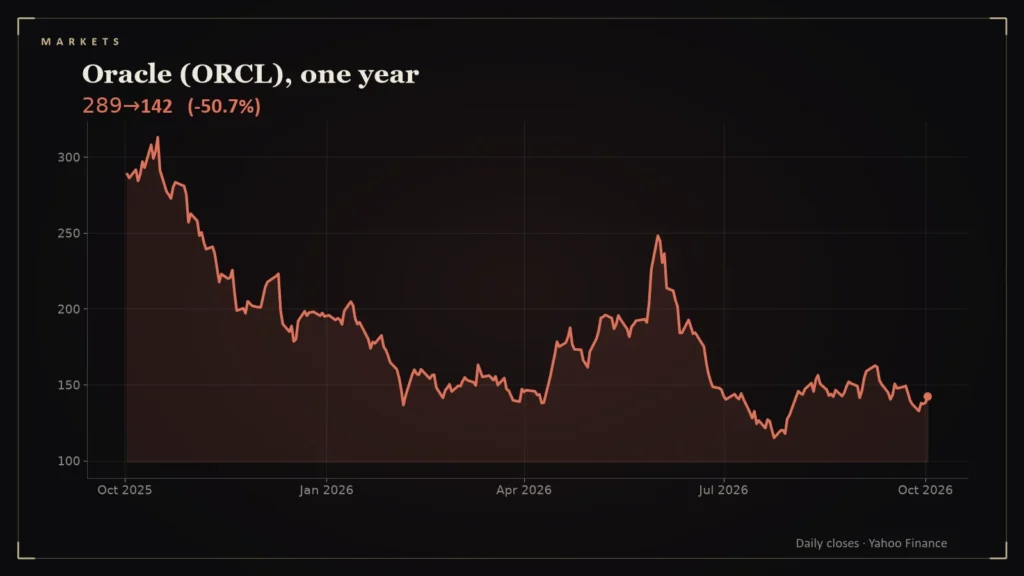
Oracle spent 2026 as the market’s most vivid example of a simple idea: it is one thing to sign big AI contracts and another to pay for the data centers that serve them.
- Oracle peaked at $248.15 on June 1, 2026, fell to $114.99 on July 24 (about 54 percent), and closed at $142.30 on October 2, up about 24 percent from the low [1].
- Fiscal 2026 capital spending rose 162 percent to about $56 billion, free cash flow was roughly negative $24 billion and total debt was about $130 billion [2].
- Remaining performance obligations were $638 billion, of which about $300 billion came from OpenAI [2].
- When OpenAI delayed its IPO to 2027, Oracle shares fell 9 percent in a week [2].
The price path
Yahoo Finance data show Oracle reaching $248.15 on June 1, 2026, falling to a low of $114.99 on July 24, a drop of about 54 percent in less than two months, and rebounding to $142.30 by October 2, up roughly 24 percent from the bottom. For the year the stock is down about 27 percent [1].
The reasons for the fall
The analysis site Channelchek traces the decline to the balance sheet beneath the headline growth. Fiscal 2026 capital expenditures surged 162 percent to about $56 billion, free cash flow turned negative at roughly $24 billion, total debt reached about $130 billion, and management projected $70 billion in capex for fiscal 2027 [2]. Its remaining performance obligations, the value of signed contracts, jumped 363 percent to $638 billion [2].
The concentration problem
About $300 billion of those obligations come from a single customer, OpenAI, a company generating about $25 billion in annualized revenue while operating at significant losses [2]. When OpenAI delayed its IPO from 2026 to 2027, Oracle shares fell 9 percent in a week, because investors worried about whether OpenAI could honor its commitments [2]. As Channelchek frames it, the problem is concentration risk, leverage and the gap between signed contracts and delivered revenue, not weak demand for AI [2].
Against its own history
The June peak is not Oracle’s high. In the daily closes, the highest close since September 2025 was $328.33 on 2025-09-10, and Channelchek reports the stock surged 36 percent on September 10, 2025 after the OpenAI deal and peaked at $345.72 that month [1][2]. By July 21, 2026 the shares were below $140, about 62 percent under the September peak and about 50 percent under the June high [2]. Measured from the closes I used, the stock moved 5 percent or more in a single day on 41 of 273 sessions between September 2025 and October 2, 2026 (my calculation) [1].
Two corporate events marked the slide. After the June earnings report the shares fell 12 percent in a session even though revenue grew and cloud infrastructure revenue surged 93 percent, and when OpenAI delayed its IPO from 2026 to 2027 the stock fell 9 percent [2]. The pattern, good operating news met by a falling price, is typical of a company whose valuation depends on a few very large contracts. The rebound to $142.30 by October 2 recovered part of the loss but left the stock far below both peaks [1].
What the recovery implies
The rebound of about 24 percent from the low suggests some of the fear was priced in. It does not erase the structural questions: Oracle plans to keep spending heavily, and its fortunes still depend on a handful of customers paying for capacity that has not yet been fully built.
The takeaway for readers is how to analyze any AI infrastructure company: look past the backlog to the cash flow, the debt, and who actually signs the checks. This is analysis, not investment advice.
Questions readers ask
Why did Oracle stock fall in 2026?
Heavy capital spending, negative free cash flow, about $130 billion in debt, and concentration of about $300 billion of its contract backlog in OpenAI [2].
How far did Oracle fall?
About 54 percent from $248.15 on June 1 to $114.99 on July 24, before partially recovering [1].
References
- Oracle (ORCL) Historical Prices — Yahoo Finance — https://finance.yahoo.com/quote/ORCL/history/
- Why Oracle Stock Has Lost Half Its Value in Six Weeks — Channelchek — https://dashboard.channelchek.com/why-oracle-stock-has-lost-half-its-value-in-six-weeks/