What to Buy at the Merch Table (and What to Skip)
Pop-up merch runs $20 to $60 for a reason. A practical guide to which merch table items hold up and which are impulse buys you will regret.
The merch table at a good show has one job: to catch you at the exact moment you would trade anything for proof you were there. That is a terrible state in which to make a purchase decision, so make the decision now.
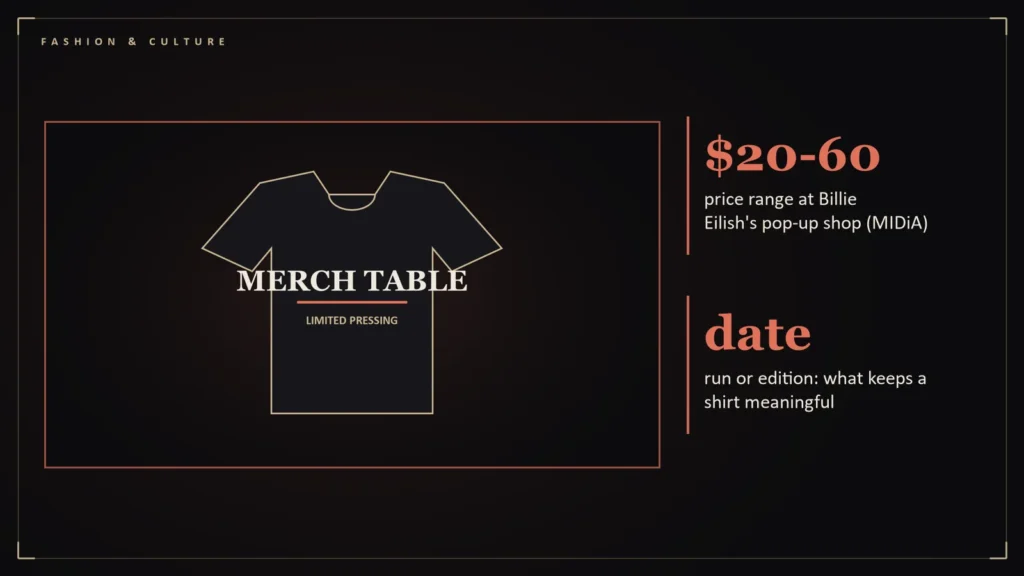
- Prices vary widely; MIDiA cites Billie Eilish’s pop-up shop with items from $20 to $60 [1].
- Fabric weight, print texture and honest sizing tell you more about a shirt than the logo does [2].
- Items tied to a specific date, run or edition keep their meaning; generic logo items are easiest to replace.
- A single rule beats every checklist: buy what you will use, wear or display [2].
Know what normal costs
Prices at the top end are not shy. MIDiA, writing about the merchandise market, points to a Billie Eilish pop-up shop with items priced from $20 to $60 [1]. At independent shows, a shirt in the same range is typical. Treat very cheap items with suspicion and very expensive ones with a clear reason, such as a limited run, an unusual material or an artist-made design.
Buy the shirt that will outlive the tour
Vintage dealers know what a good garment feels like years later. Gene Melkisethian of the DC shop Joint Custody says ’80s shirts are noticeably thin, ’90s ones thicker, and 2000s-and-later reprints feel excessively soft; screen-printed ink you can feel on the surface is the classic sign of a print that will age with character, and cracking is normal [2]. Run your thumb over the print, check the stitching, and be honest about sizing. Vintage sizes run small (an ’80s large fits like a ’90s medium), and modern ones may not be the same [2].
The three-question test
- Is it tied to something? A tour date, a release or a numbered edition makes an object a keepsake. A plain logo is a shirt.
- Will I wear it or hang it? If neither, skip it, however good the design is.
- Could I buy it later? Posters and vinyl often sell out, while basic tees are usually restocked. Spend your money where scarcity is real.
Tips from a vintage dealer
If the merch table sells reprints of old designs, or you shop for older pieces, a dealer’s checklist helps. Gene Melkisethian of Joint Custody advises checking for sewn-in neckline tags rather than heat-pressed ones, single-stitched hems for pre-early-1990s shirts and raised, cracking screen-print ink rather than smooth, flat ink [2]. Fabric weight is a clue: 1980s shirts are noticeably thin, 1990s versions thicker, and modern reprints feel unusually soft [2]. Sizing helps too: an 1980s large fits like a 1990s medium [2].
He also warns that dry rot gives a caramel-like smell and a sheen on the fabric, that fan-made rap tees are often counterfeited and that handling real examples helps develop an eye [2]. His care advice is to wash cold on a gentle cycle and air-dry, and his buying advice matches this article’s rule: purchase pieces you genuinely appreciate, not shirts as pure investments [2]. That guidance applies at the merch table as well: a shirt you will wear for years is worth more than one you buy for a screenshot.
Skip the impulse bundle
Bundles and add-ons are designed for the post-encore glow. Walk the room first, check the full lineup, and come back to the table when the lines are shorter. If a piece is still on your mind in an hour, it is probably worth having.
Questions readers ask
How much should band merch cost?
Prices vary; MIDiA cites a Billie Eilish pop-up with items from $20 to $60, which is a useful reference point for a quality tee or poster [1].
How do I judge a band tee's quality?
Feel the fabric weight, check the print texture and stitching, and confirm sizing; vintage dealers use these same checks [2].
References
- How Big Can Music Merch Get? MIDiA's Latest Report Charts the Course to $16B by 2030 — MIDiA Research — https://www.midiaresearch.com/blog/how-big-can-music-merch-get-midias-latest-report-charts-the-course-to-16b-by-2030
- Vintage Band Tee or Fake? Joint Custody Shares 9 Tips to Spot the Real Thing — DC Fray — https://districtfray.com/articles/vintage-band-tees-joint-custody