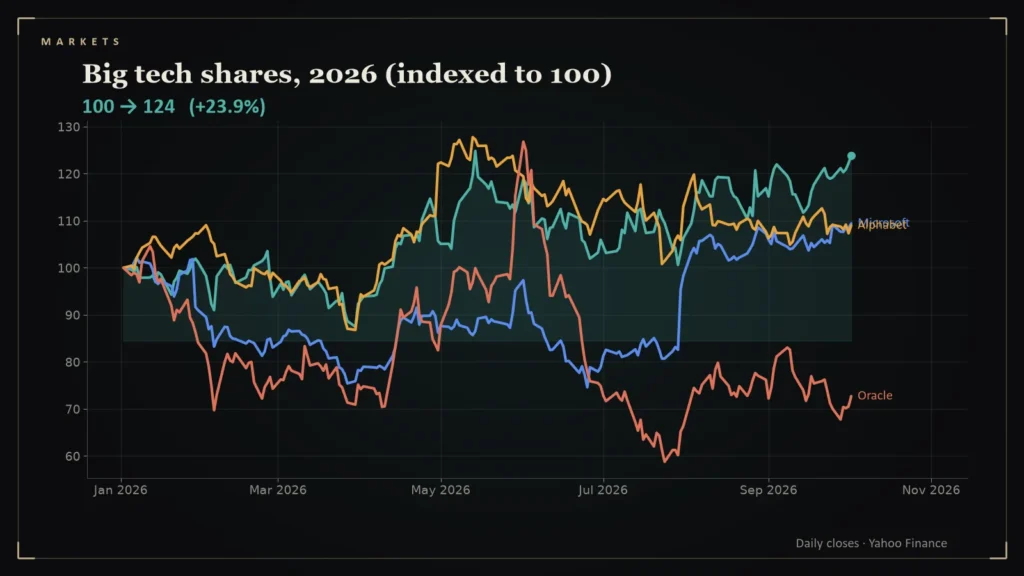
An index is a single number for a very messy crowd. In 2026 the crowd has split in an unusually wide way, and the average hides it.
- Through October 2, the S&P 500 was up about 12.8 percent for 2026 and the Nasdaq Composite about 17.0 percent [1].
- Nvidia gained about 25.4 percent, Apple 22.7 percent, Meta 10.3 percent, Alphabet 9.7 percent, Amazon 9.0 percent and Microsoft 7.0 percent [1].
- Oracle was down about 27.0 percent, Tesla about 17.6 percent and AppLovin about 60.2 percent [1].
- The spread from best to worst among these nine names is more than 85 percentage points.
The index view
As of the October 2 close, Yahoo Finance data show the S&P 500 up about 12.8 percent for the year and the Nasdaq Composite up about 17.0 percent [1]. A reader looking only at those numbers sees a healthy year with a rough patch in March.
The names behind the number
| Stock | 2026 change |
|---|---|
| Nvidia | +25.4% |
| Apple | +22.7% |
| Meta | +10.3% |
| Alphabet | +9.7% |
| Amazon | +9.0% |
| Microsoft | +7.0% |
| Tesla | −17.6% |
| Oracle | −27.0% |
| AppLovin | −60.2% |
Source: Yahoo Finance price history, changes from the 2025 close through October 2 [1].
Why the spread matters
When the best and worst of nine household-name stocks sit more than 85 points apart, the label “tech” stops telling you much. Nvidia and Apple benefited from different things than Oracle and AppLovin, which have struggled with debt, capex or controversy [2][3]. An investor who owned “the AI trade” as a single idea experienced very different years depending on which company expressed it.
The Oracle episode in numbers
Oracle is the sharpest example of the spread. Its shares surged 36 percent on September 10, 2025 after the announcement of an OpenAI deal and peaked at $345.72 that month; by July 21, 2026 they were below $140, down about 62 percent from the peak and about 50 percent from a June 2026 high [2]. The company’s fiscal 2026 capital spending was $56 billion, up 162 percent, free cash flow was negative $24 billion, total debt was $130 billion and planned fiscal 2027 capital spending is $70 billion [2].
The bull case sat in the backlog. Remaining performance obligations, contracted revenue not yet recognized, reached $638 billion, up 363 percent from $138 billion a year earlier, with roughly $300 billion tied to OpenAI, whose annualized revenue was about $25 billion [2]. When OpenAI delayed its IPO from 2026 to 2027, Oracle fell 9 percent, and after its June earnings it dropped 12 percent in a session despite revenue growth and a 93 percent surge in cloud infrastructure revenue [2]. The article’s summary of the worry is concentration, leverage and the gap between signed contracts and delivered revenue [2]. A technology trade can have one winner and one loser inside the same theme.
How to read an index year
- Look at the average and the dispersion; a calm average can hide violent moves underneath.
- Ask what each large position is exposed to: spending, financing, regulation, or a single customer.
- Remember that a rising index with falling stocks is possible, because large stocks dominate the weights.
The 2026 market has not been narrow so much as selective. It has rewarded businesses that show profit from AI spending and punished those that show mostly the spending. This is analysis, not investment advice.
Questions readers ask
Which big stocks performed best in 2026?
Among nine major names, Nvidia (+25.4 percent) and Apple (+22.7 percent) led through October 2, while AppLovin (−60.2 percent) lagged most [1].
How much is the S&P 500 up in 2026?
About 12.8 percent as of the October 2 close, per Yahoo Finance data [1].
References
- Yahoo Finance historical price data for ^GSPC, ^IXIC, NVDA, AAPL, META, GOOGL, AMZN, MSFT, TSLA, ORCL, APP — https://finance.yahoo.com/quote/%5EGSPC/history/
- Why Oracle Stock Has Lost Half Its Value in Six Weeks — Channelchek — https://dashboard.channelchek.com/why-oracle-stock-has-lost-half-its-value-in-six-weeks/
- AppLovin Faces Money Laundering Claims. Here's What's Missing — MarketBeat — https://www.marketbeat.com/articles/applovin-faces-money-laundering-claimsheres-whats-missing/