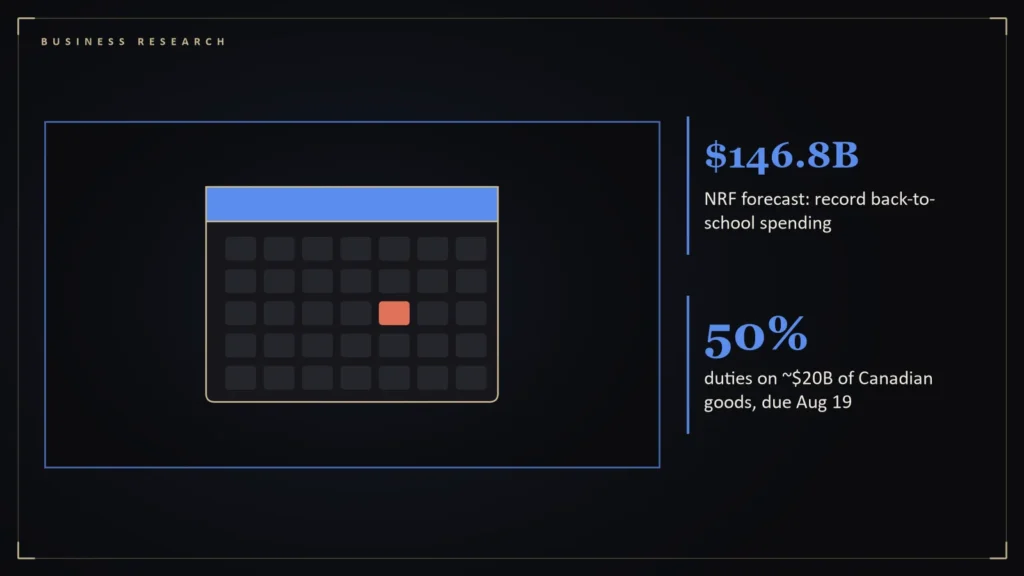
Back-to-school is retail’s second Christmas, and in 2026 it arrived with a deadline attached.
- The National Retail Federation forecast a record $146.8 billion in combined K-12 and college back-to-school spending in 2026 [1].
- Section 338 duties of 50 percent on roughly $20 billion of Canadian goods were due to take effect on August 19 [1].
- The CNBC/NRF Retail Monitor said households were “budget-conscious but took full advantage of back-to-school promotions” [2].
- Growth in back-to-school spending appears concentrated in participation and pricing, not larger per-household baskets [1].
The forecast
The National Retail Federation forecast a record $146.8 billion in combined K-12 and college spending this year, according to a pre-release analysis of the July retail sales report. The analysis notes, though, that growth appears to come from participation and pricing, not from each household buying more [1].
The tariff clock
The same preview flagged an important date: Section 338 duties of 50 percent on roughly $20 billion of Canadian goods were set to take effect on August 19, which made July’s retail sales report the last major spending data before that shock [1]. Retailers often pull purchases forward ahead of tariff dates, and that can distort the numbers.
What shoppers did
The CNBC/NRF Retail Monitor’s August report, based on card data, found that sales rose modestly, extending a streak of monthly growth to 11 months. NRF’s Matthew Shay said households remained “budget-conscious but took full advantage of back-to-school promotions to stretch their dollars,” attributing the steady performance to low unemployment and consistent wage growth [2].
The forecast, taken apart
The $146.8 billion forecast is the sum of two very different pieces: $43.3 billion for K-12, up 9.9 percent from $39.4 billion in 2025, and $103.5 billion for college, up 16.6 percent from $88.8 billion [1]. The average K-12 household planned to spend $863.86, only 0.7 percent more than the $858.07 of 2025, and 64 percent of shoppers expected higher prices [1]. That fits the framework of this article: the headline growth owes more to who is counted and to prices than to bigger baskets.
The tariff arithmetic is concrete. The Section 338 duties, effective at 12:01 a.m. Eastern on August 19, covered roughly $20 billion of Canadian imports, about 5 percent of the $382 billion imported from Canada in 2025, with categories including furniture, clothing, textiles, cement, plywood, paper, cosmetics, fishing rods, hockey sticks and swimming pools; oil, gas, critical minerals, potash and goods under sector tariffs were excluded, and USMCA origin did not exempt covered goods [1]. The baseline for retail was June sales of $768.6 billion, up 0.2 percent on the month and 6.7 percent on the year, with nonstore sales up 1.9 percent on Amazon’s Prime Day of June 23 to 26 and gasoline stations down 5.3 percent [1]. July CPI rose 0.1 percent on the month and 3.4 percent on the year, with gasoline up 24.6 percent over twelve months [1]. Seasonal forecasts and tariff dates are the kind of numbers that move together, which is why the article treats them as a set.
A framework for reading seasonal retail
- Record totals are common when prices rise, so check whether the headline is nominal.
- Pull-forward effects mean one month’s strength can steal from the next.
- Promotions matter: a shopper who buys on sale spends less per item but keeps volume up.
The upshot for 2026 is a consumer who is still showing up, carefully, in a year when fuel costs and tariff headlines have given them every reason to hold back. This is analysis, not investment advice.
Questions readers ask
How much is back-to-school spending forecast to be in 2026?
NRF forecast a record $146.8 billion in combined K-12 and college spending [1].
What tariff took effect on August 19, 2026?
Section 338 duties of 50 percent on roughly $20 billion of Canadian goods were scheduled for that date [1].
References
- US July Retail Sales, August 14: What to Watch — Shopappy — https://shopappy.com/news/industry-news/us-july-retail-sales-august-14
- CNBC/NRF Retail Monitor Shows 11th Month of Sales Growth in August — National Retail Federation — https://nrf.com/media-center/press-releases/cnbc-nrf-retail-monitor-shows-11th-month-of-sales-growth-in-august