How MP3 Works: Throwing Away What You Cannot Hear
MP3 compression uses psychoacoustic masking to discard sounds the ear would miss. The file name '.mp3' was chosen on July 14, 1995 at Fraunhofer IIS.
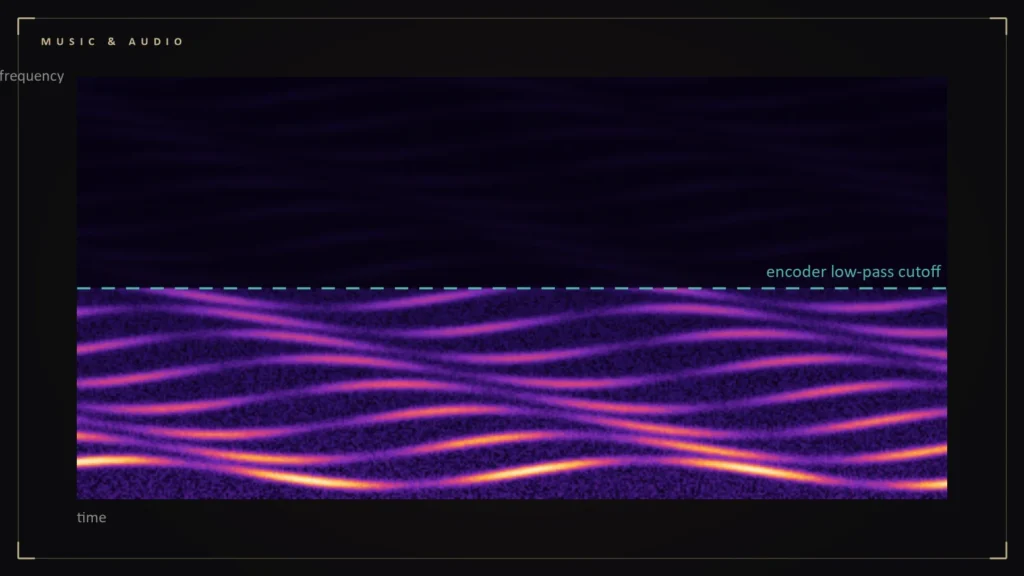
MP3 is a clever kind of packing. Imagine a suitcase where you can leave behind the clothes you would never have noticed missing. MP3 does the same with sound, and the trick is a branch of science called psychoacoustics.
- The ‘.mp3’ file extension was chosen on July 14, 1995 by an internal email poll at Fraunhofer IIS; it abbreviates MPEG-1 Audio Layer-3 [1].
- MP3 uses psychoacoustic masking: it finds components inaudible to us and stores them with less precision [1].
- Fraunhofer says this makes files up to ten times smaller with virtually no audible difference from the original [1].
- Uncompressed CD audio runs at 1,411.2 kbps, so a 128 kbps MP3 is roughly one eleventh the data rate.
A name chosen by poll
Fraunhofer IIS, the German institute that developed MP3, says the “.mp3” file extension was chosen on July 14, 1995, through an internal email poll. The name abbreviates “MPEG-1 Audio Layer-3” [1]. The core team included Karlheinz Brandenburg, Harald Popp, Jürgen Herre and Bernhard Grill, working under Prof. Dieter Seitzer [1].
The principle: masking
Human hearing has blind spots. A loud sound can hide a quieter one nearby in pitch or time. MP3 exploits this. Fraunhofer explains that the format takes advantage of the characteristics of human hearing by identifying components that are inaudible to us and storing those irrelevant parts with less precision [1]. This is called perceptual coding, and it is why MP3 is called lossy: some information is genuinely discarded.
How much is saved
Fraunhofer says the result is files up to ten times smaller with virtually no audible difference from the original [1]. The arithmetic bears this out. Uncompressed CD audio runs at 1,411.2 kbps (44,100 samples × 16 bits × 2 channels). A 128 kbps MP3 is about 1,411.2 ÷ 128, or roughly 11 times smaller. That is the origin of the pocket music library.
Standardised in the 1990s
The format was standardised through the ISO-MPEG committee as part of the MPEG-1 standard, which included three audio coding layers; Layer 3 is MP3 [1]. Fraunhofer reports that the technology generated hundreds of millions of euros in licensing revenue [1].
The song that nearly broke the codec
NPR’s history of MP3 includes a famous test. Karlheinz Brandenburg says that in 1988 he thought the system was near perfect until he heard the a cappella version of Suzanne Vega’s “Tom’s Diner”; a single voice with little ambience was “really a worst case” for the system as it stood, and her voice was destroyed [2]. He worked with Jim Johnston of AT&T on psychoacoustic models and data coding until the voice came through in full fidelity, and says he has listened to the song 500 or 1,000 times [2].
Adoption was slow. The International Organization for Standardization included the format in 1992 as one of several options, and most consumer-electronics companies preferred the simpler Layer II; early users included Telos Systems in Cleveland, which sent audio over ISDN lines [2]. In 1994 the team saw a window of opportunity to make Layer III the internet audio standard, and on July 14, 1995 they chose the .mp3 extension; the business plan was expensive encoders for companies and cheap decoders for everyone, and the free Winamp player helped spread the format [2].
Lossy versus lossless
- MP3: smaller, with information permanently discarded.
- FLAC and WAV: larger, with the original preserved. See FLAC vs MP3.
- The quality claim is the maker’s. “Virtually no audible difference” is Fraunhofer’s description and depends on bitrate and listener.
Questions readers ask
What does MP3 stand for?
MPEG-1 Audio Layer-3. The .mp3 file extension was chosen on July 14, 1995 at Fraunhofer IIS [1].
How does MP3 make files smaller?
It uses psychoacoustic masking to find components the ear would not notice and stores them with less precision [1].
References
- 30 Years of .mp3: Three Letters That Changed the World, Fraunhofer IIS — https://www.iis.fraunhofer.de/en/magazin/panorama/2025/30-years-of-mp3.html
- The MP3: A History Of Innovation And Betrayal, NPR — https://www.npr.org/sections/therecord/2011/03/23/134622940/the-mp3-a-history-of-innovation-and-betrayal