The Little Black Dress: Vogue’s 1926 ‘Ford of Fashion’
In October 1926 Vogue put Chanel's simple black dress on its cover and called it 'The Ford', predicting it would become a uniform for women of every income.
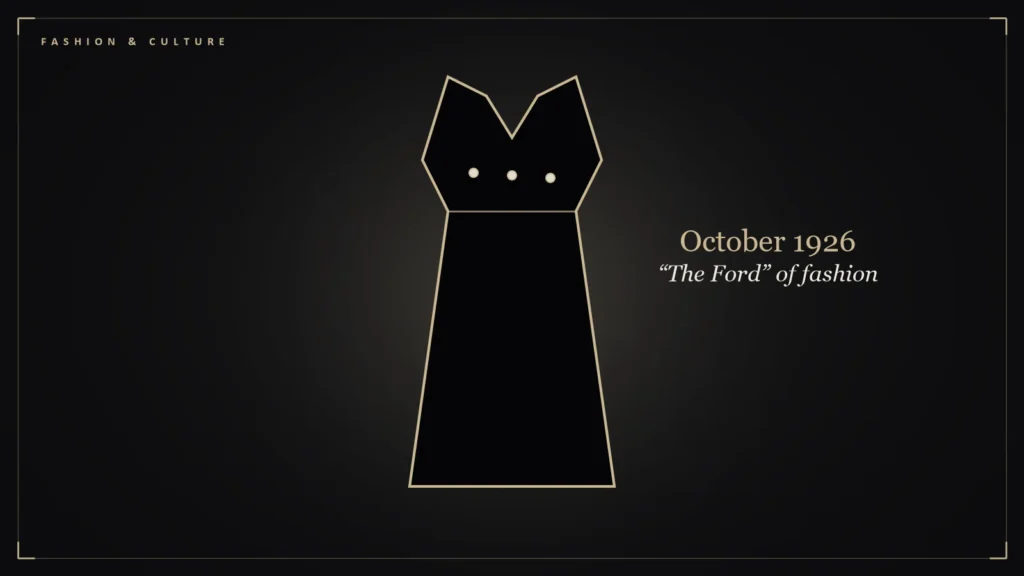
Fashion usually runs on novelty. The little black dress ran on repetition. A garment that is meant to be the same everywhere is the opposite of an event, and that was the point.
- In October 1926 American Vogue featured a simple black dress by Coco Chanel on its cover [1].
- The magazine dubbed it ‘the Ford’, after the popular Model T, because it was a standard that many women could wear [1].
- The comparison echoed Henry Ford’s remark that his car was available in any color so long as it was black [1].
- The Met holds Chanel pieces from the era that show her approach to simple, practical design [2].
The cover
Smithsonian Magazine reports that in October 1926 Vogue featured on its cover a simple black dress by Coco Chanel, and described it as “The Ford” [1]. The reference was to the Model T, then enormously popular. As Henry Ford had said of his car, it came in any color so long as it was black [1].
Why the label stuck
The article says the dress was immediately dubbed the “Ford of Fashion” for its transformative qualities [1]. The comparison made two claims. First, like a Model T, the dress was a standard rather than a one-off. Second, it was accessible: a design that many women could wear, in different fabrics and at different price points.
Simple on purpose
Chanel’s silhouette was sporty and drew on menswear, according to the Smithsonian account [1]. The Metropolitan Museum of Art’s collection includes several Chanel evening dresses and ensembles that show the house’s craftsmanship and its simple, practical approach to design in the 1920s [2].
What was new about it, and the single-model problem
The Smithsonian’s account stresses how unusual a plain black dress was. In the Victorian and Edwardian periods, simple black garments were more likely to be linked with servants or mourning than with haute couture, and even wearing a plain dress in public was a departure from tradition [1]. By 1926 Chanel was already famous for unconventional cloth such as jersey, which was unheard of in couture, and for cuts that often took notes from men’s clothes; the BBC is quoted saying her intention was that the garment be available to the widest possible market [1]. The magazine’s cover drawing showed a woman in pumps, pearls, a cloche and a long-sleeved black dress belted at a low waist [1].
The Ford comparison is looser than it sounds. Chanel’s Paris headquarters was showing several different models of the black dress, unlike the single identical Model T rolling off American assembly lines by the millions [1]. Black had also been the colour of mourning for many widows in France after the First World War and the Spanish flu, and while other designers turned to colorful clothes as an antidote to the gloom, Chanel steered into it, offsetting severe lines with a rope of large fake pearls, a fabric camellia or a plain cloche [1]. So the “standard” was a style, not a single garment.
What survives of the idea
- A system, not a style. One dress, many occasions.
- Constraint as design. One color forces attention to cut and fabric.
- Cultural echo. The same logic runs through minimalist fashion aesthetics.
This article draws on a short magazine account and museum collection pages; it does not cover the dress’s later history in detail.
Questions readers ask
What did Vogue call Chanel's little black dress in 1926?
‘The Ford’, after the Model T, according to Smithsonian Magazine [1].
Why was it compared to a Ford?
Like the Model T, it was a standard many people could have, echoing Henry Ford’s remark about any color so long as it was black [1].
References
- Why Coco Chanel Created the Little Black Dress, Smithsonian Magazine — https://www.smithsonianmag.com/smart-news/why-coco-chanel-created-lbd-180965024/
- Gabrielle 'Coco' Chanel (1883-1971) and the House of Chanel, The Metropolitan Museum of Art — https://metmuseum.org/TOAH/hd/chnl/hd_chnl.htm