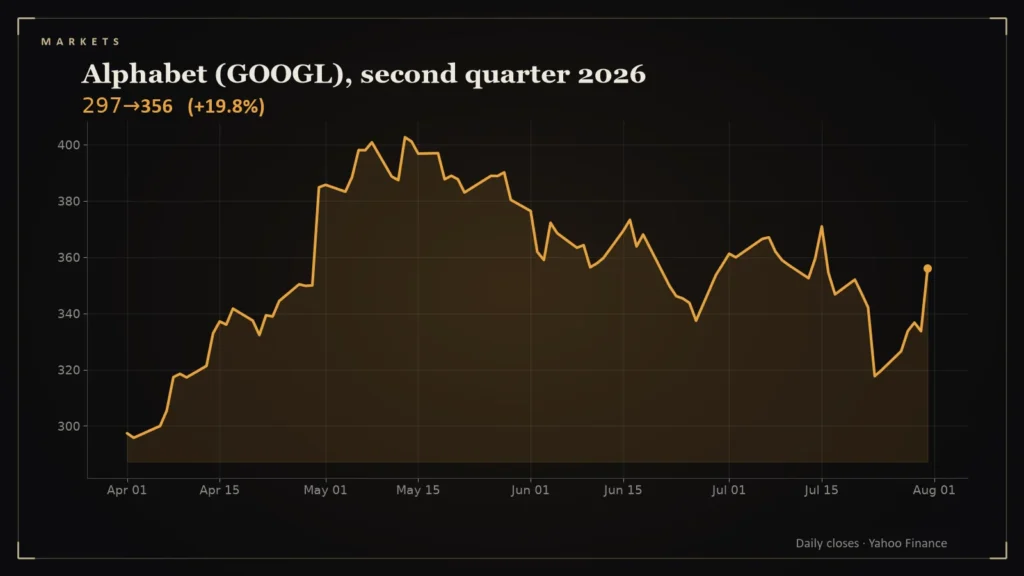
The S&P 500 contains 500 companies, and a handful of them are so large that when one has an unusual quarter, the whole index’s statistics change. In July 2026, a single company did exactly that.
- As of July 24, 2026, Alphabet reported a $98 billion gain, producing EPS of $9.11 against a $2.88 estimate [1].
- The S&P 500’s earnings surprise was 39.3 percent with Alphabet and 12.6 percent without it [1].
- Blended earnings growth stood at 37.9 percent, or 25.9 percent excluding Alphabet, at that point [1].
- Index statistics are averages; a single outlier in a weighted average can move the result.
The July 24 snapshot
When FactSet published its update on July 24, with about 27 percent of S&P 500 companies reported, the headline numbers were extraordinary. Blended earnings growth was 37.9 percent, the highest since the third quarter of 2021, and the earnings surprise was 39.3 percent [1].
The Alphabet effect
Alphabet had reported a $98 billion gain, producing earnings per share of $9.11 against an estimate of $2.88. Take Alphabet out and the surprise falls from 39.3 percent to 12.6 percent, and the growth rate from 37.9 percent to 25.9 percent [1]. One company accounted for roughly two-thirds of the surprise.
Why that happens
Index-level earnings are a sum, not an average of percentages. A company with enormous earnings contributes enormous dollars to the total, and when that company records a large one-time item such as a gain on equity securities, the total jumps. The measure is not wrong; it just answers “how did the index’s aggregate earnings compare with expectations?” rather than “how did the typical company do?”
Early in the season, and unusually skewed
The July 24 snapshot was an early one: only 27 percent of S&P 500 companies, about 135, had reported [1]. Of those, 86 percent beat EPS estimates against a five-year average of 78 percent, and 80 percent beat revenue estimates against a five-year average of 70 percent; the aggregate revenue surprise was 2.8 percent against a five-year average of 1.9 percent, and blended revenue growth of 13.2 percent was the highest since the 13.9 percent in the second quarter of 2022 [1]. Ten of eleven sectors were growing, with Energy, Communication Services, Information Technology and Materials leading and Health Care the only decline [1].
Because so few companies had reported, a single large item could move the aggregate a long way, which is what the Alphabet gain did. Analysts projected third-quarter earnings growth of 27.3 percent, fourth-quarter growth of 24.9 percent and 27.3 percent for the full year, and the forward 12-month price-to-earnings ratio was 20.1, above the five-year average of 19.9 and the ten-year average of 19.0; another 177 companies were scheduled to report the following week [1]. Early-season statistics are provisional by construction, which is why the later August 7 update told a different story in several details.
The better reading
- Prefer the version excluding the outlier when you want to know about typical companies; FactSet publishes both.
- Check the revenue picture, which was strong in July: 80 percent of companies had beaten revenue estimates and revenue growth was 13.2 percent, the highest since Q2 2022 [1].
- Remember that gains on investments can reverse next quarter.
Even without Alphabet, an earnings growth of 25.9 percent is strong. The lesson is not that the quarter was weak, but that the headline overstated how broad the strength was. This is analysis, not investment advice.
Questions readers ask
How did Alphabet affect Q2 2026 S&P 500 earnings?
Its $98 billion gain lifted the index earnings surprise to 39.3 percent as of July 24, versus 12.6 percent without it [1].
Why can one company skew index earnings?
Index earnings are aggregated in dollars, so a very large company with a one-time gain adds a large amount to the total [1].
References
- S&P 500 Earnings Season Update, July 24, 2026 — FactSet — https://insight.factset.com/sp-500-earnings-season-update-july-24-2026