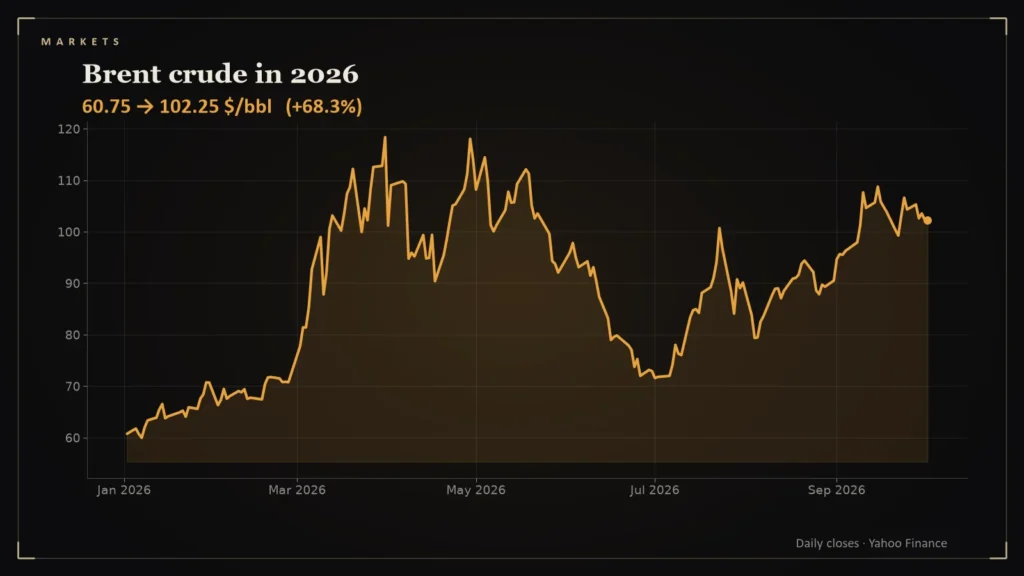
Most people have never thought about the Strait of Hormuz. In 2026 it became the most expensive piece of water in the world.
- The Strait of Hormuz handles roughly one-fifth of global seaborne petroleum trade [1].
- Before the conflict began February 28, 2026, about 138 vessels transited per day; by March 13 only a handful did, and at least 16 commercial vessels had been attacked [2].
- The International Energy Agency released 400 million barrels from emergency reserves, which did not significantly calm prices [2].
- Brent peaked at $118.35 on March 31, up from $72.48 on February 27 [3].
A chokepoint, not a pipeline
Oil is shipped in tankers, and tankers from the Persian Gulf have to pass through one channel, the Strait of Hormuz, to reach open sea. About one-fifth of global seaborne petroleum trade moves through it [1]. When a single route carries that much, any disruption hits supply faster than producers elsewhere can respond.
What happened in March
The U.S. and Israel launched strikes on Iran on February 28. By March 13, shipping through the strait had nearly halted, with only a handful of vessels passing daily, down from an average of 138 before the conflict, and at least 16 commercial vessels had been attacked [2]. Global supplies faced a daily shortfall estimated at 15 to 20 million barrels [2]. The International Energy Agency’s release of 400 million barrels from emergency reserves did not significantly calm markets [2].
The price effect
Brent crude closed at $72.48 on February 27 and hit $118.35 on March 31, an increase of about 63 percent in a month [3]. That is the shape of a supply shock: a quick, large jump, followed by partial retreats as demand adjusts and stockpiles are drawn.
Why it spreads
- Fuel: gasoline rose 27.4 percent over 12 months through August [4].
- Inflation: energy lifted headline CPI to 3.4 percent while core stayed at 2.4 percent [4].
- Policy: central banks, including the Fed and ECB, raised rates on September 16 [5][6].
From the chart to the forecasts
The March price data show how fast the shock arrived. Brent closed at $72.48 on February 27 and $118.35 on March 31, a rise of 63 percent in a month, and it closed at or above $100 on 13 of the 22 March sessions (my calculation from daily closes) [3]. Even with the International Energy Agency’s release of 400 million barrels from emergency reserves, prices stayed high [2].
Forecasters then framed the path as conditional on the strait. Goldman Sachs said that if Hormuz stayed closed, Brent could average $120 in the third quarter and $115 in the fourth, against $82 and $80 if the situation improved, and that the risks to its forecast were skewed to the upside [7]. On April 12, with Brent at $96.51, the bank described the situation as fluid [7]. The lesson of a chokepoint is that the price encodes a probability of closure as much as the current flow of barrels.
Why it persists
The EIA warns that tanker restrictions could leave millions of barrels a day shut in through year-end [1], and Goldman Sachs has warned that Brent could stay above $100 through 2026 if the closure drags on [7]. Inventories refill slowly, insurance rates stay high, and ships take weeks to reposition.
The key lesson is geographic: a global market can depend on one narrow passage. This is analysis, not investment advice.
Questions readers ask
What is the Strait of Hormuz?
A narrow channel between the Persian Gulf and the open sea that handles roughly one-fifth of global seaborne petroleum trade [1].
How much did oil prices rise in March 2026?
Brent rose from $72.48 on February 27 to $118.35 on March 31, about 63 percent [3].
References
- Brent climbs past $100 as US-Iran clashes in Strait of Hormuz reignite global energy fears — Business Today — https://www.businesstoday.in/world/story/brent-climbs-past-100-as-us-iran-clashes-in-strait-of-hormuz-reignite-global-energy-fears-554426-2026-09-10
- Oil stays above $100 a barrel amid Iran's stranglehold on Strait of Hormuz — Al Jazeera — https://www.aljazeera.com/amp/economy/2026/3/13/oil-stays-above-100-a-barrel-amid-irans-stranglehold-on-strait-of-hormuz
- Brent Crude Oil (BZ=F) Historical Prices — Yahoo Finance — https://finance.yahoo.com/quote/BZ%3DF/history/
- Consumer Price Index — August 2026 — U.S. Bureau of Labor Statistics — https://www.bls.gov/news.release/cpi.nr0.htm
- Federal Reserve Press Release, September 16, 2026 — Federal Reserve Board — https://federalreserve.gov/newsevents/pressreleases/monetary20260916a.htm
- ECB Key Interest Rates — European Central Bank — https://www.ecb.europa.eu/stats/monetary/rates/html/index.en.html
- Brent to stay above $100 through 2026 if Hormuz closure drags on another month, warns Goldman Sachs — Yahoo Finance — https://finance.yahoo.com/sectors/energy/articles/brent-stay-above-100-2026-003121731.html