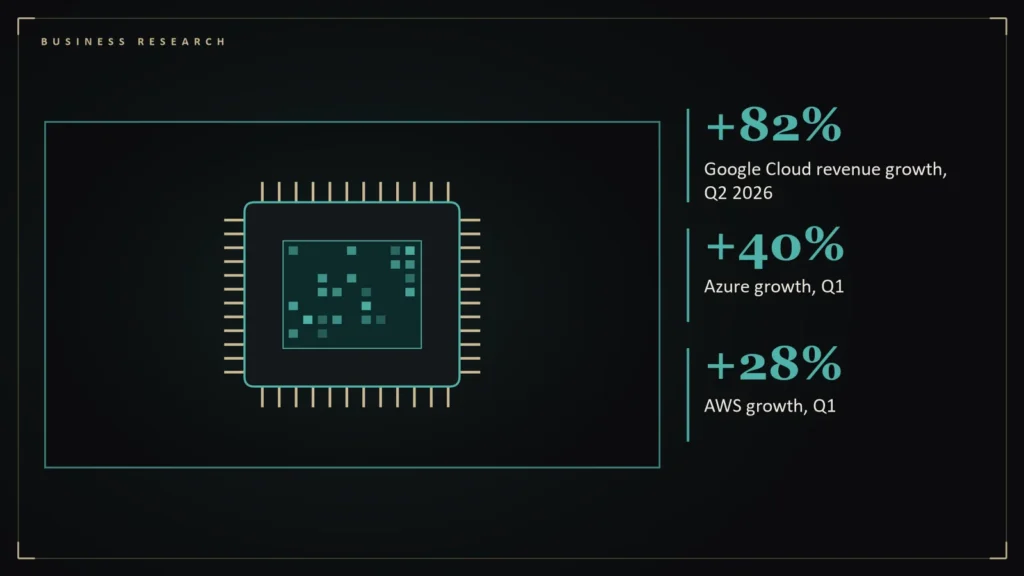
The case for the AI build-out comes down to a single line on a spreadsheet: does the spending produce revenue? For the three biggest cloud providers, the answer so far is yes, and the pace is startling.
- Google Cloud revenue grew 82 percent in the second quarter of 2026, its fastest pace since 2020 [1].
- Azure grew 40 percent in the first quarter and was estimated at about 39 percent in the second [1].
- AWS grew 28 percent in the first quarter, with about 32 percent estimated for the second [1].
- Revenue growth is only half the test; capex and free cash flow are the other half [1].
The growth rates
According to a Digital Today review of the second-quarter earnings season, Google Cloud grew 82 percent, its fastest rate since 2020. Azure, Microsoft’s cloud platform, grew 40 percent in the first quarter and was estimated near 39 percent in the second. Amazon Web Services grew 28 percent in the first quarter, with roughly 32 percent estimated for the second [1]. Estimates are analyst figures, not reported results, and should be read that way.
Why cloud is the scoreboard
Cloud revenue is where AI demand is easiest to see. Companies rent computing power and model access by the hour, and those bills show up in the cloud segments. When the segments accelerate, it suggests customers are actually paying for the capacity being built.
The other half of the equation
Growth like this has a price. The same companies are guiding to enormous capital spending in 2026 and Alphabet and Amazon both reported negative free cash flow for the first time, with long-term debt up 111 percent and 81 percent respectively [1]. Revenue growth of 30 to 80 percent is impressive only if the capacity it requires does not grow faster than the revenue it earns.
Reading growth rates with care
Growth percentages hide the size of the base, and the source gives only rates, not dollar revenue. Google Cloud’s 82 percent in the second quarter is the fastest since at least 2020, while AWS grew 28 percent in the first quarter with about 32 percent estimated for the second, and Microsoft’s Azure and cloud services grew 40 percent with about 39 percent estimated [1]. Read together, AWS was accelerating and Azure was holding roughly steady in the estimates, while Google Cloud was the outlier. A fast rate on a smaller base can add fewer dollars than a slower rate on a larger one, so the ranking by percentage is not a ranking by revenue.
Analysts treat these numbers as the payoff for spending. Evercore ISI’s Mark Mahaney was quoted saying Alphabet’s higher capital spending raises the likelihood that Amazon and Microsoft will make similar decisions [1]. Meanwhile free cash flow turned negative at Alphabet in the second quarter for the first time and was in deficit at Amazon in the first quarter, with an annual deficit expected [1]. That is the other side of the scoreboard: cloud growth is the evidence that the spending can earn a return, and cash flow is the evidence of what it costs while the return arrives.
What to watch next
- Growth durability: whether Azure and AWS hold near 40 and 30 percent, or slow as the base grows.
- Margins: whether the new capacity earns the same profit as the old.
- Customer concentration: a handful of AI labs account for a large share of demand, which is a risk if their own financing falters.
For now the evidence supports the optimists on revenue and the skeptics on cash. Both can be right at once. This is analysis, not investment advice.
Questions readers ask
How fast is Google Cloud growing?
It grew 82 percent in the second quarter of 2026, its fastest since 2020, per a Digital Today review [1].
Are the Azure and AWS figures reported or estimated?
The Q1 growth rates (Azure 40 percent, AWS 28 percent) were reported; the Q2 figures (about 39 and 32 percent) were analyst estimates [1].
References
- AI investment worries spread after Alphabet capex hike; Amazon, Microsoft, Meta also face scrutiny — Digital Today — https://www.digitaltoday.co.kr/en/view/86477/ai-investment-worries-spread-after-alphabet-capex-hike-amazon-microsoft-meta-also-face-scrutiny