No Fourth Neutrino: MicroBooNE Closes One Door and Leaves the Mystery Open
Fermilab's MicroBooNE ruled out a single sterile neutrino at 95% certainty in Nature, December 2025. The LSND and MiniBooNE anomalies remain unexplained.
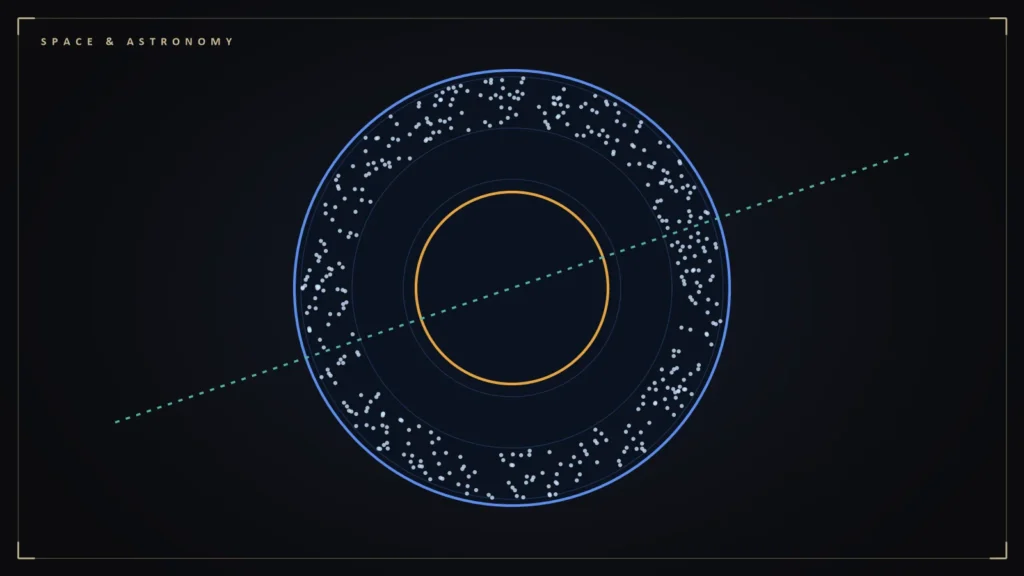
Sometimes a physics result is a closed door, and the interesting part is the room behind the door that is now empty. MicroBooNE has just done that to the idea of a fourth neutrino.
- MicroBooNE excluded a single sterile neutrino as the explanation for decades-old anomalies with 95 percent certainty; the result appeared in Nature on December 3, 2025 [1].
- The anomalies came from LSND (1995) and Fermilab’s MiniBooNE, which saw neutrinos changing flavor in ways three known types could not explain [1].
- The mystery is not solved: scientists still do not know what caused those anomalies [1].
- MicroBooNE is a liquid-argon detector that collected data from 2015 to 2021 using two beams [1].
The old puzzle
In 1995, the LSND experiment at Los Alamos saw muon neutrinos oscillating into another type in a way the three known neutrino flavors could not explain. Fermilab’s follow-up, MiniBooNE, saw similar anomalous behavior at distances shorter than theory allowed [1]. The tidy explanation was a fourth, “sterile” neutrino that does not interact through the weak force, a ghost among ghosts.
How MicroBooNE tested it
MicroBooNE is a liquid-argon time projection chamber positioned 70 meters upstream of MiniBooNE along Fermilab’s Booster Neutrino Beam. It took data from 2015 to 2021, observing neutrinos from two beams, the Booster beam and NuMI [1]. Using one detector and two beams reduces uncertainties and let the team exclude nearly the whole region where a single sterile neutrino could hide. The collaboration reports that it excluded the model with 95 percent certainty, and the work was published in Nature on December 3, 2025 [1].
What is left
Co-spokesperson Matthew Toups, a Fermilab senior scientist, points out that “the Standard Model does a great job describing a host of phenomena” [1]. The sting in the tail is that the original anomalies are still unexplained: with the simplest sterile-neutrino hypothesis largely eliminated, scientists still do not know what caused LSND and MiniBooNE to see what they saw [1].
Who did the work and how
The result comes from a collaboration of 193 scientists at 40 institutions in six countries, hosted by Fermilab, and it used only 60 percent of the total dataset collected [1]. The detector is a liquid-argon time projection chamber that sits 70 meters in front of where MiniBooNE measured, and it was exposed to two neutrino beams at once, the Booster Neutrino Beam and the NuMI beam, a novel approach that let the team test the sterile-neutrino idea from two directions [1].
The 1995 LSND result at Los Alamos and the MiniBooNE experiment designed to check it both suggested oscillations that the three-neutrino model could not explain [1]. The next step is the Short-Baseline Neutrino program, which uses multiple detectors: SBND began taking data in 2024 and ICARUS began collecting beam data in 2021 [1]. As the Fermilab scientist Matthew Toups put it, the Standard Model does a great job describing many phenomena, so any gap in it is worth chasing; here the sterile-neutrino explanation has been ruled out at 95 percent confidence, but the original anomalies are still unexplained [1].
Why a null result is a result
A negative finding is not a failure; it is an elimination. Physics advances by crossing suspects off the list, and a good detector that rules out the usual suspect forces better ideas: an unmodeled interaction, a subtle detector effect, or something new. The detective story is not over. It just lost its most popular suspect.
Questions readers ask
Did MicroBooNE prove sterile neutrinos do not exist?
No. It ruled out a single sterile neutrino as the explanation for the LSND and MiniBooNE anomalies with 95 percent certainty, but other possibilities remain [1].
Where was the result published?
In Nature, on December 3, 2025 [1].
References
- MicroBooNE Finds No Evidence for a Sterile Neutrino — Fermilab — https://news.fnal.gov/2025/12/microboone-finds-no-evidence-for-a-sterile-neutrino/