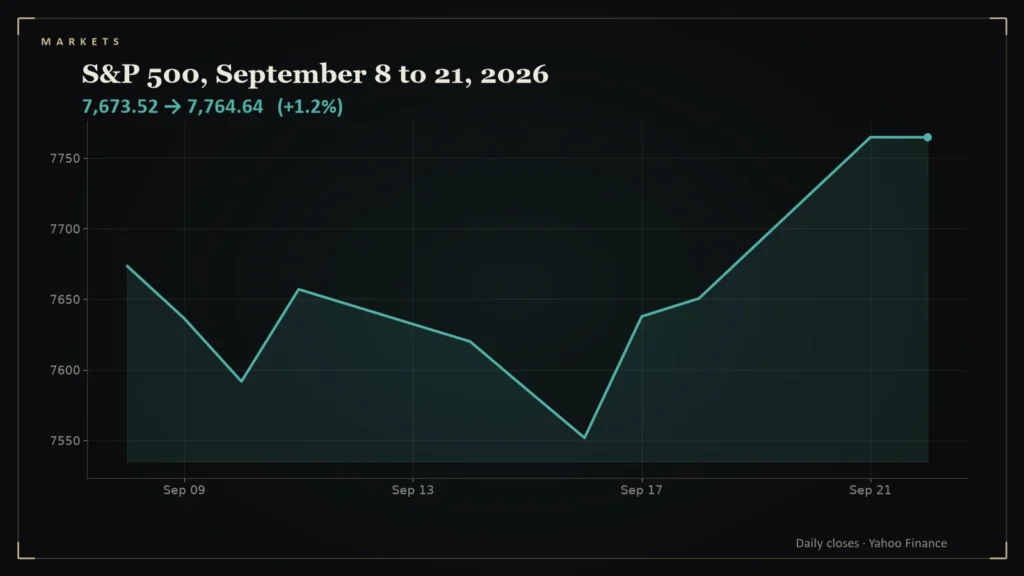
A 1.5 percent gain in the S&P 500 is a loud day by the standards of a calm tape. September 21 was one, and the other prices that moved with it help show what kind of day it was.
- The S&P 500 closed at 7,764.70 on September 21, up 1.49% from 7,650.50 [1].
- That is still 0.4% below the record close of 7,798.99 set on August 13 [1].
- Brent crude fell 3.40% to 100.34 the same day [2].
- Gold fell 0.93% to 4,383.90 dollars an ounce, so the rally was not a flight from risk [3].
The session
The S&P 500 closed at 7,764.70, up 114.20 points or 1.49% from the previous close of 7,650.50 [1]. The Dow rose 0.71% and the Nasdaq Composite 2.26% [4][5]. It was a broad advance rather than a one-sector story.
Still short of the record
The index’s highest close in the data reviewed was 7,798.99 on August 13 [1]. A close of 7,764.70 leaves it 34.29 points, or 0.4%, below that mark. A big day, in other words, is not the same as a new high.
Oil and gold fell too
Brent futures dropped 3.40% to 100.34 dollars a barrel [2]. Gold slid 0.93% to 4,383.90 dollars [3]. Typically, safe-haven buying lifts gold when stocks fall. Here, stocks rose and gold eased, which fits a market in a buying mood rather than a nervous one. The 10-year yield barely changed, at 4.96% against 5.00% [6].
How common are 1.5 percent days?
Across the S&P 500 series from October 2024 to September 21, 2026, there are 491 daily changes, and 23 of them were gains of 1.5 percent or more, roughly 5 percent of sessions [1]. September 21’s own gain of 1.49 percent rounds to 1.5 but just misses that cut, so it is not one of the 23. So a gain this size is uncommon but far from unique. After those 23 earlier large up days that have a following session in the data, the next day’s average change was +0.19%, with 15 of 23 next days positive [1]. That is a small sample and a descriptive result, not a trading rule.
One more detail: the VIX, the market’s fear gauge, barely moved on the day. It closed at 14.87 on September 21 against 14.81 on September 18 [7]. A strong rally with a flat volatility reading suggests investors were not rushing for protection before the move or after it; they were simply buying. That is consistent with a market in a relaxed mood, though, again, the data describes behaviour without proving motive.
The pairing with oil is also worth checking rather than assuming. On 9 of those 23 large up days Brent futures closed lower than the day before [2]. That suggests the combination seen on September 21, stocks up strongly and oil down, has happened before, although the data cannot say whether one drove the other. All counts are my calculation from daily closes and would shift if the start date or the series changed.
What this data cannot tell you
Price tables show what moved, not why. No attempt is made here to assign a cause, and a single day should not be extrapolated. What the numbers do support is a plain description: a broad equity gain on falling oil and slightly lower gold.
All figures are daily closes from Yahoo Finance historical data pages, as of the dates shown.
Questions readers ask
Was September 21 a record day for the S&P 500?
No. It closed at 7,764.70, which is 0.4% below the record close of 7,798.99 on August 13 [1].
Why did oil fall on September 21?
The price data shows Brent fell 3.40% to 100.34 but does not show a cause, and none is asserted here [2].
References
- S&P 500 (^GSPC) Historical Data, Yahoo Finance — https://finance.yahoo.com/quote/%5EGSPC/history/
- Brent Crude Oil Futures (BZ=F) Historical Data, Yahoo Finance — https://finance.yahoo.com/quote/BZ%3DF/history/
- Gold Futures (GC=F) Historical Data, Yahoo Finance — https://finance.yahoo.com/quote/GC%3DF/history/
- Dow Jones Industrial Average (^DJI) Historical Data, Yahoo Finance — https://finance.yahoo.com/quote/%5EDJI/history/
- Nasdaq Composite (^IXIC) Historical Data, Yahoo Finance — https://finance.yahoo.com/quote/%5EIXIC/history/
- CBOE 10-Year Treasury Yield (^TNX) Historical Data, Yahoo Finance — https://finance.yahoo.com/quote/%5ETNX/history/
- CBOE Volatility Index (^VIX) Historical Data, Yahoo Finance — https://finance.yahoo.com/quote/%5EVIX/history/