Gifting by Sign: What Works, What Backfires
A zodiac gift lands when it plays and flatters. Pew data and the psychology of horoscopes explain how to pick one that does not feel like a prediction.
A zodiac gift is a small risk with a good payoff. Done right, it says “I know your whole deal and I like it.” Done wrong, it says “I have read one paragraph about you on the internet.” Three ideas separate the two.
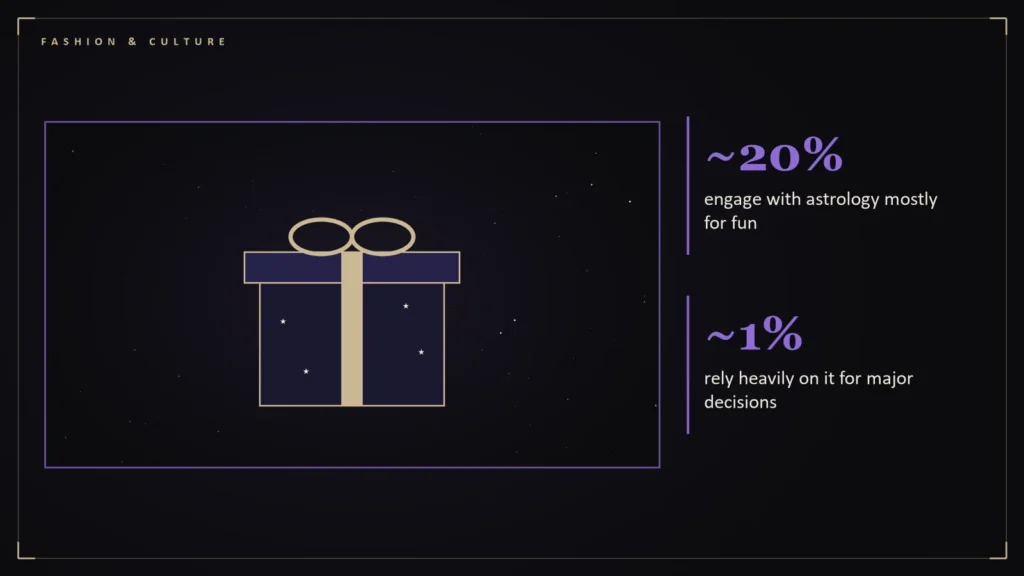
- About 2 in 10 U.S. adults engage with astrology mostly for fun, so a playful gift fits more recipients than a serious one [1].
- Only about 1 percent rely heavily on astrology for major decisions, which makes a gift that sounds like a forecast a poor bet [1].
- Horoscope descriptions feel personal because broad, flattering statements are widely accepted as accurate (the Barnum effect) [2].
- The safest gift celebrates the sign’s reputation without pinning a label on the person.
1. Gift the fun, not the forecast
Pew Research Center found that roughly two in ten U.S. adults use astrology, tarot or fortune tellers mostly for fun, about one in ten because they believe it offers insight, and about 1 percent rely on it heavily for major life decisions [1]. The majority of recipients, believers included, treat it as play. Match that tone: a witty graphic, a constellation chart of their birth sky, a tee in their sign’s signature color. Avoid anything that reads as advice (“Scorpios should never trust…”).
2. Flatter the sign, not the person
Horoscope language works because it is broad and generous. Forer’s classic 1948 experiment found students rated an identical, horoscope-derived paragraph 4.3 out of 5 for accuracy, a pattern known as the Barnum effect [2]. Take the hint: choose a gift that celebrates what the sign is famous for (Leo’s drama, Virgo’s precision) in an affectionate register. Make it a compliment they can accept without claiming you have measured their soul.
3. Check the sign, then check the person
Know the sign before you buy; “close enough” is a gift-card waiting to happen. Then ask what the person actually wears. A zodiac hoodie is a delight for someone who lives in hoodies and a drawer-filler for someone who does not. If they have never mentioned astrology, a small, subtle piece, a glyph on a pocket, a constellation line on a sleeve, travels better than a bold statement.
Who you are buying for
The survey data give a way to think about recipients. About 4 in 10 women ages 18 to 49 believe in astrology, against about 3 in 10 women 50 and over and about 2 in 10 men under 50; about half of LGBTQ+ adults consult astrology, tarot or fortune tellers yearly, and about 2 in 10 of them rely at least a little on those insights for major decisions [1]. A gift that works for a playful believer may land differently for someone who treats it seriously, so the rubric above starts with the person.
The Barnum effect explains why generic zodiac flattery works: people prefer flattering information and tend to trust authority figures, so broad statements feel personal [2]. That is an argument for gifts that celebrate a sign’s symbols, colors or motifs rather than assigning traits. A constellation print says “I noticed what you like”; a printed personality profile says “I have decided what you are like,” and the second is the version most likely to backfire.
A quick rubric
- They love it: go bold, make it theirs, add their rising sign.
- They are curious: a subtle glyph, a note about why you chose it.
- They roll their eyes: skip the sign, gift the sky, with a moon-phase print or a star map of a date that matters.
Questions readers ask
Is a zodiac gift a good idea if the person does not believe in astrology?
Often yes, if it is playful. About 2 in 10 U.S. adults engage with astrology mostly for fun, so a lighthearted sign-themed gift tends to be received as a joke they are in on [1].
References
- How many Americans believe in astrology and rely on fortunetelling? — NBC Chicago, reporting Pew Research Center — https://www.nbcchicago.com/news/national-international/how-many-americans-believe-in-astrology-rely-on-fortunetelling/3751055/
- Barnum Effect — EBSCO Research Starters — https://www.ebsco.com/research-starters/psychology/barnum-effect