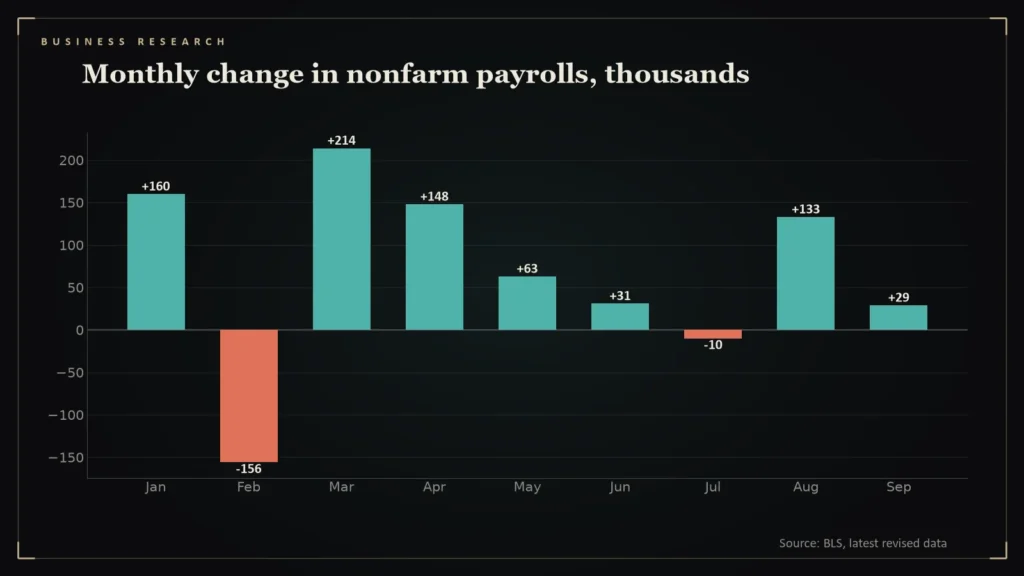
On paper, July was a contradiction: fewer jobs and a lower unemployment rate in the same month. Both numbers are correct, and the gap between them is one of the more useful lessons in reading a labor report.
- July 2026 payrolls were first reported at +21,000 and are now estimated at −10,000 after revision [1].
- The unemployment rate in July was 4.1 percent, down from 4.2 percent in June [2].
- The labor force participation rate was 61.4 percent in July and 61.8 percent in September [1][2].
- The Fed’s September statement said job gains “have kept pace with the workforce” [3].
The two surveys
The Bureau of Labor Statistics produces the headline payroll number from a survey of employers, and the unemployment rate from a separate survey of households. They can differ for a month or two for many reasons. In July, the employer survey, after revision, showed payrolls falling by about 10,000, having first been reported as a gain of 21,000 [1]. The household survey showed unemployment at 4.1 percent, a tenth of a point lower than June [2].
How both can be true
Unemployment is the share of people in the labor force without jobs. If the labor force stops growing, or even shrinks, the rate can fall while the count of jobs does not grow. Participation measures that: it was 61.4 percent in July and recovered to 61.8 percent by September [1][2]. The unemployment rate looks better when fewer people are looking for work.
What the Fed said
The FOMC’s September statement used a phrase that captures the same logic: job gains “have kept pace with the workforce, and the unemployment rate has changed little” [3]. The committee was in effect saying that a small number of new jobs is consistent with a stable labor market when the supply of workers is also small.
What the household survey showed in September
The household survey adds texture to the payroll story. In September 7.1 million people were unemployed, the participation rate was 61.8 percent, and the employment-population ratio was 59.2 percent, little changed since January [1]. About 1.9 million people had been unemployed 27 weeks or longer, 27.1 percent of all the unemployed; 4.5 million were working part time for economic reasons, and 5.8 million people outside the labor force said they wanted a job [1]. The number of marginally attached workers fell by 236,000 to 1.5 million [1].
The establishment survey, which counts jobs, showed gains in health care (17,000, slower than its 12-month average of 33,000), construction (11,000) and manufacturing (9,000), and a loss of 7,000 in financial activities [1]. The average workweek was 34.4 hours for all employees [1]. The report also reiterated the revisions that give July its negative figure: July was revised down by 31,000 and August down by 29,000 [1]. A reader checking whether the first number was reliable would look at exactly those revisions.
Why it matters for a reader
- A weak payroll number does not automatically mean rising unemployment.
- Watch participation alongside the jobless rate; a falling rate can reflect fewer people searching.
- Expect the monthly number to be revised. July moved by 31,000 jobs from first print to now [1].
The deeper point is that a slower labor market with slower labor-force growth is a different thing from a weakening one. July looks like the first.
Questions readers ask
How can payrolls fall while unemployment falls?
The two come from different surveys, and the jobless rate can fall when the labor force stops growing, which is why participation is worth watching [1][2].
What was the unemployment rate in July 2026?
4.1 percent, according to the BLS series [2].
References
- The Employment Situation — September 2026 — U.S. Bureau of Labor Statistics — https://www.bls.gov/news.release/empsit.nr0.htm
- BLS Public Data API: Labor Force Statistics, series LNS14000000 and LNS11300000 — https://api.bls.gov/publicAPI/v1/timeseries/data/LNS14000000
- Federal Reserve Press Release, September 16, 2026 — Federal Reserve Board — https://federalreserve.gov/newsevents/pressreleases/monetary20260916a.htm