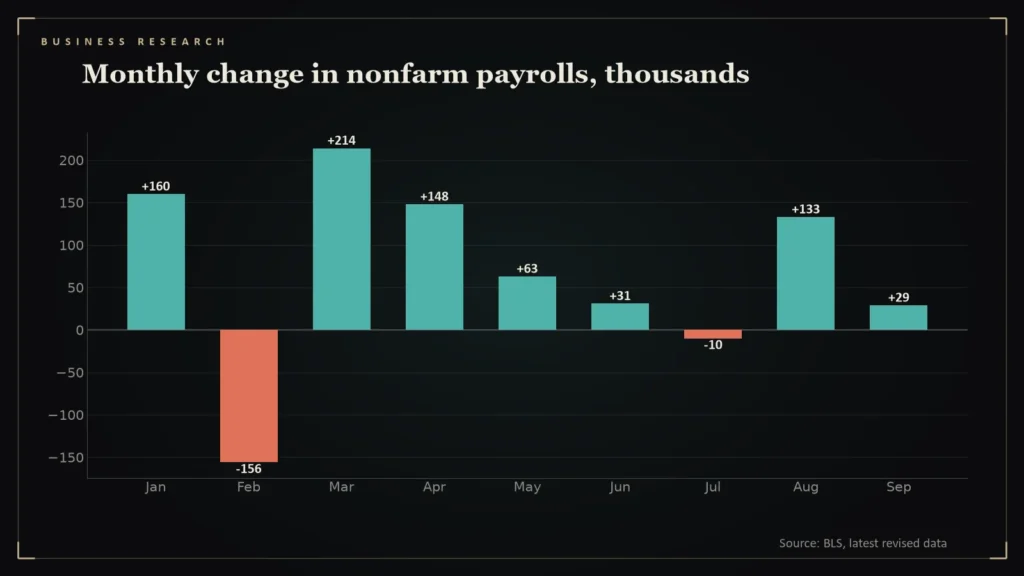
A jobs report is a pulse reading, and September’s was faint but steady. The economy added 29,000 jobs, the unemployment rate stayed at 4.2 percent, and wages crept up by a nickel.
- Nonfarm payroll employment rose by 29,000 in September 2026, with the unemployment rate unchanged at 4.2 percent [1].
- Average hourly earnings for private-sector employees rose 5 cents, or 0.1 percent, to $37.81 [1].
- Compared with September 2025, hourly earnings are up 3.0% ($36.70 to $37.81) and payroll employment up 496 thousand [2].
- The labor force participation rate was 61.8 percent [2].
The headline numbers
The Bureau of Labor Statistics reported on Friday, October 2 that nonfarm payroll employment rose by 29,000 in September, and that the unemployment rate held at 4.2 percent, in a narrow band that has persisted since March. Average hourly earnings for all employees on private nonfarm payrolls edged up 5 cents, or 0.1 percent, to $37.81 [1].
The year-over-year view
Monthly figures wobble, so the longer view helps. Average hourly earnings were $36.70 in September 2025 and $37.81 in September 2026, an increase of 3.0% [2]. Total nonfarm payroll employment was 158,548 thousand a year ago and 159,044 thousand now, an increase of 496 thousand over twelve months, or about 41 thousand a month on average [2].
What 29,000 means
A gain of 29,000 jobs is small beside 2024, when payroll employment grew by an average of about 117 thousand a month [2], and it is a reminder that job growth has slowed. It does not signal a downturn on its own: the unemployment rate has stayed between 4.0 and 4.5 percent in every month with data since January 2025 [2]. Slow hiring with low layoffs is sometimes called a “low hire, low fire” labor market.
Why markets watch it
Jobs and wage data feed expectations for Federal Reserve policy, which in turn shapes bond yields. The 10-year Treasury yield closed at 5.28% on October 2, and the S&P 500 closed at 7,722.72, up 0.73% on the day [3][4]. The data show these moved on the same day as the report, without establishing that the report caused them.
The longer run behind the headline
One month tells little, so look at the run. In the BLS series I pulled, payroll employment grew by an average of 41 thousand a month over the latest twelve months with data, and by 68 thousand a month in 2026 so far [2]. September’s +29 thousand is therefore below both averages. The unemployment rate in that data has moved within a narrow band, from 4.1 to 4.5 percent across the latest twelve months with data [2].
The participation rate adds nuance. It stood at 61.8 percent in September against 62.5 percent twelve data-months earlier [2]. Unemployment can stay flat while hiring slows if fewer people are looking for work, which is one reason economists read the two figures together. Note that the BLS did not publish October 2025 data, so “twelve months” here means twelve published months. Averages are my calculation from the BLS series and will change with revisions.
Fine print
- Monthly estimates are revised. Last month’s figure may change.
- Survey-based numbers carry sampling error. A 0.1 point change in unemployment is within it.
- These are seasonally adjusted figures except where noted.
Questions readers ask
How many jobs were added in September 2026?
Nonfarm payroll employment rose by 29,000, and the unemployment rate held at 4.2 percent, according to the Bureau of Labor Statistics [1].
How fast are wages rising?
Average hourly earnings were $37.81 in September 2026 against $36.70 a year earlier, an increase of 3.0% [2].
References
- The Employment Situation, September 2026, U.S. Bureau of Labor Statistics — https://www.bls.gov/news.release/empsit.nr0.htm
- Bureau of Labor Statistics Public Data API, Current Employment Statistics — https://www.bls.gov/developers/
- CBOE 10-Year Treasury Yield (^TNX) Historical Data, Yahoo Finance — https://finance.yahoo.com/quote/%5ETNX/history/
- S&P 500 (^GSPC) Historical Data, Yahoo Finance — https://finance.yahoo.com/quote/%5EGSPC/history/