Marist’s March Snapshot: Fraud Tops the List of Election Worries
Marist's March 2026 poll found 63% confident ballots will be counted accurately and voter fraud topping concerns at 33%. A close reading of the numbers.
Pollsters rarely ask the same question twice in the same words, which is why Marist’s tracking of election security is valuable: it lets us watch a belief move. The March 2026 edition, taken for NPR and PBS News, shows how.
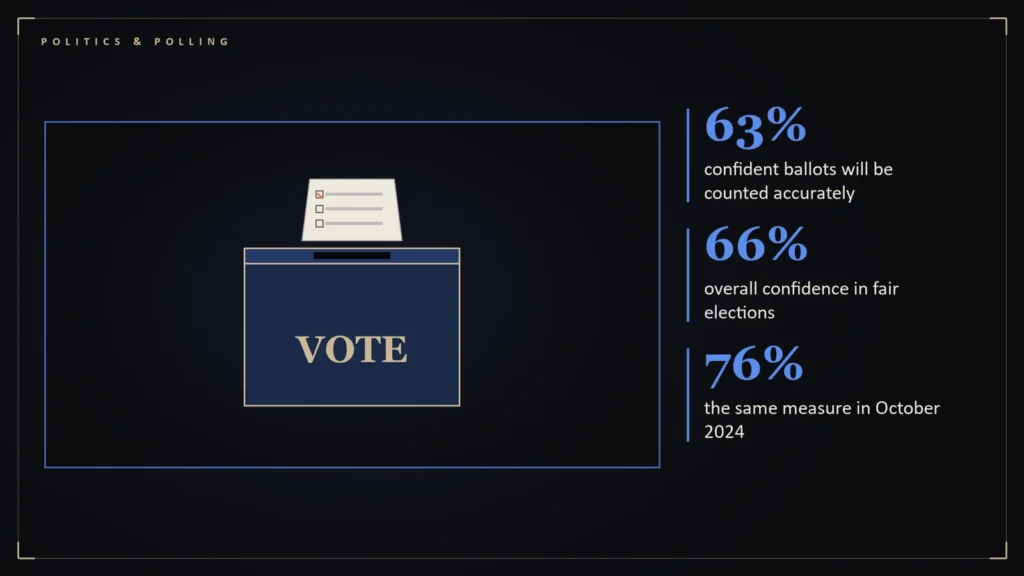
- Marist’s March 2-4, 2026 poll of 1,591 adults (margin of error plus or minus 2.8 points) found 63 percent confident ballots will be counted accurately in November [1].
- Confidence that local elections will be fair was 72 percent among Democrats, 70 percent among Republicans and 65 percent among independents [1].
- Overall confidence in fair elections was 66 percent, down from 76 percent in October 2024 [1].
- Voter fraud was the top-named threat at 33 percent, whereas misleading information led in January 2020 at 35 percent [1].
The basics
The survey interviewed 1,591 national adults between March 2 and 4, 2026, with a margin of error of plus or minus 2.8 percentage points. Sixty-three percent expressed substantial or moderate confidence that ballots cast in November’s midterms will be counted accurately [1].
Local versus national
When respondents were asked about their own local elections, confidence was higher and more bipartisan: 72 percent of Democrats, 70 percent of Republicans and 65 percent of independents expected fairness [1]. Trust tends to be highest closest to home, where people can see the poll workers.
The ten-point drop
Marist also compared overall confidence in fair elections with earlier waves. Sixty-six percent of Americans were very confident or confident this time, against 76 percent previously, a ten-point decline since October 2024 [1].
Beyond the headline numbers
Marist asked what Americans see as the biggest threat to election security. Voter fraud was named by 33 percent, misleading information by 26 percent, voter suppression by 24 percent, foreign interference by 8 percent and problems at polling places by 7 percent [1]. Half of respondents thought fraud was very likely or likely, but the partisan split was wide: 70 percent of Republicans, 45 percent of independents and 32 percent of Democrats [1]. On the opposite worry, 58 percent thought it likely that eligible voters would be told they are ineligible, including 74 percent of Democrats against 47 percent of Republicans and independents [1].
Priorities divide the same way. Overall, 59 percent said ensuring everyone eligible can vote matters more and 41 percent said preventing ineligible voting matters more; 70 percent of Republicans chose prevention, while 86 percent of Democrats and 53 percent of independents chose access [1]. On other questions, 54 percent opposed and 46 percent supported National Guard presence at polling places, 85 percent expected artificial intelligence to spread false election information, and 68 percent called betting on elections unacceptable [1]. The poll used 1,591 adults and a margin of error of plus or minus 2.8 points, so the smaller gaps should be treated cautiously [1].
What people worry about
The leading perceived threat to election security was voter fraud, named by 33 percent. In January 2020 the top threat in Marist’s polling had been misleading information, at 35 percent [1]. The shift is a useful reminder that what people fear changes with the news cycle, and that a worry can be sincere without being evidence of the thing itself.
The takeaway is not that confidence has collapsed but that it has become more conditional: higher at the local level, lower nationally, and shaped by which threat is most often in the headlines.
Questions readers ask
What did Marist's March 2026 poll find about ballot counting?
Sixty-three percent expressed substantial or moderate confidence that ballots will be counted accurately in November [1].
What is the biggest perceived threat to election security in the poll?
Voter fraud, at 33 percent [1].
References
- Election Security, March 2026 — NPR/PBS News/Marist Poll — https://maristpoll.marist.edu/polls/election-security-march-2026/