Four Mini-Earths Next Door: What Barnard’s Star Actually Has
Four planets, each a fifth to a third of Earth's mass, orbit Barnard's Star six light-years away. Why they matter and why none are habitable.
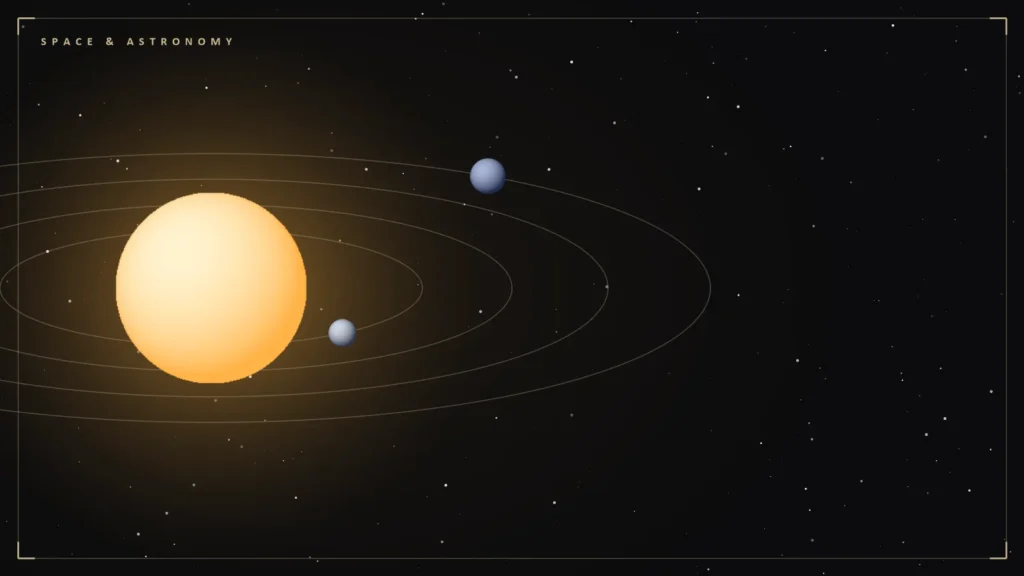
Barnard’s Star is the closest single star to the Sun after the Alpha Centauri system, a dim red dwarf six light-years away. It has always attracted dreamers, and astronomers have finally confirmed that it has a family.
- Four planets orbit Barnard’s Star, each between about a fifth and a third as massive as Earth [1].
- Their years last from a little over two days to just under seven; the star is six light-years away [1].
- The detection used radial velocity: MAROON-X on Gemini confirmed the innermost planet and revealed three more, building on ESPRESSO data [1].
- They orbit too close to be habitable, but small rocky planets are probably the best places to look for life [1].
A family of featherweights
Four planets orbit Barnard’s Star, each between about a fifth and a third as massive as Earth [1]. They are tiny by planetary standards, less massive than Venus or Mars would be next to them, and crowded close to the star: the innermost planet’s year lasts a little more than two days, the outermost just shy of seven [1].
The hard part: hearing a whisper in a hurricane
Astronomers found the planets by measuring how their gravity makes the star wobble, a technique called radial velocity. The signals are tiny: the planets tug the star by about 0.2 to 0.5 meters per second, while the star’s own quakes and jitters create noise of roughly 2 meters per second [1]. Teasing the planets out meant building detailed mathematical models of the star’s behavior and subtracting it, like removing a washing machine’s rumble to hear someone whispering in the next room [1].
The instrument that made it possible was MAROON-X, an extreme-precision radial velocity spectrograph on the Gemini telescope on Maunakea in Hawaii. It confirmed the innermost planet and found three siblings. A planet previously reported as “b” had come from ESPRESSO, an instrument on the Very Large Telescope in Chile [1].
How faint the signals are
The four planets are designated b, c, d and e, and the host is a red dwarf six light-years away, the nearest single star to the Sun, since the Alpha Centauri system, though closer, is made of three stars [1]. The detection relied on radial velocity, using MAROON-X on the Gemini telescope in Hawaii and ESPRESSO on the Very Large Telescope in Chile. The planets’ signals are “faint whispers” of 0.2 to 0.5 meters per second, set against stellar noise of roughly 2 meters per second [1]. Pulling out a signal several times smaller than the noise is the part that took years of data.
The discovery team was led by Ritvik Basant of the University of Chicago and published in The Astrophysical Journal Letters in March 2025, and the planets were entered into NASA’s Exoplanet Archive on March 13, 2025 [1]. NASA notes that Barnard’s Star has a history of false planet detections, which is why confirmation by two independent instruments counts for so much [1].
Alive? Probably not, and that is fine
These worlds sit far too close to their star to be habitable [1]. The value of the discovery is different. It shows that small, rocky planets, the kind most likely to host life, can be found and characterized around even the nearest stars, and that our own neighborhood may be full of them [1].
The next step for the field is closer examination: bigger telescopes, more careful modeling of stellar noise, and the patient work of finding the planets that sit far enough out to be temperate.
Questions readers ask
How many planets does Barnard's Star have?
Four are now known, each between about a fifth and a third of Earth’s mass [1].
Could life exist on Barnard's Star planets?
Not on these four: they orbit too close to their star to be habitable [1].
References
- Discovery Alert: Four Little Planets, One Big Step — NASA Science — https://science.nasa.gov/universe/exoplanets/discovery-alert-four-little-planets-one-big-step/