Safe Listening: The 85-Decibel Limit and the Three-Decibel Rule
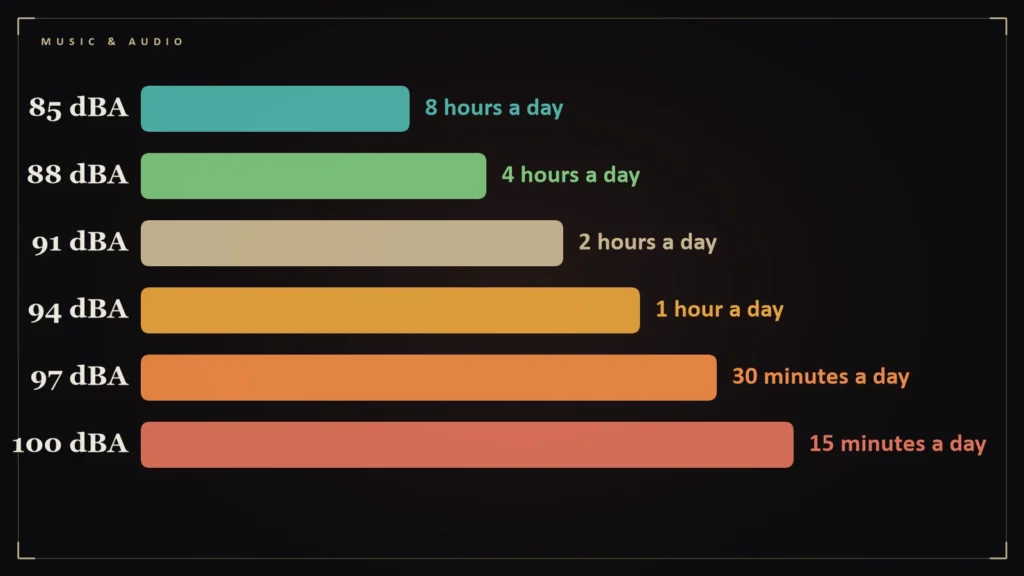
NIOSH recommends no more than 85 dBA averaged over eight hours, and halving exposure time for every 3 dBA increase. By that rule, 100 dBA allows 15 minutes.
Hearing is like a battery that cannot be recharged. Every loud evening takes a little off, and you rarely notice until it has gone. A simple rule makes the cost visible.
- NIOSH’s recommended exposure limit is 85 A-weighted decibels (dBA) averaged over an eight-hour workday [1].
- For each 3 dBA increase in noise level, NIOSH recommends cutting the exposure time in half [1].
- By that rule, 88 dBA allows 4 hours, 91 dBA 2 hours, 94 dBA 1 hour and 100 dBA about 15 minutes.
- At 95 dBA or higher, such as at concert venues, you must shout to be heard by someone 3 feet away [1].
The limit
The U.S. National Institute for Occupational Safety and Health, part of the CDC, has set a recommended exposure limit of 85 A-weighted decibels averaged over an eight-hour workday [1]. Workers exposed at or above that level face significant risk of hearing loss over their careers [1].
The three-decibel rule
Louder sound uses up the allowance faster. NIOSH recommends that for each 3 dBA increase in noise level, the exposure duration be reduced by half [1]. Working it out: 85 dBA allows 8 hours, 88 dBA 4 hours, 91 dBA 2 hours, 94 dBA 1 hour, 97 dBA 30 minutes, and 100 dBA 15 minutes. That is my arithmetic from the rule, and it shows how quickly time collapses as volume climbs.
What the levels feel like
NIOSH gives practical cues. At 85 dBA you must raise your voice to be heard by someone 3 feet away, as with lawn mowers and power tools. At 95 dBA or higher you must shout, as around chain saws, ambulance sirens and concert venues [1].
Warning signs
Signs of noise-induced hearing loss include ringing ears after leaving a noisy area, sounds seeming dull or flat, and needing to turn up the radio or phone compared with before [1]. The CDC notes that noise-induced hearing loss is preventable [1].
Three factors, and what the page tells workers
NIOSH says noise is hazardous depending on how loud it is, how long the exposure lasts and how often it is repeated, and that everyone differs in susceptibility even though the limit is based on eight hours [1]. Equipment that produces about 85 to 90 dBA includes printing presses, lawn mowers, vacuums and power tools, while exposures averaging 95 dBA or more include bulldozers, ambulance sirens, chain saws, bars and nightclubs and large sporting events [1]. NIOSH also offers a sound level meter app for iOS devices [1].
Two practical signs are listed beyond the shouting test: ringing ears or sounds that seem dull or flat after leaving a noisy area, and needing to turn up the car radio or phone volume at the end of a shift compared with the start [1]. For workers the advice is to take breaks, reduce time in noisy areas, keep personal-device volume low, listen only in non-noisy areas and wear hearing protection correctly [1]. For employers it recommends providing hearing protection when noise exceeds 85 dBA regardless of how long it lasts, after trying elimination, substitution and engineering controls first [1].
Applying it to music
- Turn it down a little. Three decibels less doubles your safe time.
- Use the shouting test. If you cannot talk at arm’s length, it is loud.
- Quiet surroundings help. Noise-cancelling headphones reduce the need to turn up.
These are occupational guidelines for adults, not a medical assessment; consult an audiologist about your own hearing.
Questions readers ask
What is a safe noise level for eight hours?
NIOSH recommends 85 A-weighted decibels averaged over an eight-hour workday [1].
How long can you listen at 100 decibels?
By NIOSH’s three-decibel rule, about 15 minutes, since each 3 dBA increase halves the allowed time from 8 hours at 85 dBA [1].
References
- Noise-Induced Hearing Loss, CDC NIOSH — https://www.cdc.gov/niosh/noise/about/noise.html