The Barnum Effect Explains Why Your Zodiac Shirt Feels So Personal
In 1948 students rated an identical horoscope-book paragraph 4.3 out of 5 for accuracy. The Forer effect is why zodiac clothing feels written for you.
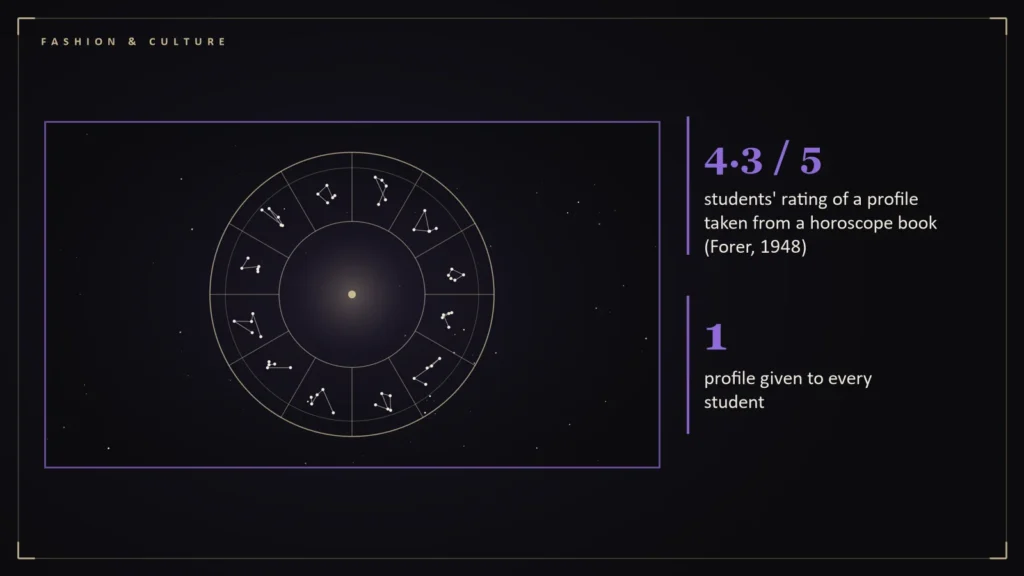
In 1948, psychologist Bertram Forer gave his students a personality test, promised each of them a profile built from their answers, and handed back sheets of paper he described as personal. Every sheet was identical. Forer had assembled it from lines in a horoscope book. The students rated it, on average, 4.3 out of 5 for accuracy [1].
- In Bertram Forer’s 1948 experiment, every student received the same vague profile taken from a horoscope book, and they rated it 4.3 out of 5 for accuracy on average [1].
- The Barnum effect is the habit of accepting broad statements as uniquely descriptive of yourself, especially if they are flattering and sound authoritative [1].
- That is why “Leo = bold” lands: it is positive, broad, and true of almost anyone.
- About 2 in 10 U.S. adults use astrology mostly for fun, which means most wearers already suspect the trick and enjoy the shirt anyway [2].
A cold reading that fits every coat
The experiment gave the phenomenon its name, the Forer effect, or the Barnum effect after the showman. It describes our tendency to accept broad generalizations as accurate and specific to ourselves, particularly when the statements are positive and come from someone who sounds authoritative [1]. “You enjoy being with friends, but sometimes you like your quiet time” is true of nearly everyone, yet it reads like a diagnosis [1].
Why it works on a T-shirt
Zodiac traits are written in the same dialect. Aries is fearless. Libra is fair-minded. Pisces feels everything. Each is flattering, each is vague enough to fit most people on a good day, and each is delivered in a tone of ancient certainty. Print one on a hoodie and you have a garment that quietly tells its wearer they are understood.
None of this makes the clothing silly. Knowing the mechanism does not stop a good song from moving you. It does mean the honest design brief is not “predict the customer” but “give them a flattering mirror.” The craft is in making the mirror beautiful.
The man behind the name
The label comes from showman P.T. Barnum (1810 to 1891), co-founder of the Barnum & Bailey Circus, who sold fraudulent attractions such as the “FeeJee Mermaid,” the remains of a monkey and a fish presented as a mummified mermaid, and who called his practice “humbugging” [1]. Forer himself did not use the name. The psychologist Paul Meehl coined the term “Barnum effect” in a 1956 article in American Psychologist, roughly a decade after Forer’s experiment, and warned psychologists against relying on indistinct statements in their own practice [1].
In Forer’s study the students did not know the profile was identical for everyone: he delayed revealing the trick until after they had rated its accuracy [1]. The effect is stronger when people like what they hear and when they trust the source, which explains why it shows up in horoscopes, cold readings, online personality quizzes, marketing copy and self-help writing [1]. Knowing the mechanism does not ruin the shirt; it just changes what you are buying, an affectionate nod rather than a diagnosis.
The wearer is usually in on it
Pew Research Center’s survey of U.S. adults found that roughly two in ten use astrology, tarot or fortune tellers mostly just for fun, while about one in ten do so because they believe it offers helpful insight [2]. A large part of the audience, in other words, is already aware that this is play. They wear their sign the way someone wears a team jersey: as membership, not as a forecast. That is a healthier relationship than the mystics or the skeptics usually assume.
Questions readers ask
What is the Barnum effect?
It is the tendency to accept very broad generalizations as accurate descriptions of oneself, particularly when they are flattering and presented as authoritative [1].
What did Forer's 1948 experiment show?
Students who each received an identical, horoscope-derived profile rated it 4.3 out of 5 for accuracy on average, without knowing everyone had the same text [1].
References
- Barnum Effect — EBSCO Research Starters — https://www.ebsco.com/research-starters/psychology/barnum-effect
- How many Americans believe in astrology and rely on fortunetelling? — NBC Chicago, reporting Pew Research Center — https://www.nbcchicago.com/news/national-international/how-many-americans-believe-in-astrology-rely-on-fortunetelling/3751055/