Economists talk about the labor market, inflation and interest rates as separate stories. In 2026 they are one story, and you need all three dials to read it.
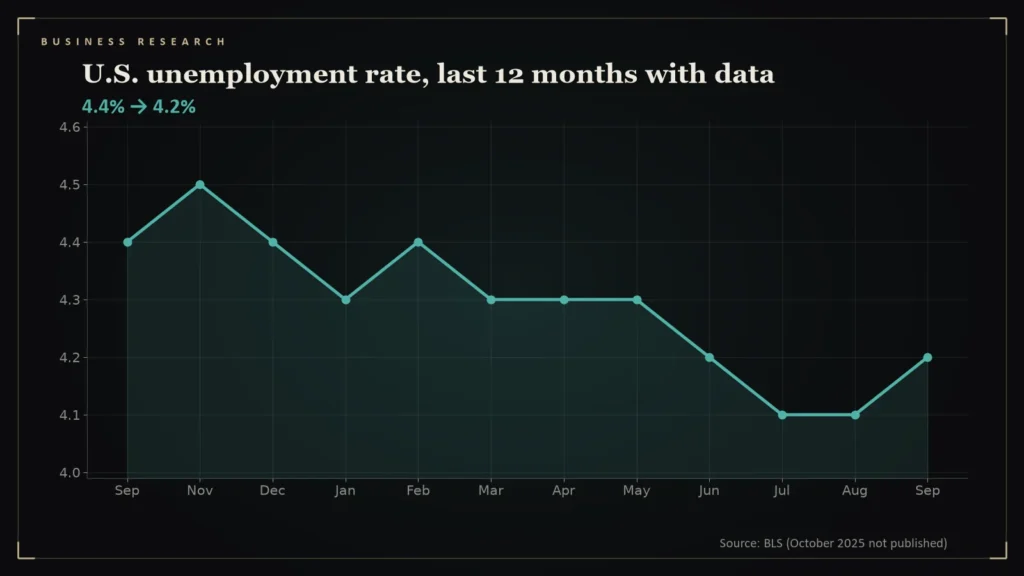
- Nonfarm payrolls rose 29,000 in September and unemployment held at 4.2 percent; July was revised to a loss of 10,000 jobs and August to a gain of 133,000 [1].
- As currently published, 2026 monthly payroll changes from January to September average roughly 68,000 (my calculation from BLS levels) [1][2].
- August CPI rose 0.4 percent on the month and 3.4 percent over 12 months; core CPI was up 2.4 percent over 12 months [3].
- On September 16, 2026 the Fed raised its target range by a quarter point to 3.75 to 4.00 percent in a 12-0 vote [4].
Dial one: jobs, cooling but not collapsing
The September jobs report showed payrolls up 29,000 and unemployment at 4.2 percent, a narrow range that has held since March. Revisions took 60,000 jobs off July and August combined: July went from +21,000 to −10,000, and August from +162,000 to +133,000 [1]. Using the revised level series, payroll growth from January through September has averaged about 68,000 a month, with one negative month in February (−156,000) and another in July (−10,000) [2]. Average hourly earnings were $37.81 in September, up 3.0 percent from a year earlier [1].
Dial two: prices, with energy doing the damage
The Consumer Price Index rose 0.4 percent in August and 3.4 percent over 12 months. Core prices, which exclude food and energy, rose 0.3 percent on the month and 2.4 percent over the year, and energy was up 16.3 percent from a year earlier [3]. The distance between 3.4 percent and 2.4 percent is energy, and energy is a war story.
Dial three: rates, finally moving
The Federal Open Market Committee voted 12-0 on September 16 to raise the target range for the federal funds rate by 25 basis points to 3.75 to 4.00 percent, saying inflation remains elevated and that the action will support a timelier return to 2 percent [4]. Its statement described activity as expanding at a solid pace, with job gains keeping pace with the workforce [4].
Putting the dials in one table
The three dials can be lined up in one place using the same sources. Twelve-month CPI inflation in 2026 ranged from 2.4 percent in Jan to 4.2 percent in May, and stood at 3.4 percent in Aug [3]. The unemployment rate was 4.2 percent in September, with payroll growth averaging roughly 68 thousand a month for the year [1][2]. The Fed’s target range after September 16 was 3.75 to 4.00 percent [4].
One comparison puts the dials in relation. The midpoint of the new target range is 3.875 percent. Subtracting August’s 3.4 percent inflation leaves a real policy rate of about +0.5 percentage points (my calculation, which uses headline CPI and a simple midpoint). Economists usually judge that figure against an estimate of the neutral rate, which this article does not attempt; the plain point is that the policy rate is only slightly above inflation, after months on hold.
What the three say together
A labor market adding 68,000 jobs a month is not weak if few new workers are arriving, and the Fed said as much. A 3.4 percent headline inflation rate with 2.4 percent core is not a broad overheating, but it is enough to push a central bank that had been on hold. The dials point in the same direction: slower hiring, energy-driven inflation, tighter policy. The risk lies in the way they feed each other.
Questions readers ask
What did the September 2026 jobs report show?
Payrolls rose 29,000 and unemployment was 4.2 percent; July and August were revised down by 60,000 jobs combined [1].
Why did the Fed raise rates in September 2026?
The FOMC said inflation remains elevated and that raising the target range to 3.75 to 4.00 percent will support a timelier return to 2 percent [4].
References
- The Employment Situation — September 2026 — U.S. Bureau of Labor Statistics — https://www.bls.gov/news.release/empsit.nr0.htm
- BLS Public Data API: Current Employment Statistics, series CES0000000001 — https://api.bls.gov/publicAPI/v1/timeseries/data/CES0000000001
- Consumer Price Index — August 2026 — U.S. Bureau of Labor Statistics — https://www.bls.gov/news.release/cpi.nr0.htm
- Federal Reserve Press Release, September 16, 2026 — Federal Reserve Board — https://federalreserve.gov/newsevents/pressreleases/monetary20260916a.htm