Trust in Elections, Three Polls Deep: Where Confidence Stands in 2026
Pew, Marist and States United each measure faith in U.S. elections differently. Read together, they show confidence slipping ahead of the 2026 midterms.
Public trust in elections is not one number. It is a family of questions asked in different words, to different samples, at different times, and the answers move with all of them. The honest way to read the field is to line up the major surveys, notice what each is really asking, and look for the direction they share.
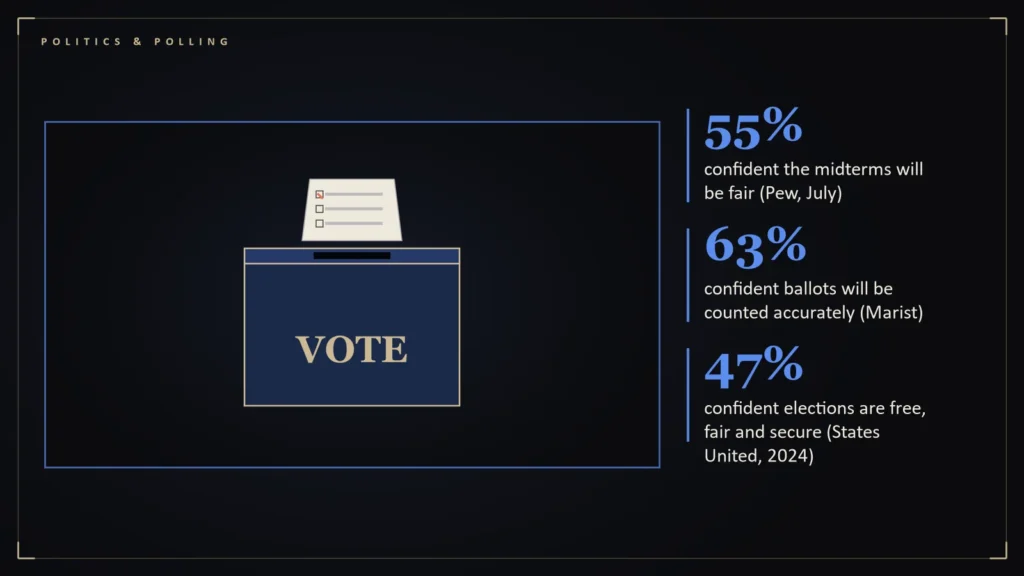
- Pew’s July 6-12, 2026 survey found 55 percent of Americans confident the midterms will be conducted fairly and accurately, down from 61 percent in 2024 and 64 percent in 2022 [1].
- Marist’s March 2-4, 2026 poll found 63 percent confident ballots will be counted accurately in November [2].
- States United’s June 2024 survey found 47 percent completely or fairly confident that elections are free, fair and secure [3].
- Each poll asks a different question, so the numbers are not interchangeable, but the direction is consistent.
Pew: fair and accurate
Pew Research Center surveyed 3,554 U.S. adults on its American Trends Panel from July 6 to 12, 2026. Fifty-five percent said they are confident the upcoming midterm elections will be conducted fairly and accurately. That compares with 61 percent in 2024, 64 percent in 2022 and 59 percent in 2020 [1].
Marist: counted accurately
A narrower question, whether ballots will be counted accurately, produced a slightly higher figure. In an NPR/PBS News/Marist poll of 1,591 national adults conducted March 2 to 4, 2026, with a margin of error of plus or minus 2.8 points, 63 percent expressed substantial or moderate confidence that ballots would be counted accurately in November [2].
States United: free, fair, secure
Earlier, the States United Democracy Center tracked five surveys between June 2023 and June 2024, covering 7,659 adults. In June 2024, 47 percent said they were completely or fairly confident that elections are free, fair and secure, a figure that stayed stable over the year [3]. A broader and stricter phrase gets a lower number. The wording matters as much as the mood.
Who is confident, and who is not
Pew’s July 6 to 12 survey of 3,554 adults lets us see the trend and the groups behind the 55 percent. Confidence that the midterms will be conducted fairly and accurately was 59 percent in April 2020, 64 percent in August 2022, 61 percent in July 2024 and 55 percent now [1]. Age matters: 66 percent of adults 65 and older are confident, against 59 percent of those 50 to 64, 49 percent of those 30 to 49 and 50 percent of those 18 to 29 [1]. College graduates are more confident (61 percent) than adults without a degree (52 percent) [1].
The same Pew work offers a goal most people share. In an April 2026 survey of 5,103 adults, 90 percent said it is important that no eligible voters are prevented from voting and 85 percent said it is important that no ineligible voters are allowed to vote [1]. That overlap helps explain why the arguments are about trust in the process rather than about what elections are for. The three polls here ask different questions of different samples, so the numbers are best read as a direction, not a single series.
What the three share
Different questions, different years, one pattern: roughly half to six-in-ten adults express confidence, and the level in 2026 is below earlier Pew readings [1][2][3]. Confidence also differs sharply by group. Pew found adults 65 and older at 66 percent confident and college graduates at 61 percent [1]. A fall in confidence is not itself evidence that anything is wrong with the vote; it is evidence about belief, which is an input to turnout and legitimacy.
The practical rule for readers is to compare a poll only with itself over time, and to ask what the question really measures before taking a headline number at face value.
Questions readers ask
How confident are Americans in the 2026 midterm elections?
Pew’s July 2026 survey found 55 percent confident they will be conducted fairly and accurately, down from 61 percent in 2024 [1].
Why do election-confidence polls give different numbers?
They ask different questions, such as fair and accurate, counted accurately, or free, fair and secure, of different samples at different times [1][2][3].
References
- How confident are Americans in the midterm elections' fairness and accuracy? — Pew Research Center — https://www.pewresearch.org/short-reads/2026/08/05/how-confident-are-americans-in-the-midterm-elections-fairness-and-accuracy/
- Election Security, March 2026 — NPR/PBS News/Marist Poll — https://maristpoll.marist.edu/polls/election-security-march-2026/
- Tracking Attitudes About Elections and Political Violence Over Time — States United Democracy Center — https://statesunited.org/resources/over-time-survey