Gold is the one asset that sits in a vault and pays you nothing, so the price of owning it is partly the interest you do not collect. When interest rates climb, that silent cost grows, like rent on an empty house.
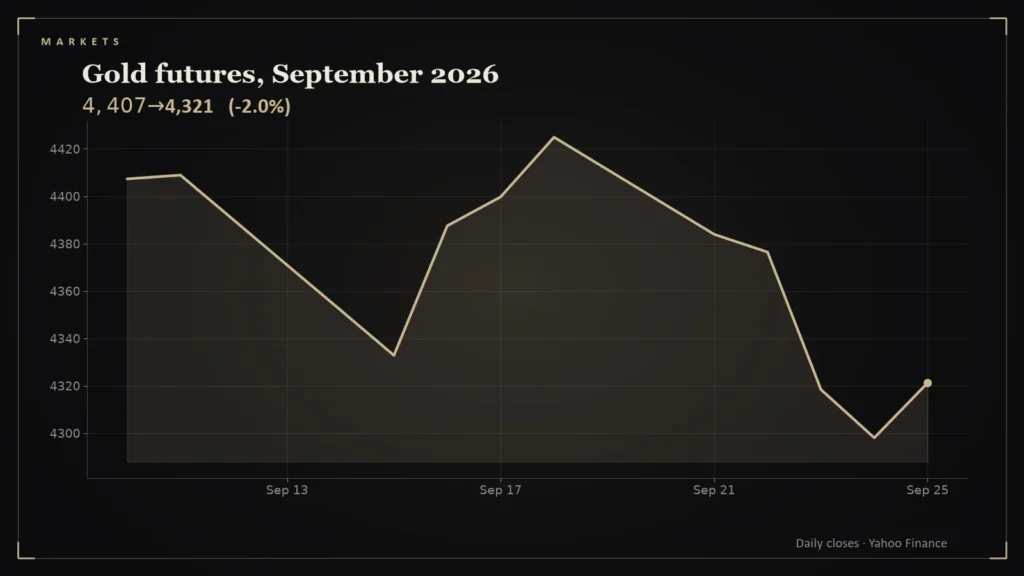
- Gold closed at $4,321.20 an ounce on September 25, down 2.34% from $4,424.90 a week earlier [1].
- Over the same week the 10-year yield rose from 5.00% to 5.18% [2].
- The money tied up in one ounce at $4,321, invested at 5.18%, would earn about $224 a year; gold pays no interest.
- That ‘opportunity cost’ is one reason gold often struggles when yields rise, though many other forces also move it.
A week of opposites
Gold futures closed at $4,424.90 on September 18 and $4,321.20 on September 25, a drop of 2.34% [1]. Across the same days, the 10-year Treasury yield rose from 5.00% to 5.18% [2]. Higher yields and a lower gold price appeared together.
The arithmetic of forgone interest
An investor with $4,321, the price of one ounce, could instead buy that amount of 10-year Treasuries yielding 5.18%. That pays $224 a year, or $19 a month, in interest [2]. An ounce of gold pays zero. If yields rise another percentage point, the forgone income on the same money grows by $43 a year. This is simple multiplication, not a forecast.
Why it is only part of the story
Economists often look at real yields, meaning yields after subtracting expected inflation, rather than the headline number. Gold also responds to currency moves, central-bank purchases, geopolitics and investor mood. A week in which gold and yields moved in opposite directions is consistent with the opportunity-cost idea but does not prove it.
The same arithmetic across yield levels
The forgone-interest idea is easiest to see by varying the yield. At a gold price of $4,321 an ounce, the yearly interest on the same money at different Treasury yields is [2]:
| Yield | Interest a year on $4,321 |
|---|---|
| 1.00% | $43 |
| 2.00% | $86 |
| 3.00% | $130 |
| 4.00% | $173 |
| 5.18% | $224 |
Over the period in my data, from October 2024 to September 25, 2026, the 10-year yield averaged 4.35% [2]. At that average, the interest on money equal to one ounce’s price would have been roughly 8.7 percent over two years. Gold itself rose from $2,668 to $4,321, a gain of 62% over the same stretch [1]. So over two years the metal’s price gain far outran the interest foregone; the opportunity-cost argument describes pressure in a given week, not the whole picture. Calculations are mine and ignore taxes, storage costs and reinvestment.
Using the idea
- Compare income streams. Ask what the same money would earn elsewhere.
- Watch the direction of yields. Rising yields raise gold’s hurdle.
- Do not rely on one relationship. It has failed in some periods.
Prices and yields are daily closes from Yahoo Finance historical data. Interest figures are pre-tax, simple annual yields.
Questions readers ask
Why does gold often fall when interest rates rise?
Because gold pays no interest, so higher yields on bonds raise the income an investor gives up by holding it. It is one of several influences, not a rule.
How much interest would the price of an ounce of gold earn in Treasuries?
At a 10-year yield of 5.18%, $4,321 would earn about $224 a year before tax [1][2].
References
- Gold Futures (GC=F) Historical Data, Yahoo Finance — https://finance.yahoo.com/quote/GC%3DF/history/
- CBOE 10-Year Treasury Yield (^TNX) Historical Data, Yahoo Finance — https://finance.yahoo.com/quote/%5ETNX/history/