Pale Blue Dot: The Photograph Voyager 1 Took Looking Back
On February 14, 1990 Voyager 1 photographed Earth from 3.7 billion miles, then switched its cameras off for good 34 minutes later. The origin of Pale Blue Dot.
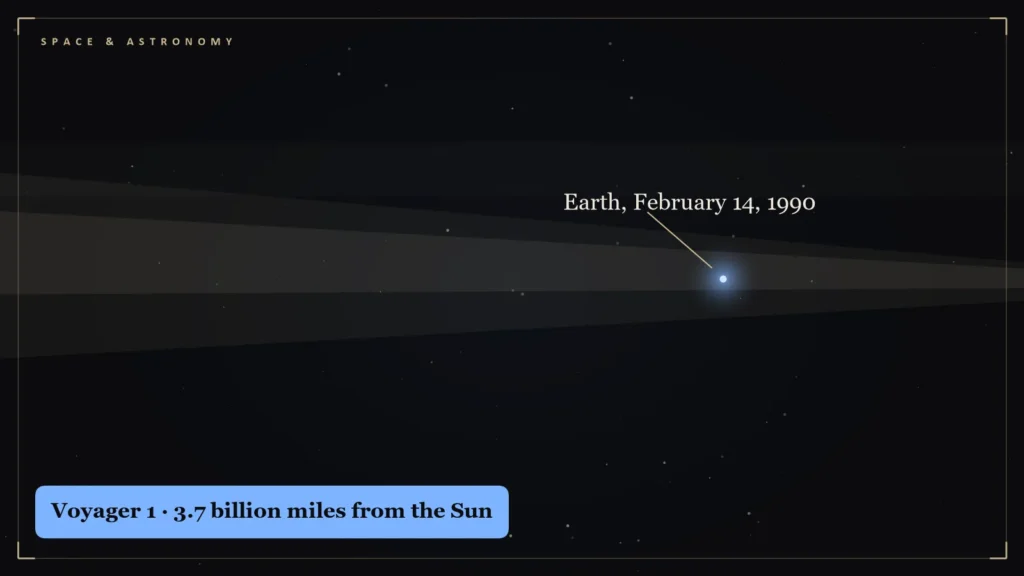
A photograph of home taken from far enough away is a humbling object. The Pale Blue Dot shows Earth as a speck caught in a stripe of sunlight, which is exactly what it was.
- Voyager 1 photographed Earth on February 14, 1990 at 04:48 GMT from 3.7 billion miles (6 billion kilometers) from the Sun [1].
- It was part of the first ‘family portrait’ of the solar system, 60 images capturing six planets and the Sun [1].
- Voyager 1 powered off its cameras permanently at 05:22 GMT, 34 minutes after the Pale Blue Dot image [1].
- Carl Sagan, a member of the imaging team, had proposed the idea in 1981 [1].
The last photo
NASA records that the image was taken on February 14, 1990, at 04:48 GMT, from a distance of 3.7 billion miles (6 billion kilometers) from the Sun. Earth appears as just a point of light [1]. Mission managers had commanded Voyager 1 to photograph Earth one final time before leaving the solar system [1].
A family portrait
The picture was part of the first “family portrait” of the solar system, a series of 60 images capturing six planets and the Sun. Mars, Mercury and Pluto were not visible [1].
Cameras off for good
Voyager 1 powered off its cameras permanently at 05:22 GMT the same day, just 34 minutes after capturing the Pale Blue Dot [1]. The data took four separate communications passes with NASA’s Deep Space Network and arrived on Earth on May 1, 1990 [1].
The sequence of that day, and the long wait
NASA gives the order of the observations. On February 13, 1990 Voyager 1 warmed up its cameras for three hours, then its science platform was pointed at Neptune; it went on to Uranus, Saturn, Mars, the Sun, then Jupiter, Earth and Venus [1]. The Earth images were taken at 04:48 GMT on February 14, just 34 minutes before the cameras were powered off for good at 05:22 GMT to save energy for the long journey [1]. Neptune and Uranus appear elongated because the spacecraft moved during their 15-second exposures, and Mars was lost in scattered sunlight in the camera, Mercury was too close to the Sun and Pluto too small, far away and dark [1].
The pictures did not arrive at once. It took until May 1, 1990, and four separate communications passes with NASA’s Deep Space Network, for all the data to reach Earth [1]. JPL mounted the mosaic on a wall in its von Kármán Auditorium, covering over 20 feet, and the image of Earth had to be replaced often because so many people touched it [1]. In 2020 a version called “Pale Blue Dot Revisited” was processed by JPL engineer Kevin M. Gill with input from original planners Candy Hansen and William Kosmann [1]. Sagan, who had the idea in 1981, wrote that the point was for humanity to see Earth’s vulnerability [1].
The man who asked
Carl Sagan, a Voyager Imaging Team member, had conceived the idea in 1981 of photographing Earth from such a distance. He later wrote of the image: “That’s here. That’s home. That’s us.” [1] The same person led the committee that chose the contents of the Golden Record.
- Date: February 14, 1990.
- Distance: 3.7 billion miles from the Sun.
- Result: a point of light.
Questions readers ask
When was the Pale Blue Dot photographed?
On February 14, 1990 at 04:48 GMT by Voyager 1, from 3.7 billion miles (6 billion km) from the Sun [1].
Who proposed photographing Earth from so far away?
Carl Sagan, a Voyager imaging team member, conceived the idea in 1981 [1].
References
- Voyager 1's Pale Blue Dot, NASA Science — https://science.nasa.gov/mission/voyager/voyager-1s-pale-blue-dot/