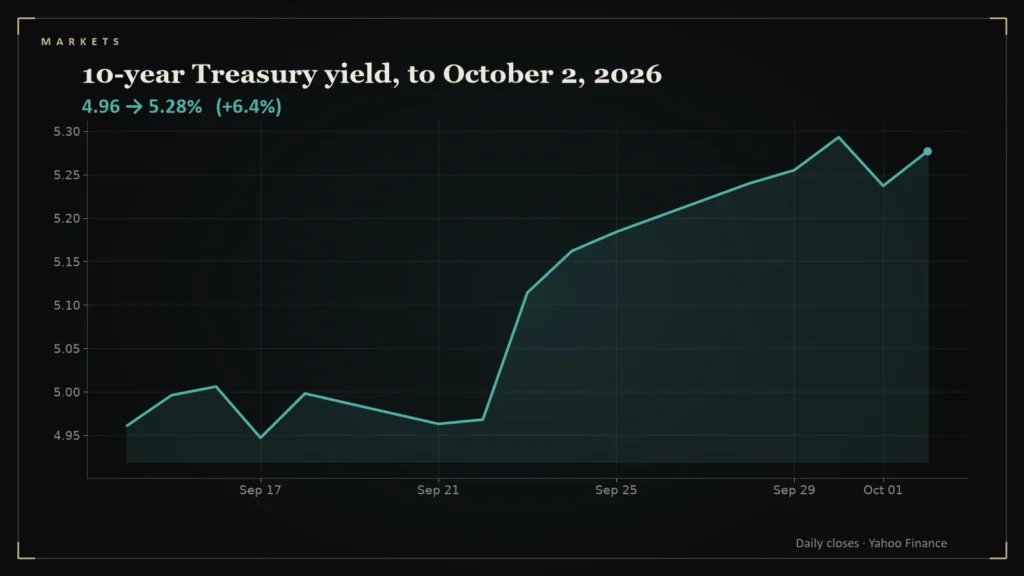
Interest rates are the gravity of finance. When they rise, everything else has to carry more weight. This week the 10-year Treasury yield touched a two-year high at 5.29%, and the stock market kept climbing anyway.
- The 10-year yield’s highest close in the October 2024 to October 2026 data was 5.29%, on September 30 [1].
- It was 3.79% on October 2, 2024, so it is up about 149 basis points in two years [1].
- The S&P 500 gained -0.27% over the week of September 28 to October 2, to 7,722.72 [2].
- Gold closed the week at $4,162, down 3.68% from $4,321 [3].
The yield
The 10-year yield closed at 5.18% on September 25 and rose through the next week: 5.24% on the 28th, 5.26% on the 29th, a peak of 5.29% on the 30th, then 5.24% and 5.28% [1]. Within the two years of data available, from October 2024 to October 2026, the September 30 close is the highest [1]. On October 2, 2024 the yield was 3.79%.
Stocks, undeterred
Higher yields usually press on stock valuations, since bonds become more competitive. Even so, the S&P 500 closed the week at 7,722.72, up -0.27% from 7,743.41 a week earlier [2]. It dipped to 7,651.54 on September 30 and recovered 0.93% by Friday. Meanwhile the VIX closed the week at 15.31 [4].
Gold and the dollar
Gold fell from $4,321 to $4,162 over the week, a drop of 3.68% [3]. The U.S. Dollar Index closed at 101.93, compared with 100.97 a week earlier [5].
How long above five percent?
The first close at or above 5 percent in 2026 came on September 16, and in the data there are 9 closes at or above 5 percent from that date through October 2 [1]. Over the latest twelve months the 10-year yield ranged from 3.95% to 5.29%, so it is currently near the top of its year [1]. The two-year-ago comparison already given, 3.79% on October 2, 2024, means the move is large in a longer frame as well.
What else moved with the yield? Over the week of September 28 to October 2 the dollar index closed at 101.93 against 100.97, and the VIX at 15.31 against 14.87 [5][4]. Neither suggests acute market stress. The jobs report on October 2 showed modest job growth and an unemployment rate of 4.2 percent [6], which is consistent with an economy neither overheating nor collapsing. All values are daily closes; the counts are my calculation.
What it means for borrowers and savers
A 10-year yield above 5 percent raises the baseline for long-term borrowing. For savers, new Treasuries pay more. For anyone who owns an older bond, the market value is lower. The jobs report on October 2 showed 29,000 added jobs and 4.2 percent unemployment, an economy that is slowing but not stalling [6].
- A two-year window is short. Yields were higher in earlier decades.
- The relationship between stocks and yields is loose. This week was an exception to the usual pattern.
- No forecast is implied.
Questions readers ask
What was the 10-year Treasury yield this week?
It peaked at 5.29% on September 30, the highest close in the October 2024 to October 2026 data, and ended the week at 5.28% [1].
Do rising yields always hurt stocks?
No. The S&P 500 rose -0.27% this week even as yields reached a two-year high [1][2].
References
- CBOE 10-Year Treasury Yield (^TNX) Historical Data, Yahoo Finance — https://finance.yahoo.com/quote/%5ETNX/history/
- S&P 500 (^GSPC) Historical Data, Yahoo Finance — https://finance.yahoo.com/quote/%5EGSPC/history/
- Gold Futures (GC=F) Historical Data, Yahoo Finance — https://finance.yahoo.com/quote/GC%3DF/history/
- CBOE Volatility Index (^VIX) Historical Data, Yahoo Finance — https://finance.yahoo.com/quote/%5EVIX/history/
- U.S. Dollar Index (DX-Y.NYB) Historical Data, Yahoo Finance — https://finance.yahoo.com/quote/DX-Y.NYB/history/
- The Employment Situation, September 2026, U.S. Bureau of Labor Statistics — https://www.bls.gov/news.release/empsit.nr0.htm