Sputnik 1: The Beep Heard Round the World, October 4, 1957
Sputnik 1 reached orbit on October 4, 1957 and its radio beeps, built on batteries that made up over half its weight, were heard by amateur operators worldwide.
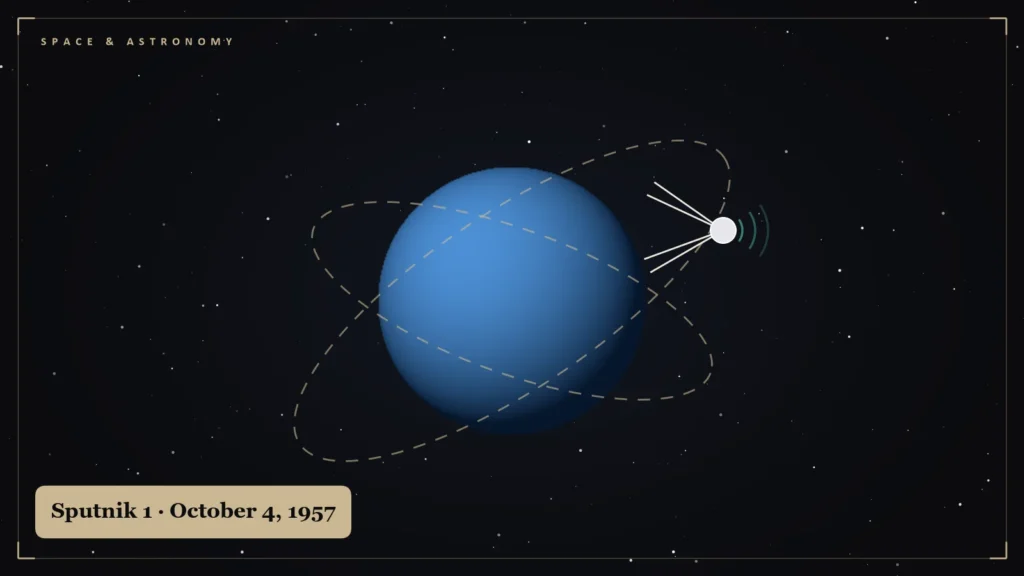
The first satellite was not remembered for what it measured. It was remembered for how it sounded: a thin, repeating beep that anyone with a radio could hear passing overhead.
- The Soviet Union launched Sputnik 1 on October 4, 1957, the first human-made object placed into Earth orbit [1].
- It carried three batteries and two transmitters, and over half its weight was batteries for the signal [1].
- It transmitted for 22 days, though engineers estimated a two-week lifespan [1].
- It fell back to Earth and was destroyed on January 4, 1958 [1].
The launch
The Smithsonian’s National Air and Space Museum records that the Soviet Union launched Sputnik 1 on October 4, 1957, placing the first human-made object into Earth orbit [1]. The satellite was built of aluminum, titanium and magnesium with a polished mirror finish. Inside were three batteries, two transmitters, a fan and a barometric switch. More than half its weight was batteries to power the signal [1].
The sound
The radio transmitter broadcast a “beep-beep-beep” on frequencies that amateur operators could receive anywhere in the world [1]. The design choice was deliberate: a signal anyone could pick up turned the satellite into a public event. Transmission lasted 22 days, longer than the two weeks engineers had estimated, until the batteries died [1].
The end and the aftermath
Sputnik fell back into the atmosphere and was destroyed on January 4, 1958 [1]. America’s first satellite attempt, the Vanguard rocket, exploded during liftoff in December 1957. The United States then launched Explorer on February 1, 1958, using the Army’s Juno 1 rocket [1]. The following July, the act that created NASA was signed; read how NASA was signed into existence.
Why it was launched at all
NASA’s history explains the purpose. Sputnik was launched as a contribution to the International Geophysical Year, a multinational scientific effort that ran from July 1, 1957 to December 31, 1958, and it weighed 184 pounds and orbited every 90 minutes [2]. Designer Sergei Korolev had planned a complex scientific satellite on the R-7 rocket, and when that fell behind schedule he rapidly built a much simpler one; the launch took place from the site now known as the Baikonur Cosmodrome [2].
The satellite itself carried no scientific instruments, only a transmitter sending the beep-beep signal; the rocket’s large core stage also reached orbit and, because it was reflective, most observers saw it rather than the much smaller satellite [2]. Sputnik’s batteries ran out on October 26 and it reentered on January 4, 1958 [2]. The shock in the United States led to Congressional hearings and the creation of NASA, and twelve years after Sputnik, humans landed on the Moon [2].
Why a beep mattered
- It was audible. Proof of spaceflight arrived as sound as well as a news headline.
- It was simple. A radio transmitter was easy to build and easy to hear.
- It set a pattern. Space history keeps returning to sound, from the Voyager Golden Record to recordings on Mars.
Questions readers ask
When was Sputnik 1 launched?
On October 4, 1957, as the first human-made object in Earth orbit [1].
How long did Sputnik transmit?
For 22 days, until its batteries died, longer than engineers’ two-week estimate [1].
References
- What was Sputnik and why was it important? The Space Age begins, Smithsonian National Air and Space Museum — https://airandspace.si.edu/stories/editorial/what-was-sputnik-and-why-was-it-important-space-age-begins
- 65 Years Ago: Sputnik Ushers in the Space Age, NASA History — https://www.nasa.gov/history/65-years-ago-sputnik-ushers-in-the-space-age/