51 Pegasi b: The Planet That Started the Exoplanet Age
Mayor and Queloz announced the first exoplanet around a Sun-like star in October 1995. 51 Pegasi b orbits in four days and earned the 2019 Nobel Prize.
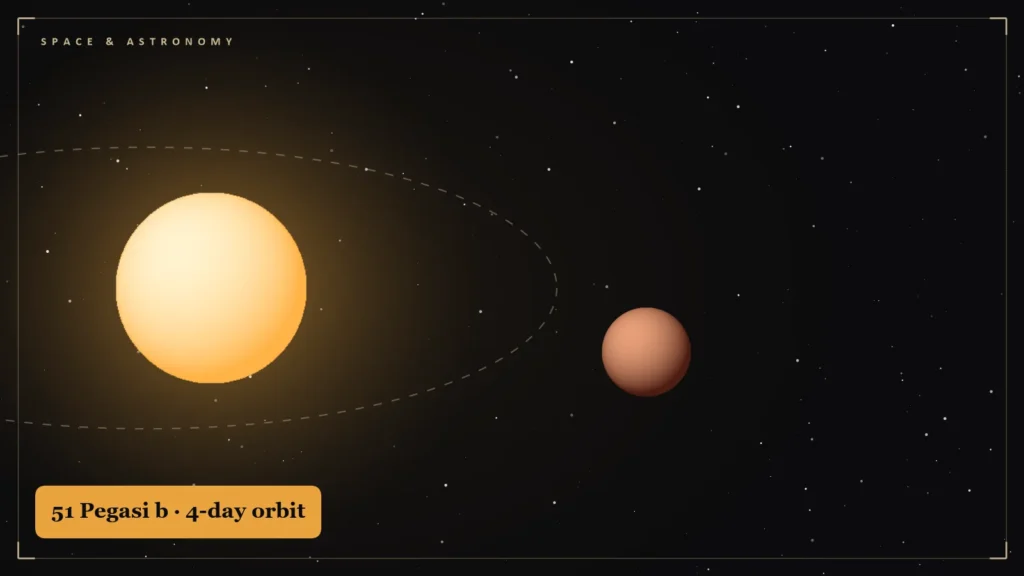
For most of history, other solar systems were an article of faith. Then in 1995 a Swiss pair of astronomers found a planet circling a star much like our Sun, and faith became a catalogue.
- Michel Mayor and Didier Queloz announced the discovery of 51 Pegasi b in October 1995 and shared the 2019 Nobel Prize in Physics [1].
- The planet takes only four days to orbit its star and lies 51 light-years from Earth [1].
- It is a hot Jupiter, a gas giant with a temperature of 1,000 to 1,800 degrees F (538 to 982 degrees C) [1].
- More than 5,500 exoplanets were confirmed when NASA’s article was published [1].
The discovery
NASA reports that Michel Mayor and Didier Queloz announced the discovery in October 1995 and shared the Nobel Prize in Physics in 2019. The planet, 51 Pegasi b, was the first exoplanet confirmed around a Sun-like star [1]. Earlier exoplanets had been found in 1992 around pulsars, the remnants of exploded stars, but those were not Sun-like systems [1].
A strange world
51 Pegasi b takes only four days to complete one orbit and is 51 light-years from Earth [1]. It is a “hot Jupiter,” a gas giant planet beyond our solar system sitting so close to its star that its temperature is estimated at 1,000 to 1,800 degrees Fahrenheit (538 to 982 degrees Celsius) [1]. Nothing in our own solar system resembles it, which surprised astronomers.
How it was found
Large planets in tight orbits cause a pronounced wobble in their stars. Astronomers detect that wobble using the radial velocity method, which measures tiny shifts in the star’s light as it moves toward and away from us [1]. Think of watching a dog walker from far away: you may not see the dog, but you can tell it is there from the way the walker is tugged.
From ELODIE to HARPS
The European Southern Observatory’s announcement of the 2019 Nobel Prize traces the instrument line. The discovery was announced on October 6, 1995 by Michel Mayor and Didier Queloz, who used the ELODIE spectrograph at the Observatoire de Haute-Provence in France [2]. The success led to CORALIE, a better version mounted on the 1.2-meter Swiss Euler Telescope at ESO’s La Silla Observatory in Chile, and the experience from both instruments went into HARPS, the High Accuracy Radial velocity Planet Searcher, which began operating in 2003 [2].
HARPS also made the first spectroscopic detection of visible light reflected off an exoplanet, from 51 Pegasi b itself [2]. Mayor and Queloz shared the physics prize with James Peebles of Princeton, who was honored for contributions to understanding the evolution of the universe and Earth’s place in the cosmos [2]. ESO’s Director General Xavier Barcons noted that ESPRESSO on the Very Large Telescope, the instrument that later helped confirm Barnard’s Star planets, continues the radial-velocity tradition [2].
Since then
NASA says more than 5,500 exoplanets were confirmed in orbit around other stars at the time of the article’s publication [1]. Counts rise regularly, so check NASA’s exoplanet archive for the current figure.
- Announced: October 1995.
- Orbit: four days.
- Honour: 2019 Nobel Prize in Physics, shared by Mayor and Queloz.
Questions readers ask
What was the first exoplanet found around a Sun-like star?
51 Pegasi b, announced by Michel Mayor and Didier Queloz in October 1995 [1].
What is a hot Jupiter?
A gas giant planet beyond our solar system that orbits very close to its star, like 51 Pegasi b with its four-day orbit [1].
References
- Nobel Winners Changed Our Understanding with Exoplanet Discovery, NASA Science — https://science.nasa.gov/universe/exoplanets/nobel-winners-changed-our-understanding-with-exoplanet-discovery/
- 2019 Nobel Prize in Physics Awarded for Discovery of Exoplanet Orbiting a Solar-type Star, ESO — https://www.eso.org/public/announcements/ann19049/