Why Stage Costumes Look Odd Up Close and Perfect From Row Z
Stage costumes are built for distance and motion: ombre dyeing for faded effects, lycra in flying corsets, 18,000 hand-set studs. Design for the back row.
If you have ever stood close to a stage costume, you know the feeling of being slightly let down. The seams are chunky. The paint is bold. The sparkle is aggressive. That is not sloppiness. It is distance engineering.
- Costume makers use techniques such as ombre dyeing for faded effects and lycra panels in pieces like flying corsets [1].
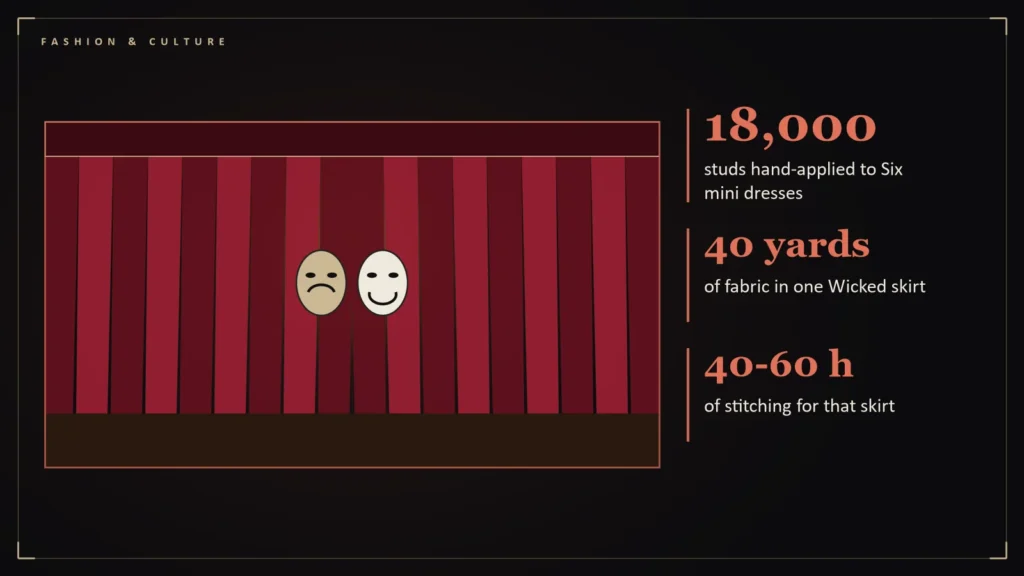
- Costumes are built to be read from far away: a Six costume shop hand-applied 18,000 studs to the exhibited mini dresses [2].
- A single Wicked skirt took about 40 yards of fabric and 40 to 60 hours of stitching [2].
- Costumes shape how actors move and feel, not just how they look [1].
Designing for the last row
A costume has to communicate across a hundred feet, under hot lights, in motion. Fine detail disappears; contrast and silhouette survive. Makers at the National Theatre describe the balancing act directly: costumes are made to look historically accurate while also serving what the designer wants to say about the play [1]. Detail is a language, and on stage it has to be spoken loudly.
Effects that fake time and weight
The National Theatre’s makers use techniques with real craft behind them. Ombre dyeing produces a convincing faded, worn look that would take years to earn naturally; lycra panels let specialized pieces, such as flying corsets, stretch and move [1]. One costume, the “dancing uniform,” hides a dancer within it [1].
Hours you cannot see
The labor is out of all proportion to what reads from the seats. At the Showstoppers! exhibit, labels recorded that Elphaba’s skirt in Wicked needed about 40 yards of fabric and 40 to 60 hours for one person to stitch, and that a costume shop hand-applied 18,000 studs across the exhibited Six dresses [2]. Hours that big are invisible from row Z, but they are why a dress keeps its shape for eight shows a week.
Keeping costumes alive
The work does not stop once a costume is built. Actors’ Equity requires pieces that touch skin to be washed daily, and the Showstoppers! coverage noted that the Phantom costumes are dry-cleaned twice a week by Winsor Cleaners, which has served Broadway for 100 years [2]. The shows push materials as well: The Lion King uses 300 puppets built with shells, grass, bamboo, feathers, beads, rope and quilted suede, while Aladdin used 1,125 different fabrics and 80 turbans in its Prince Ali number [2].
At the National Theatre, the same logic produces effects such as the “Somme mud” of fuller’s earth, Rosco paint and PVA used in The Silver Tassie, and uniforms that are copied from archive pieces and then aged with ombre dyeing to give a shadow effect [1]. Some costumes are rehearsed like props: prototypes are road-tested with actors before tailors fit costumes over them [1]. Looking odd up close is the price of looking right from the back of the house, and keeping it that way every night is a trade in itself.
It is also built for the performer
A costume is working equipment. At the National Theatre, designers and makers think about how a garment will change an actor’s posture and physicality [1]. A corset that reshapes the spine does more than look period-correct; it changes the person wearing it.
The practical lesson for anyone buying or designing theatrical clothing is to stop judging it at arm’s length. View it from where it was meant to be seen, at the size it was meant to be seen, under the light it was made for.
Questions readers ask
Why do stage costumes look rough up close?
They are built to read from a distance and survive repeated use; bolder construction and effects carry across the theater [1][2].
What techniques do costume makers use for stage effects?
Examples include ombre dyeing for faded looks and lycra panels for stretch in pieces like flying corsets [1].
References
- Costume at the National Theatre — Google Arts & Culture — https://artsandculture.google.com/story/costume-at-the-national-theatre-national-theatre/UwVxRuA8lwYA8A?hl=en
- Showstoppers! Spectacular Costumes from Stage and Screen — Woman Around Town — https://womanaroundtown.com/?p=212246