What a Black Hole Sounds Like: The Perseus Cluster Sonification
Chandra X-ray data showed black hole pressure waves in the Perseus cluster, 57 octaves below middle C. NASA scaled them up 57 and 58 octaves to be audible.
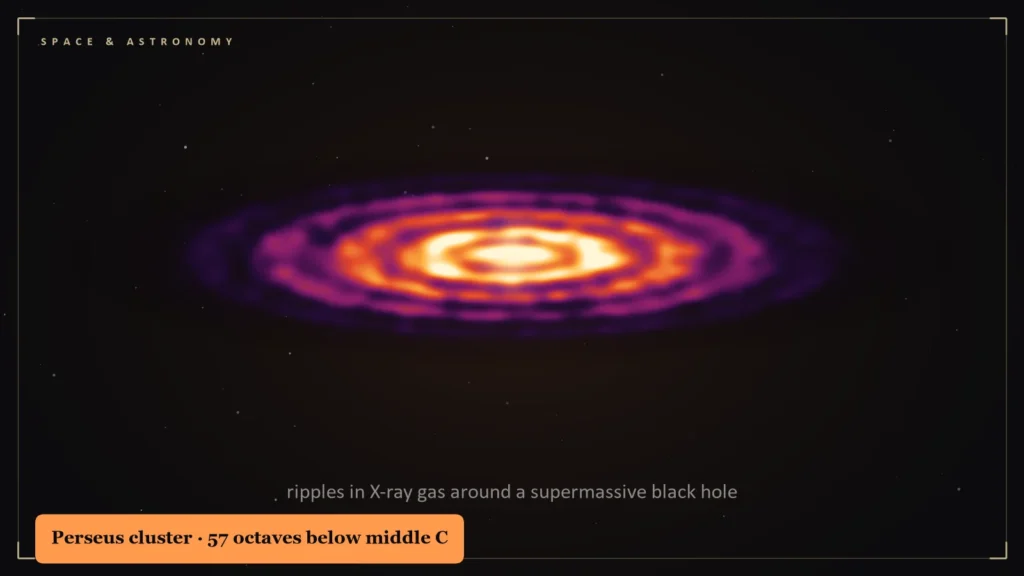
Space has no air, so in the ordinary sense it has no sound. But the gas between galaxies is thick enough to ripple, and ripples can be turned into music. The Perseus cluster is the best-known case.
- Since 2003 the black hole at the center of the Perseus galaxy cluster has been associated with sound, 57 octaves below middle C [1].
- Pressure waves from the black hole caused ripples in the cluster’s hot gas that could be translated into a note [1].
- Scientists scaled the signals upward by 57 and 58 octaves, making them 144 quadrillion and 288 quadrillion times higher in frequency [1].
- The 2022 sonification was led by the Chandra X-ray Center with astrophysicist Matt Russo and musician Andrew Santaguida [1].
The discovery
The Chandra X-ray Center reports that since 2003, the black hole at the center of the Perseus galaxy cluster has been associated with sound. Pressure waves sent out by the black hole caused ripples in the cluster’s hot gas, and the ripples could be translated into a note 57 octaves below middle C [1]. Chandra saw those ripples in X-ray light.
Why 57 octaves is inaudible
Each octave doubles the frequency, so 57 octaves below middle C is a pitch far too low for any ear, a wave whose cycle lasts millions of years. To make it audible, the team scaled the signals up by 57 and 58 octaves above their true pitch, which is 144 quadrillion and 288 quadrillion times higher than the original frequency [1]. It is like speeding up a film until a flower opening is visible in seconds.
Who made it
The sonifications were led by the Chandra X-ray Center, with input from NASA’s Universe of Learning. The collaboration was driven by visualization scientist Kimberly Arcand, astrophysicist Matt Russo and musician Andrew Santaguida [1].
What was extracted and what was scaled
Chandra stresses that this sonification is unlike others because it revisits the actual sound waves found in Chandra data, not a mapping of brightness to pitch [1]. The popular belief that there is no sound in space comes from most of space being a vacuum with no medium, whereas a galaxy cluster has copious gas enveloping hundreds or thousands of galaxies, giving the waves a medium [1]. The waves were extracted in radial directions, outward from the center, then resynthesized into human hearing by scaling them 57 and 58 octaves above their true pitch [1].
The two scaling figures can be checked: each octave doubles frequency, so 57 octaves is a factor of 257, about 1.44×10¹⁷, which is 144 quadrillion, and 58 octaves doubles that to about 288 quadrillion (my arithmetic) [1]. The radar-like scan around the image lets a listener hear waves emitted in different directions [1].
Science and art together
Sonification does not replace charts. It gives another channel for pattern recognition, and it makes astronomy accessible to people who cannot see an image. For a different way into recorded sound, our guide to sound on Mars looks at real microphone recordings.
- Real data. The waves come from Chandra observations.
- Scaled for ears. The pitch shift is a translation, not the true sound.
- Not heard in space. No one could hear it directly.
Questions readers ask
What does a black hole sound like?
NASA’s sonification of the Perseus cluster scales real pressure-wave data up by 57 and 58 octaves so the ripples become audible [1].
Is that the real sound of a black hole?
No. The real signal is 57 octaves below middle C, far too low to hear; the sonification translates it into the range of human hearing [1].
References
- Perseus Cluster Sonification, Chandra X-ray Center — https://chandra.si.edu/sound/perseus.html