What Sound Is Like on Mars: Slower, Quieter and Split by Pitch
Perseverance's microphones found that on Mars low-pitched sound travels at 240 m/s and high-pitched at 250 m/s, and that sound fades within about 8 meters.
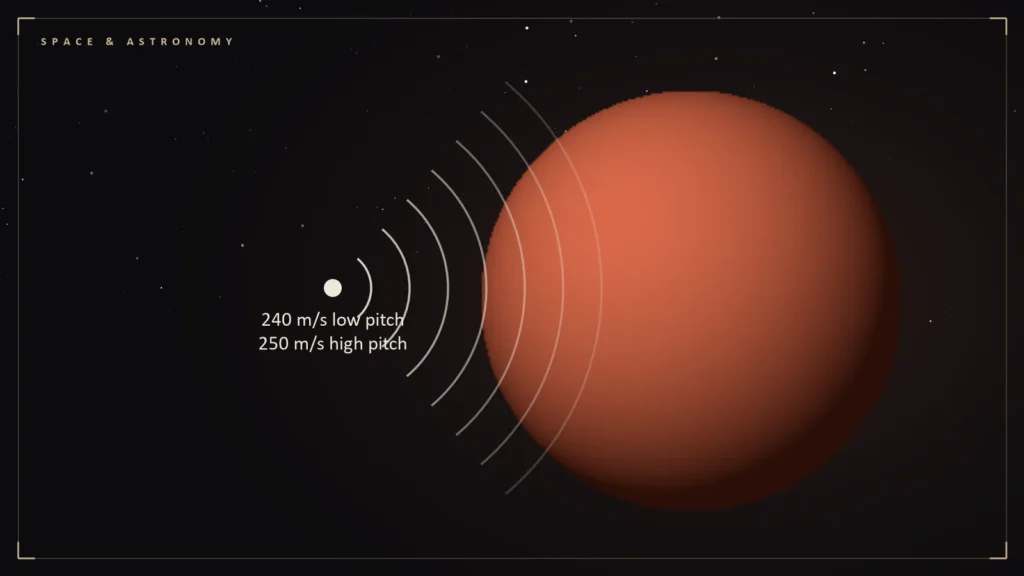
Mars is the quietest concert hall in the solar system. The air is so thin that sound dies quickly, like a shout in a snowstorm. NASA’s Perseverance rover has microphones, and what they heard changes what we know about sound itself.
- On Mars, low-pitched sounds travel at about 537 mph (240 m/s) and higher-pitched sounds at 559 mph (250 m/s); on Earth sound travels about 767 mph (343 m/s) [1].
- Perseverance carries two microphones: one on the SuperCam mast head and one on the rover’s chassis [1].
- Mars has a thin, cold, carbon dioxide atmosphere, and sound carries only short distances there [1].
- The study was published in Nature on April 1, 2022 and covered the first 216 Martian days [1].
Two speeds of sound
On Earth, sound travels at about 767 miles per hour (343 meters per second). On Mars, NASA reports, low-pitched sounds travel at about 537 mph (240 m/s), while higher-pitched sounds move faster, at 559 mph (250 m/s) [1]. That means on Mars a high note outruns a low note. On Earth, all pitches arrive together, which is why a distant orchestra stays in time. On Mars, a distant band would drift apart in pitch.
The microphones
The rover carries two microphones. One is mounted on the SuperCam at the head of the mast, and another is on the rover’s chassis, where it recorded the Gaseous Dust Removal Tool [1]. The study, published in Nature on April 1, 2022, examined recordings from the first 216 Martian days of the mission [1].
Why Mars is so quiet
The cause is the atmosphere, which NASA describes as thin, cold and carbon dioxide-rich [1]. Sound needs air molecules to carry it, and there are far fewer of them. NASA’s account says sound carries only about 26 feet (8 meters) on Mars, against 213 feet (65 meters) on Earth [1]. Lead researcher Sylvestre Maurice said they thought the microphone was broken, it was so quiet [1].
What the recordings picked up
The microphones recorded more than silence. NASA lists the rover’s mechanical whine and click in a light Martian wind, the whir of the rotors of the Ingenuity helicopter and the crackling strike of the rock-zapping laser [1]. The international team made the first analysis of acoustics on the planet and says audio can be used to probe subtle air-pressure changes and to gauge the health of the rover [1]. Lead author Sylvestre Maurice of the University of Toulouse called it “a new sense of investigation we’ve never used before on Mars” [1].
The recordings also revealed pressure variations produced by turbulence in the atmosphere as its energy changes at tiny scales, and Martian wind gusts at very short timescales were measured for the first time [1]. Higher-pitched tones carry hardly at all: at about 26 feet (8 meters), against about 213 feet (65 meters) on Earth, high-pitched sounds are lost completely [1]. Prior to the mission scientists expected the atmosphere to affect the speed of sound, but the effect had never been observed until these recordings [1].
Why it matters beyond curiosity
Sound is a free sensor. The speed of sound depends on the gas and its temperature, so how it behaves is a clue about the air. The same logic applies at home: a recording tells you about the room it was made in. For a listening experience built on that idea, browse our lossless catalogue.
- Speed: 240 m/s for low pitches, 250 m/s for high ones.
- Range: about 8 m versus about 65 m on Earth.
- Cause: a thin, cold, carbon dioxide atmosphere.
Questions readers ask
How fast does sound travel on Mars?
About 240 m/s for low-pitched sounds and 250 m/s for higher-pitched ones, compared with about 343 m/s on Earth [1].
Why is Mars so quiet?
Its thin, cold, carbon dioxide atmosphere carries sound only short distances [1].
References
- What Sounds Captured by NASA's Perseverance Rover Reveal About Mars, NASA — https://www.nasa.gov/solar-system/what-sounds-captured-by-nasas-perseverance-rover-reveal-about-mars/